At a Glance
- Narrator: Natalie Moore is the sole credited voice, which means every faction in a story built on who may speak to whom runs through one performer.
- Subjects: Forbidden cities and enforced law, enemies made into allies, love as a destructive force, family secrets.
- Tone: Escalating, romantic, unusually punishing for its shelf.
- Bottom line: The entry where the series stops circling and commits, so long as you arrive having read the first two.
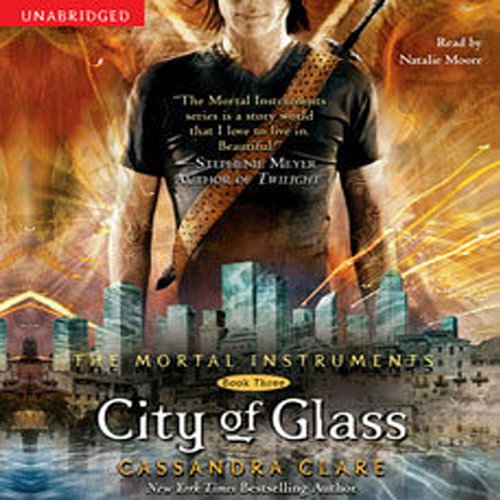
Book three is where the Mortal Instruments series stops circling and commits, and this audiobook is a fifteen-hour version of that commitment. City of Glass sends Clary to the ancestral home of the Shadowhunters without permission, which the copy is careful to note is against the Law, and breaking the Law could mean death. Simon meanwhile sits in a Shadowhunter prison for the offense of being a vampire who can stand in sunlight. Natalie Moore reads all of it. Cassandra Clare's third entry is also where the series' central alliance question finally has to be answered out loud.
Setup here is efficient in a way the earlier books were not obliged to be. Clary's mother's life is what she is trying to save, and the cure sits inside a city she is forbidden to enter. Jace does not want her there, which the copy places second on its list of complications. An unfamiliar Shadowhunter named Sebastian turns up as an ally, a sentence built to make a reader sit up. And Valentine has stopped working toward power and started mustering the full force of his, which changes the shape of every scene that follows: the threat has arrived rather than approached.
A response from December 2009 puts the escalation precisely. In the first two books, that reader writes, the plot 'revolved around smaller battles with Downworlders and demons in New York'; here a reader is 'finally exposed to what everyone's been waiting for,' the thing all the earlier battles and secrets were leading toward. The same response opens by quoting the book's own line, 'To love is to destroy,' which tells you the register Clare is working in. This is young adult fantasy where the romance is not the reward for surviving the plot. It is the mechanism of the damage.
Most interesting in the column is a quiet disagreement with the metadata. One of the earliest responses, filed within a week of release, is titled 'A satisfying ending,' notes that 'Questions get answered; plot points get tied up,' and reports that the series 'has gotten better with every book' after expectations had run too high going into City of Bones. The record says series number three. Both readings can hold at once, and a listener should know which they are buying: a volume that closes its arc completely, and a series that did not stop when it closed.
The Best Parts of City of Glass
That alliance is the real engine, and it is a genuinely good structural idea. The copy asks whether Downworlders and Shadowhunters can set aside their hatred long enough to work together, and everything else depends on the answer. What makes it land is that the hatred was earned across two previous books rather than asserted in this one, so the cost of cooperating stays visible on both sides. Fantasy series stage a unite-against-the-greater-evil moment routinely. Fewer of them make the greater evil someone whose stated plan is to destroy one of the two parties and not the other.
Natalie Moore is credited as the single reader, and on this title the assignment is substantial. A roster running from Clary and Jace to Simon, Sebastian and Valentine, plus an imprisoned vampire, a set of institutional factions, and a story built on who is permitted to speak to whom inside a city with rules. Single-narrator fantasy succeeds or fails on whether faction lines stay clear in dialogue when three characters who dislike each other share a room. The column stays silent on how that turns out, leaving the casting fact as all the page provides.
A later response makes a small point with more weight than its size suggests. It calls the book 'not predictable' and describes being 'taken through many emotions as well as through the struggles of good versus evil.' For a third volume, unpredictability is the hardest quality to keep: by book three a reader knows the rules, the roster and the register, and the standard failure is a plot that executes expectations competently. If that entry is right, Clare is still willing to break the series' own patterns this far into the run, which is most of what separates a series that improves from one that settles.
Before You Commit to City of Glass
A piece of advice buried in the column does not translate to audio, and anyone choosing between editions should hear about it now. A reader recommends going to the end of the book, past the acknowledgments, to find a letter Jace wrote before leaving to track Sebastian, and reports that it is 'so emotional.' In print that is a flip to the back. In audio it means scrubbing through back matter at the tail of a very long file, past credits, with no page numbers to aim at. Bonus content parked in print back matter remains one of the format's real weak points.
Filing is narrower than the book. Romance is the only tag attached, and the romance is certainly load-bearing, but the copy in the same breath describes an antagonist gathering the full force of his power to wipe out an entire people, a character imprisoned for a condition rather than an act, and a city whose laws kill. A listener browsing a romance shelf meets all of that too. The recording also dates to March 2009, which is worth registering for anyone accustomed to more recent production conventions.
A different object turns up in the column as well. One entry, filed from Saudi Arabia, is written in Arabic and concerns a physical copy that arrived split along the spine, a return, and a full refund handled quickly, with praise for how fast the seller responded. It is a fair account of a shipment and tells a listener nothing about the story or the reading. On a title this old that kind of crossover is common, and it is a reminder that whatever score sits on this page was assembled from responses to several different objects.
Should You Listen to City of Glass?
Anyone who has read the first two entries should go straight in, since the copy assumes them and the arc lands here. It also rewards a reader after young adult fantasy in which the romance carries real consequences rather than arriving as a reward for surviving the plot, and one who enjoys institutional politics: a Law that kills, an ancestral city with rules about who may enter, a faction deeply suspicious of a vampire over a quality nobody chose. It is a long listen and the material genuinely fills it.
Starting here is a mistake. The copy names a mother, a prison, a Law and a set of factional grudges without introducing any of them, and the pleasure of the alliance depends on hostility established in books this one declines to summarize. Listeners who want the bonus letter should buy a text edition alongside it, since audio is a poor tool for locating something filed after the acknowledgments. And anyone shopping the romance tag for something low-stakes has misjudged the register, because the line about love and destruction is not decoration.
A Few Questions About City of Glass
Who reads the audiobook, and is anybody else credited?
Natalie Moore reads it, and nobody else is named. No second performer, no cast production and no downloadable document appear on the page, so one voice carries the full roster across fifteen hours and twenty-two minutes, from the first minute to the last.
Who are the Downworlders, and does the audiobook explain them?
The copy treats Downworlders as an established category, names vampires among them and describes an eternal enmity with Shadowhunters, but defines nothing. A newcomer meets the term as a given. The recording carries no glossary and no character list, so the context has to be assembled from dialogue on the move.
How dark does it get for a young adult title?
Darker than the romance tag implies. The copy sets an army against an entire people, imprisons a character for a condition rather than an act, and puts death behind a broken rule. Older teens and adults are the comfortable audience here; younger middle-grade readers are not.