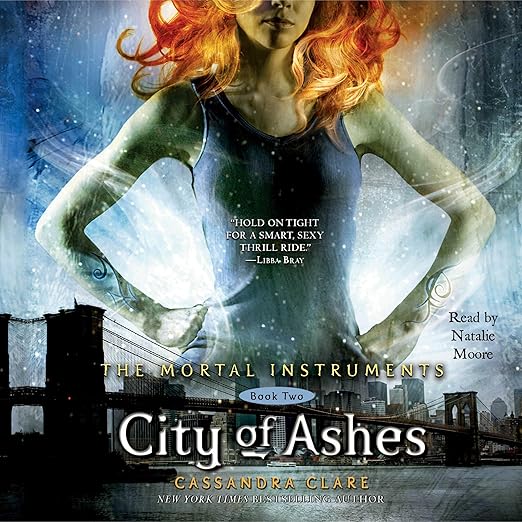
Clary Fray is seventeen years old and her father is a genocidal rogue Shadowhunter, her mother is in a magically induced coma, and the boy she can't stop thinking about has just been revealed as her brother. City of Ashes, the second Mortal Instruments novel by Cassandra Clare, narrated here by Natalie Moore, accelerates rather than consolidates the chaos of the first book. As an audiobook, it works with a particular intensity: Clare's prose is built for pace, and Moore's narration keeps the energy moving through a plot that layers revelation on revelation without giving the reader much room to breathe.
The emotional core of this installment is Clary's impossible position: she loves Jace, she can no longer act on that love, and the man responsible for this situation is also her father and the primary antagonist threatening every Downworlder in New York. Someone is murdering Downworlder children, the Soul-Sword has been stolen, and the Inquisitor has arrived with a particular focus on Jace. Valentine is behind most of it. The question is not whether Clary knows this but how she can stop it when Jace seems willing to betray his own principles to help a father neither of them can quite bring themselves to hate.
Clare's worldbuilding in the Mortal Instruments series has always been its structural strength. The Shadowhunter mythology, with its Downworlder hierarchy of vampires, werewolves, warlocks, and faeries, operates as a fully realized alternative urban ecosystem rather than a backdrop. In this second installment, Clare expands the Downworlder dimension: the Vampire Clan, the werewolf pack, and the warlock Magnus Bane all play larger roles than they did in City of Bones. That expansion serves the plot, which is fundamentally about who gets protection under Shadowhunter law and who gets treated as expendable. The murdered Downworlder children push that question from background to foreground.
The Jace-Clary situation is handled with more complexity than the genre's typical forbidden romance. Clare is interested in how the revelation about their relationship changes not just the romantic dynamic but Jace's entire psychological architecture. His willingness to consider helping Valentine stems not from weakness but from a genuine crisis of identity: if everything he believed about his origins is false, what does that make him? That interior dimension gives the audiobook more substance than a straightforward paranormal action-romance would have.
Highlights
Natalie Moore is a capable narrator for this material. She differentiates the principal voices well: Clary's anxiety-laced determination, Jace's defensive sarcasm, Simon's evolving uncertainty as he navigates a world he barely understands. Moore doesn't overplay the romantic tension, which is the right call. Clare's text provides the subtext; the narration doesn't need to underline it. In a series with this many characters and multiple competing Shadowhunter factions, Moore's consistency in voice assignment makes the twelve-plus-hour runtime navigable rather than confusing.
The audio format favors this kind of book. The plot's velocity is best experienced as a continuous forward movement rather than a text to be savored in short bursts. Listeners who have found the first book compelling will fall into the second one naturally, and Moore's narration maintains the momentum through the slower expository passages that come with any second installment in a series that is still building its mythology.
One listener described going back to City of Bones and then 'powerhousing through the rest of The Mortal Instruments' after starting City of Ashes. That kind of binge pull is a genuine achievement in long-form fiction, and it speaks to Clare's skill at ending chapters in ways that make stopping feel like a small defeat.
What to Watch For in City of Ashes
Listeners who did not read City of Bones first will be at a significant disadvantage. City of Ashes assumes the reader carries the first book's world and character introductions and does not spend much time re-establishing them. The Mortal Instruments is a series that rewards linear engagement; lateral entry points don't exist in any meaningful way.
The romantic plot involving Clary and Jace is the source of both the series' emotional intensity and its most frustrating moments. The forbidden dimension of their relationship dominates enough of the narrative that readers who are primarily interested in the Shadowhunter mythology, the action, or the Downworlder politics rather than the emotional throughline may occasionally find the pacing uneven. The strongest sequences in the book, the Soul-Sword heist, the Inquisitor's confrontation with Jace, the revelations about Valentine's experiments, exist in productive tension with the relationship drama but don't always integrate seamlessly with it.
Cassandra Clare's control of the Shadowhunter mythology's internal rules is one of the series' structural strengths. The Soul-Sword, as the second of the Mortal Instruments, carries specific powers that Valentine intends to exploit in ways that would destabilize the treaty between Shadowhunters and Downworlders. That political and contractual dimension, the way supernatural governance operates through specific objects with defined powers, gives the plot a legalistic texture that grounds the more romantic elements in something with stakes beyond the personal. Clare knows how her world's rules work and uses them to generate plot rather than just setting.
Natalie Moore handles the mythology's technical vocabulary consistently across the twelve-plus-hour runtime, which becomes increasingly important as the book introduces the Inquisitor, the Clave, and the formal mechanics of Shadowhunter law. New listeners to the series will encounter some of this terminology without the full context provided by the first book, but Moore's confident delivery keeps the mechanics accessible even when the specific history is not fully present.
Is This One for You?
This audiobook is for listeners who completed City of Bones and want to continue; starting here without the first book will produce a disorienting experience. Teen and adult readers of urban fantasy and paranormal romance who enjoy richly built mythology alongside emotionally complicated central relationships will find this a strong second installment. Listeners who want cleaner narrative resolution than a mid-series book can provide should know that City of Ashes escalates considerably and resolves selectively, setting up the next volume rather than closing the arc.