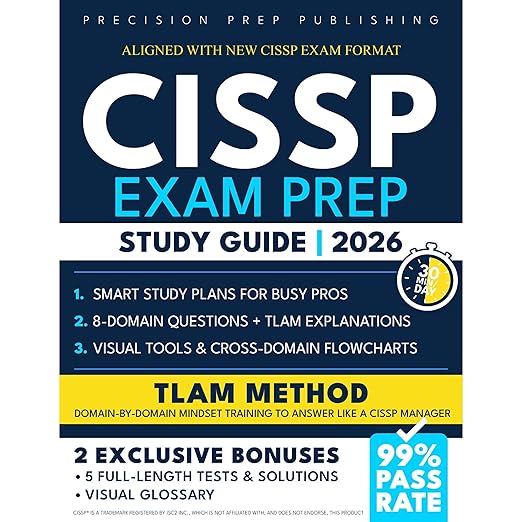
Can the CISSP exam really be tackled in thirty minutes a day? That is the specific promise this audiobook opens with, and it is a bold one for a certification that ISC2 itself designs to test judgment under pressure, not just memorized facts. Precision Prep Publishing built this guide around eight full domains under the April 2024 ISC2 exam outline, and the pitch is squarely aimed at people who already have real cybersecurity experience but keep getting tripped up by the exam's habit of rewarding managerial reasoning over technical recall. Nineteen hours and six minutes is a serious runtime commitment, closer to a part time course than a casual refresher, and that scale alone tells you this is meant to be lived with over weeks, not sampled once before a test date.
Virtual Voice Flattens the TLAM Method's Nuance
What actually distinguishes this guide from a straightforward question bank is the TLAM Method, short for Think Like a Manager, threaded through every domain rather than bolted on as a bonus chapter. Reviewer Bruce Farelli specifically credits the approach with shifting his thinking from purely technical instincts toward the risk based reasoning the exam is actually built to test, which lines up with how ISC2 has repositioned CISSP over recent revisions, away from pure technical trivia and toward scenario judgment. William J. Callaghan's review backs this up from a different angle, praising how the guide breaks a genuinely intimidating body of material into daily sessions that stay realistic for someone already working full time in the field. That structural discipline, three separate study plans running three, six, and nine months, matters more here than in most exam guides, since CISSP candidates are rarely full time students with open schedules.
Virtual Voice narrates the full nineteen hours, and that choice lands differently depending on which part of the guide is playing. For enumerating the eight domains, defining terms, and walking through straightforward factual content, the synthetic delivery holds up fine, clear pronunciation, steady pacing, no distracting artifacts. Where it struggles is exactly where the TLAM Method is supposed to do its heaviest lifting: the exam is built on modeling how an experienced manager actually weighs one imperfect option against another, and that kind of reasoning usually depends on a human voice's ability to shift emphasis mid sentence, to let a pause do some of the interpretive work. A synthetic narrator delivers the same measured cadence whether it is listing acronyms or walking through a genuinely difficult risk tradeoff, which flattens exactly the skill this guide claims to be teaching.
Eight Domains Structured for Commuter-Friendly Navigation
Abby Dove's review calls out something that matters more in audio than it would in print: how easy the material is to jump between. Structured, modular content built around eight clearly bounded domains translates naturally to audio chapters that a commuting IT professional can navigate by section rather than needing to progress linearly front to back. That modularity is really the case for choosing this format at all. Nobody needs to listen to domain three again from the beginning just to review one weak subtopic, and nineteen hours split cleanly across eight domains means a listener already strong in, say, asset security can skip ahead without losing the thread. For working professionals squeezing in half an hour during a commute or a lunch break, that flexibility does more real work than production polish would.
The guide's own framing leans hard on distinguishing itself from a pure question bank, and on audio specifically, that distinction plays out as genuinely more listenable than a dry recitation of exam facts would be. Explanations of why wrong answers fail alongside why the correct one works give the narration actual content to walk through, sentence by sentence, rather than just a list to read aloud. It is worth noting plainly that this is an independent publication with no ISC2 affiliation or endorsement, a fact the listing states directly, so the credibility case rests entirely on the reviewers' actual pass adjacent experience rather than any official backing. Given a 4.6 average across 47 ratings, that credibility case is holding up reasonably well among the professionals who have actually used it to study.
Practice Tests Sit Behind a QR Code Only
The ten full length practice tests, over 1,450 questions aligned to ISC2's domain weighting, exist only behind a QR code pointing to digital resources outside the audiobook itself. That is a real limitation worth naming clearly: a listener cannot answer adaptive format practice questions by ear, and the visual glossary promised alongside the tests is equally inaccessible in pure audio form. Anyone who has studied for a major IT certification before knows practice testing under timed, adaptive conditions is often where the actual exam day readiness gets built, more than passive review does. That work has to happen on a phone or laptop, completely separate from whatever is playing through headphones, which makes this audiobook a companion to the full study system rather than the whole system by itself.
Because Virtual Voice reads every domain in the same measured register, listeners need to supply their own sense of which passages deserve extra attention. A human narrator working from a technical script will often naturally slow down or add weight to a genuinely tricky risk tradeoff example; here, that signal has to come from the listener's own attentiveness, since the narration will not flag it. This matters most in the domains ISC2 itself weights heaviest, security and risk management chief among them, where the difference between two plausible sounding answers really is the entire point of the TLAM framing. Treat this as a second pass or reinforcement tool alongside the main text and practice platform, not the primary vehicle for encountering the material the first time.
For Repeat Test-Takers Missing the Managerial Framing
Working IT professionals already deep in a security career but still missing the exam's managerial framing are exactly who this was built for, especially candidates who have already failed once and suspect the gap is judgment, not knowledge. It also suits anyone trying to build a consistent daily study habit around a demanding day job, since the three tier study plan structure gives a realistic pacing option for almost any schedule. Commuters who want to reinforce domain knowledge passively, between active study sessions with the practice tests, will get real value here too.
Diagram-and-chart learners should plan on pairing this with the QR code digital resources from day one rather than treating the audio as sufficient on its own. Complete CISSP newcomers with no prior security experience may also find the pacing assumes more background than a first time candidate actually has, since the TLAM framing presumes a listener already has the technical instincts it is trying to redirect. This is reinforcement and habit building material for someone already deep in CISSP prep, not a standalone introduction to the field.
Common Questions
Is this audiobook aligned with the current ISC2 CISSP exam outline?
Yes, the guide states it follows the April 2024 ISC2 CISSP Exam Outline across all eight domains, though it is an independent publication with no official ISC2 endorsement.
How should this audiobook fit into a broader CISSP study plan?
Best used alongside the three, six, or nine month structured study plans it outlines, as a way to reinforce domain content during commutes or downtime rather than as the sole source of exam preparation.