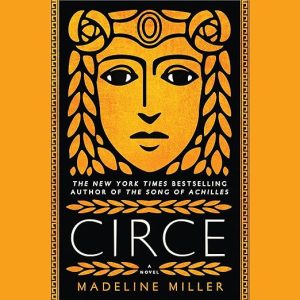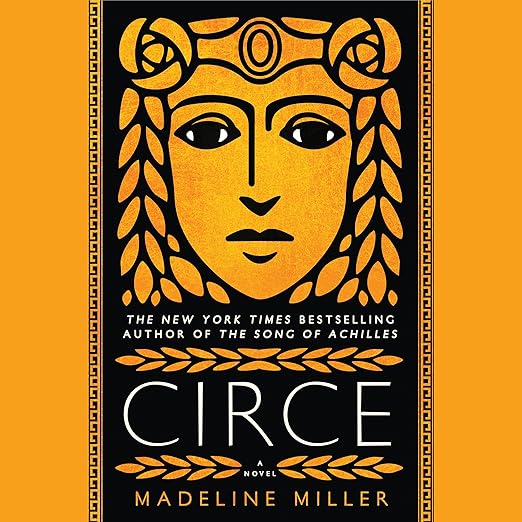
I came to Circe later than most. When Madeline Miller's retelling of the sorceress's story was releasing to starred reviews from what felt like every publication simultaneously, I was deep in a Homer phase and felt, wrongly, that I did not need someone else's interpretation of the mythology I was already living with. I finally listened on a long train journey, somewhere between Lyon and Paris, and understood by the halfway point why readers had been evangelical about it for years.
The premise is deceptively contained. Circe, daughter of the sun god Helios, lacks the obvious powers of her divine family. Where her siblings are beautiful or cruel in spectacular ways, she is strange: drawn to mortals, capable of a witchcraft that transforms rivals into monsters, eventually exiled by Zeus to an island where she will spend centuries in isolation. What Miller does with that isolation is the book's real subject.
First, the Big Picture
Miller structures the novel as a long education. Circe's island is not simply a prison. It is a laboratory where she learns the limits of her power, the uses of patience, and what it means to want something for its own sake rather than because the gods have decreed you should. The episodic structure, in which famous mythological figures pass through her island across centuries, works better in the listening than it reads on paper because Weeks' narration gives each encounter its own emotional register without breaking the continuity of Circe's voice. The Minotaur's section is strange and mournful. The Daedalus and Icarus passage has a lightness that makes what follows land harder. Odysseus's arrival is handled with more ambivalence than most retellings dare.
Reviewers have consistently noted that Miller's greatest achievement is keeping the classical setting intact while shifting the focus so completely that the myth reads new. One reviewer calls it a classic tale reimagined with a modern twist, though that description undersells the precision of what Miller does: she does not modernize Circe's world or transplant the mythology into contemporary concerns. She simply moves the camera. Circe's perspective is not a lens we have been offered before, and in that perspective the familiar events of Greek mythology reveal their strangeness.
Why Listen to Circe
Perdita Weeks is the case for the audiobook version. Her Circe is not the haughty enchantress of popular imagination. She is someone who has learned to be precise because carelessness costs her dearly, and Weeks embeds that precision in her delivery without making it cold. The long passages of isolation, which in print risk feeling static, become genuinely meditative in audio. You are inside Circe's solitude with her in a way that the page does not quite achieve. The twelve-hour runtime also suits the novel's structure: long enough to feel immersive, short enough that the pace never drags.
A Few Reservations
The early sections require patience. One reviewer accurately notes a slow buildup, and the novel's first quarter is more interested in establishing who Circe is within her divine family than in generating forward momentum. Readers expecting constant plot will be asked to wait. There is also a question of prior mythology knowledge: reviewers with Greek lit backgrounds consistently report deeper pleasure, and while Miller does not require classical fluency, she rewards it. The one-star review in this listing, about print size rather than content, is a reminder that the audiobook sidesteps that particular complaint entirely.
Who Should Pick Up Circe
This is the right choice for listeners who want literary fiction with mythological depth, for anyone interested in how women's stories get rewritten when the women are given the pen, and for anyone who wants to understand why this novel became such a cultural touchstone in the years after its release. It rewards patience. It does not reward skimming. Skip it if you need consistent action, or if the idea of spending time with a character's inner life for twelve hours sounds more like obligation than pleasure.
Questions Listeners Ask
Do I need to know Greek mythology to appreciate Circe?
Knowledge helps but is not essential. Miller includes enough context that the major figures, Odysseus, Daedalus, Medea, the Minotaur, are legible even to newcomers. However, readers familiar with the Odyssey and Hesiod's Theogony will catch additional layers in how Miller reframes the canonical events, and their experience is consistently richer according to reviewer accounts.
How does Perdita Weeks handle the shift between Circe's divine register and her more vulnerable, human-facing moments?
Weeks uses restraint as her primary tool. Circe's emotional shifts are carried through slight tonal changes rather than dramatic inflection, which suits a character who has learned to guard herself. The controlled performance means that the moments of genuine feeling, and there are several in the final third, land with proportionate weight.
Is Circe's story told chronologically, and does the episodic structure work across 12 hours of listening?
Yes, the novel is broadly chronological from Circe's birth through her centuries of exile and beyond. The episodic quality, where mythological figures arrive on her island at intervals across time, works well in audio because Weeks maintains consistent characterization for Circe while differentiating the visitors. The rhythm of arrival and departure becomes satisfying rather than repetitive.
How does Circe compare to Miller's earlier Song of Achilles for audiobook listeners?
The two novels are quite different in texture. Song of Achilles is more conventionally plot-driven and emotionally immediate. Circe is slower, more interior, and concerned with longer spans of time. Listeners who found Song of Achilles too emotionally demanding may actually prefer Circe's more measured pace, while those who loved the romance at the heart of Achilles may need to adjust their expectations here.