The Short Version
- Performance: Stephen Perring handles Cain's self-deprecating inner voice with dry confidence, finding the register between comic timing and battlefield urgency that the character demands.
- What it covers: Reluctant heroism, comedic survival instinct, Warhammer 40K grimdark with genuine levity
- Feel: Propulsive and witty, lighter than the average Black Library production
- Our call: The best entry point in the series for readers new to Cain, and a genuine highlight for established fans who have been along for the ride.
I came to Ciaphas Cain late, embarrassingly late, if I am being honest about my Warhammer 40K reading history. I had worked through a substantial chunk of the Horus Heresy before a friend insisted I was doing it wrong, that the grimdark needed a counterweight, and that the counterweight was a commissar who spends most of his career desperately trying not to be the hero everyone insists he is. I started Death or Glory on a Tuesday evening and finished it by Thursday morning, which for a nearly nine-hour listen is a pace I do not hit often.
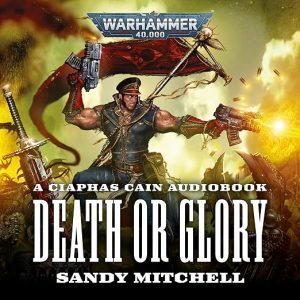
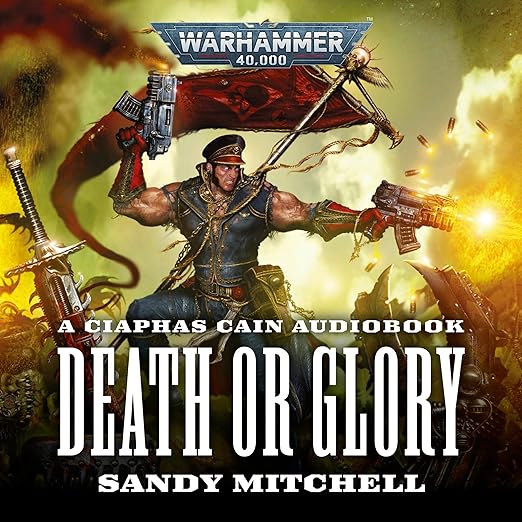
Death or Glory is the fourth novel in Sandy Mitchell's Ciaphas Cain series, narrated by Stephen Perring for Black Library. It is also, chronologically, the first story in Cain's career, functioning as a prequel to the earlier published entries. A reviewer who reread the series in chronological order noted that this perspective adds a new dimension to Cain's arc, and I think that is exactly right. Seeing the events that presumably shaped his particular brand of reluctant competence before the character fully calcified gives the book a slightly different emotional texture than its publication order would suggest.
The Verdict, Briefly
The setup is pure adventure comedy: after escaping a disastrous space battle, Cain and his aide Jurgen crash-land behind enemy lines, surrounded by hundreds of thousands of orks and desperately short of options. The only path forward is to round up scattered troops and fight through to safety, which is, as Cain observes in his usual internally panicked fashion, exactly the kind of situation he has spent his career engineering elaborate excuses to avoid. The structural elegance here is that Mitchell strips away Cain's usual support systems. No regiment to hide behind, no staff to deflect credit toward. It is just Cain, Jurgen, improvisation, and an improbable sequence of competence masquerading as luck.
Mitchell's Flashman homage is well-documented, and a reviewer drew that connection explicitly. The debt to George MacDonald Fraser's cowardly Victorian anti-hero is real, but Mitchell has transplanted the archetype into a setting that suits it differently. Cain operates in a universe where incompetence genuinely gets people killed in enormous numbers, which means his survival instinct and tactical intelligence read as more consequential than Flashman's often-farcical escapades. The comedy lands because it is earned by real stakes.
The Best Parts of Ciaphas Cain: Death or Glory
Narrator casting matters especially for a series this dependent on comedic timing. Perring understands that Cain's voice is fundamentally ironic, the man describes his own heroics as accidents while describing his cowardice in the florid language of philosophical reflection. Getting that balance wrong in either direction kills the joke. Perring does not get it wrong. His pacing through the editorial footnotes, a structural device Mitchell uses to let other characters comment on Cain's memoirs, is particularly sharp, providing just enough tonal shift to signal the frame without belaboring it. Reviewers who have listened across the series describe consistent enjoyment, which suggests Perring's interpretation holds up across the run.
One reviewer called Death or Glory their favorite in the series, describing it as a ridiculous jaunt of pure fun. That is not underselling it. The book does not pretend to be more than it is: an extremely well-executed adventure comedy in one of fiction's more inherently self-serious universes. Its unpretentiousness is part of the appeal. Death or Glory does not invite the reader to feel clever for appreciating it. It invites the reader to enjoy nine hours of an entertaining anti-hero escaping an impossible situation through a combination of luck, stubbornness, and the kind of tactical instinct Cain consistently refuses to acknowledge he possesses.
Points to Consider
Warhammer 40K is a setting defined by its maximalism. Everything is vast, ancient, and catastrophically doomed. That aesthetic is compelling in concentrated doses, but it can become oppressive across a long series, and the Black Library catalogue reflects this, some of the best novels in the range are those that find tonal variation within the grimdark frame. The Ciaphas Cain series is the most sustained example of that variation. A reviewer described Gaunt's Ghosts as the best of the grimdark, and the comparison is instructive: the Cain series is not competing with Gaunt's emotional weight. It is offering something different, the comedy of self-deception in a universe that would usually treat self-deception as a death sentence. The fact that Cain survives everything through what he insists is pure luck is the running joke, and like the best running jokes, it accumulates rather than diminishes with repetition.
Who Should Listen to Ciaphas Cain: Death or Glory
Warhammer 40K lore familiarity genuinely helps here. The orks, the broader military structure, and certain background references will land better for readers with some prior context. That said, Death or Glory is probably the most accessible entry in the Ciaphas Cain series precisely because its plot is so cleanly self-contained: man lands in bad situation, man fights way out. You do not need deep series knowledge to follow the shape of the story. Readers who find the standard grimdark tone of Black Library releases exhausting will find Cain a genuine relief. Those committed to the grim-dark aesthetic and uninterested in comedy may want to look elsewhere, this book is not trying to be Gaunt's Ghosts, and knows it. Currently listed as a free audiobook on Audible, this is a low-stakes way to find out whether the Cain series is for you.
Good to Know
How does Death or Glory compare to other Warhammer 40K audiobooks in tone?
It is significantly lighter and more comedic than most Black Library productions. Think adventurous satire rather than relentless grimdark, Mitchell is consciously writing against the universe's prevailing tone, and Death or Glory is the purest expression of that approach.
Is Stephen Perring's narration consistent with the rest of the Ciaphas Cain audio series?
Perring narrates multiple entries in the series, and long-time listeners report consistent satisfaction. His dry delivery suits Cain's self-deprecating memoir voice well across the run.
Is Ciaphas Cain: Death or Glory available as a free audiobook?
Yes, it is currently listed at $0.00 on Audible, a free audiobook for members and an excellent way to sample the series before committing to the full run.