- Narration: No confirmed horror-fiction credit on file for Holter Graham, whose established register is calm nonfiction pacing; whether that suits Arnie's obsessive unraveling is untested here.
- Themes: Jealousy personified, obsession, a friendship tested by possession
- Mood: Tense but oddly tender, more tragic than frightening
- Verdict: A jealousy story wearing horror's clothes; go in expecting heartbreak more than scares.
Christine finds Stephen King doing something almost perverse with a haunted-object story: making a 1958 Plymouth Fury the most jealous character in the book, and Holter Graham's job on this audiobook is to narrate a teenage boy's slow replacement by his own car. Naming a car after a woman is nothing new, but King pushes the metaphor until it stops being decoration and starts being the actual plot.
The Verdict, Briefly
Arnie Cunningham falls for the car before he falls for anyone in it: dilapidated, red-and-white, rusting on a front lawn in suburban Pennsylvania, nicknamed Christine by its original cantankerous owner. His best friend Dennis Guilder narrates the warning signs early, since Arnie has never had much luck with popularity or cars before. Once Christine enters the picture, Arnie's sudden confidence lets him start dating Leigh Cabot, the most striking girl at Libertyville High, even as the restored car quietly starts consuming every other part of his life, a trade of popularity for something much stranger that the book takes seriously rather than playing for cheap irony.
King leans on an old cliche for the closer, and leans hard: 'hell hath no fury like a woman scorned,' cast directly onto the car itself. That is a deliberate choice rather than filler, and it reframes the whole plot as jealousy first and haunting second, Christine reacting to Arnie's attention drifting toward Leigh the way a scorned lover would, not the way an object typically behaves in a haunted-object story.
Reviewers genuinely disagree about what kind of book this is. One calls it a horror novel, a love story, and a tragedy in the same breath. Another admits King's novels rarely scare, calling this one merely a horrifying concept rather than an outright frightening read, though still delightful for it. Both readings hold up: this is less a haunted car story than a jealousy story that happens to have an engine in it.
Dennis and Leigh end up doing the actual detective work the plot needs: uncovering the truth behind Christine's history as a car that has apparently killed before, under its original, cantankerous owner. That investigative thread runs parallel to Arnie's transformation rather than driving it directly, which gives the book two engines of its own, a mystery slowly getting solved by the people losing Arnie, and a possession narrative happening to Arnie himself, that eventually have to meet.
Dennis's position as the friend watching from just outside the relationship gives the investigative half of the book its real tension: piecing together what is happening to Arnie has to happen mostly from the outside, through changed behavior and secondhand rumor about Christine's past, rather than from any privileged view into Arnie's own head. That gap is where most of the book's genuine unease lives, more than in the car itself, since dread built from watching a friend change is harder to shake than dread built from a machine that occasionally does something strange.
Why Christine Works as an Audiobook
Holter Graham has an established track record narrating calm, authoritative nonfiction and young-reader adaptations, measured pacing that suits ideas-driven material well. Horror fiction built around a teenager's obsessive unraveling is a real register gap from that, and nothing in this listing confirms whether that measured control transfers to Arnie's descent or whether the material needs something rawer. Treat that as a genuine open question rather than an assumed strength either way. What does carry over honestly is a general patience with ideas-driven material, useful for a book that spends real time inside Arnie's changing interior logic rather than staging one set piece after another.
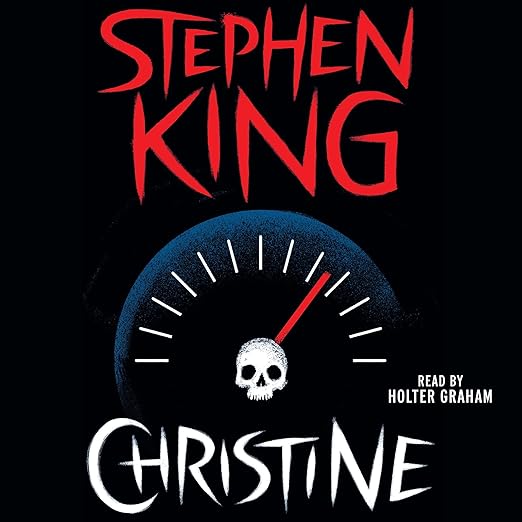
The novel's pull across formats is worth noting too. One listener admits not having read the book yet but still wanted this specific printing for its sturdy spine, nice pages, and genuinely well-designed retro cover, treating it as a collectible object worth curating rather than just a story to consume once. That kind of long-tail attachment to a decades-old title says something real about how the book has aged, and a nineteen-and-a-half-hour audiobook edition gives that same longevity a second life for listeners who never owned a physical printing to curate in the first place.
Points to Consider
That same collector's review is worth flagging directly: it evaluates the print edition's manufacturing quality, spine, paper, cover design, rather than anything about the story or this audio recording specifically. Treat it as evidence of the book's staying power as a physical object, not as a review of Holter Graham's reading.
One reviewer mentions preferring the book to 'the movie,' though nothing in this listing's own data describes that adaptation directly, so treat the comparison as an aside rather than useful detail about the film itself. On the numbers, five ratings land at 23 of a possible 25, two points under a flawless score, a small, unremarkable gap rather than anything worth reading into. Runtime is worth weighing on its own terms too: nineteen and a half hours is a real commitment for a single-conceit horror premise, and listeners who prefer their King lean and propulsive should know this one takes its time getting Arnie from awkward teenager to Christine's property.
Should You Listen to Christine?
Stephen King completists, horror readers willing to accept tragedy and even romance as part of the package, and anyone drawn to the specific conceit of a jealous car will get the most from this one. The nineteen-and-a-half-hour runtime gives Arnie's slide from awkward teenager to Christine's obsessive property plenty of room to build gradually rather than rushing the transformation. Readers who already love Dennis and Leigh's amateur-investigator thread specifically will also find plenty to hold onto, since that mystery gets real room to develop alongside Arnie's own arc rather than being resolved in a rushed final act.
Listeners hoping for wall-to-wall fright should recalibrate first, since even an enthusiastic reviewer here admits King rarely delivers straightforward scares. This one rewards listeners more interested in obsession, jealousy, and a friendship tested by both than in jump scares or gore. Anyone expecting a monster or a haunted house rather than an escalating human relationship should recalibrate expectations before pressing play, and should probably push this one further down the queue in favor of faster, plottier King titles instead.
Before You Listen
Should horror fans expect Christine to be frightening or more of a tragedy?
Expect tragedy first. One admiring reviewer still admits King rarely delivers outright scares, using the word 'horrifying' about the concept rather than the experience of listening to it. The jealousy-driven plot rewards listeners more interested in obsession and heartbreak than in jump scares or gore.
Does this audiobook feature the same story as the movie adaptation?
One reviewer mentions preferring the book to 'the movie,' but this listing's own data never describes that adaptation, so a direct comparison is not possible from what is here. Treat that mention as one listener's aside rather than confirmation of how closely any film version follows this specific audiobook's text.
Is this audiobook considered one of Stephen King's essential titles or a lesser-known one?
The reviews attached here lean toward essential: one reviewer calls it a masterpiece outright, and another specifically wanted a well-made printing worth curating in a personal King collection. That level of enthusiasm, plus the distinctive jealous-car conceit, suggests this holds a more central place in King's catalog than a deep cut would.