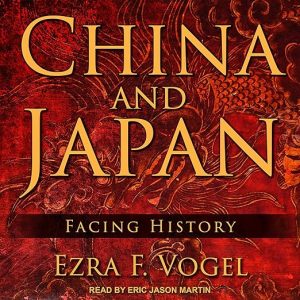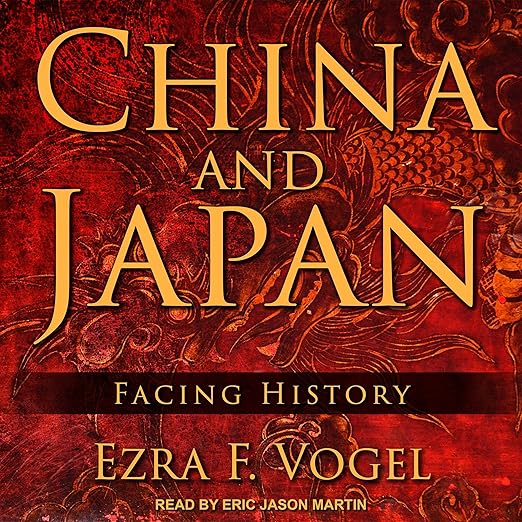
China and Japan carries a particular weight as Ezra Vogel's final major scholarly work. Vogel spent his career in East Asian studies, writing the books that shaped English-language understanding of Japan's postwar economic transformation and China's reform era, and this audiobook, narrated by Eric Jason Martin across twenty-two hours and fifty-one minutes, represents his effort to bring those two separate lines of inquiry into sustained conversation with each other. The bilateral relationship between China and Japan, stretching back fifteen centuries, is one of the most consequential and least adequately understood dynamics in contemporary geopolitics, and Vogel's attempt to give it the full historical treatment it deserves was exactly the right project for his final major scholarly contribution.
Centuries of Chinese Dominance, Then 1895
Vogel's organizing argument is both carefully scholarly and, in its own understated way, politically urgent. He traces how China held the dominant position in this relationship for most of its long history: the Japanese imperial court sent repeated delegations to Tang dynasty China to absorb Buddhist philosophy, administrative governance systems, and aesthetic culture, and Japan's cultural self-understanding was shaped for centuries by that absorption process. The 1895 Sino-Japanese War changed the dynamic entirely for the first time, with Japan's successful modernization placing it in the dominant regional position, and the bitter consequences of that reversal culminated in the occupation of China during World War II and in atrocities that Vogel documents without minimization or diplomatic evasion.
What distinguishes his approach from a simpler narrative of Japanese guilt is the simultaneous insistence on Chinese accommodation. Vogel argues directly that Japan owes China a thorough, accountable apology, the vague and partial acknowledgments offered by various postwar Japanese governments have not been adequate to the scale of what happened, but he argues with equal directness that China has at times used legitimate historical grievance as a tool for domestic nationalist politics in ways that serve current political power rather than genuine historical reckoning. The dual accountability he demands of both governments is the element that gives the book its analytical weight rather than simply its moral satisfactions, and it is what separates Vogel's treatment from advocacy disguised as scholarship.
Eric Jason Martin narrates the twenty-two-hour production with appropriate steadiness. Historical scholarship of this density benefits from narration that does not editorialize or impose interpretive inflection, and Martin keeps a consistent and clear tone that allows Vogel's own arguments to carry their full rhetorical weight without vocal amplification.
Twenty-Two Hours Built for a Cumulative Argument
The audiobook format is genuinely suited to this material for a specific structural reason: Vogel's prose is written for the educated general reader rather than for specialists in Chinese or Japanese studies, and his argument builds cumulatively across fifteen centuries in ways that benefit from hearing it laid out continuously rather than reading it across isolated sittings. The twenty-two-hour runtime is substantial, but it corresponds to genuine breadth of historical content. Each turning point Vogel examines, the Tang dynasty cultural exchange, the Meiji modernization, the 1895 war, the 1930s occupation, the postwar economic relationship, the current territorial disputes, receives the analytical attention its complexity deserves rather than being compressed for convenience.
For listeners following current developments in East Asian security, territorial disputes in the South and East China Seas, or trade and technology policy between the two countries, this audiobook provides the historical architecture that makes those developments interpretable rather than merely reportable. One reviewer noted that political dynamics in Asia are critical to understand in the era of expanding Chinese influence, a framing that has only become more accurate since Vogel completed this manuscript.
Missing Timestamps and an Outsider's Diplomatic Limits
One reviewer noted repetitions and minor textual imprecisions suggesting some production rush in the final editing process. In a twenty-two-hour audiobook, those repetitions are more noticeable than in print, and the same reviewer mentioned the absence of chapter timestamps that would make navigating back to specific passages easier for listeners who want to revisit particular sections or use the audiobook as an ongoing reference tool. These are production criticisms rather than content criticisms, but they are worth flagging for listeners who engage with long historical works at that level of structural detail.
Vogel's position is that of a sympathetic outside observer, a Harvard scholar with decades of relationships in both countries but not a citizen of either, and his diplomatic recommendations carry the characteristic limitations of that stance. His calls for Japanese apology and Chinese accommodation are reasonable in the abstract but do not fully account for the domestic political incentives on both sides that make such moves extremely difficult in practice. The book is more analytically useful as historical foundation than as a near-term diplomatic road map, and readers should engage with it in that spirit.
Parallel Careers Merge into One Synthesis
Listeners with an interest in East Asian history and contemporary geopolitics will find this audiobook one of the most substantive English-language treatments of the China-Japan relationship currently available. Those who have read Vogel's earlier work on Japan or on China separately will find this a satisfying synthesis of his parallel lines of scholarly inquiry brought into direct conversation at last. The twenty-two-hour commitment is real and requires a patient listener; those who want the argument delivered efficiently or prefer a shorter historical overview should find a more compressed entry point before attempting this full synthesis. Skip it if you need conclusions delivered quickly; Vogel's method is comprehensive by design, and compression would undermine exactly what makes the work valuable for the long view.
The Short Version
- Voice: Eric Jason Martin delivers the dense historical material at a clear and measured pace that suits the complexity of 1,500 years of bilateral relations without becoming academic.
- Big ideas: Historical memory and the politics of apology, the shifting balance of East Asian power across centuries, World War II and its unresolved contemporary legacies
- Atmosphere: Scholarly, lucid, and diplomatically urgent
- Worth it?: Ezra Vogel's final major work is essential background for anyone trying to understand current East Asian geopolitics, a twenty-two-hour commitment that rewards patient engagement considerably.
A Few Questions About China and Japan
Does the China and Japan audiobook assume prior knowledge of East Asian history, or is it accessible to general listeners?
Vogel wrote for the educated general reader rather than for specialists. The historical context is explained rather than assumed, making the audiobook accessible to listeners without prior expertise, though the twenty-two-hour scope requires sustained patience and attention throughout.
How does the audiobook handle the political sensitivity of Japan's wartime conduct in China during World War II?
Vogel is direct about both the scale of Japan's conduct and the inadequacy of subsequent Japanese apologies. He argues explicitly for a thorough accounting while simultaneously arguing that China has at times used historical grievance instrumentally for domestic political purposes, making this a more genuinely balanced treatment than a simple moral indictment would be.
Does Eric Jason Martin's narration handle Chinese and Japanese proper nouns and place names accurately across the twenty-two-hour audiobook?
Martin maintains consistent pronunciation throughout, which matters considerably for a production covering hundreds of historical figures, place names, and institutional terms across two major languages. Listeners with deep familiarity with both languages may notice occasional imprecision, but the production is generally reliable on this front.