At a Glance
- Narrator: Mel Hudson handles a genuinely unusual structural challenge - chapters alternating between human survivors and the evolving consciousness of an uplifted spider civilization - with consistent skill, finding distinct registers without resorting to caricature.
- Subjects: Evolution and non-human intelligence, the right to inherit a world, civilization as contingency rather than inevitability
- Tone: Vast and unsettling, with long stretches of awe punctuated by dread
- Bottom line: Sixteen hours that justify every one of them - Children of Time earns its reputation as one of the more formally ambitious science fiction novels of the last decade.
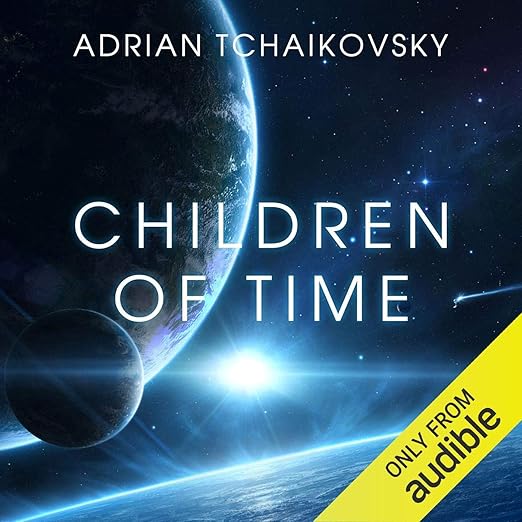
Adrian Tchaikovsky's Children of Time arrives in audio as the first volume in a series that has since grown to three novels and several companion works, and it is the kind of audiobook that genuinely rewards the full sixteen hours and thirty-one minutes rather than treating length as a concession. Narrated by Mel Hudson, this is science fiction built on a structural gamble: alternating chapters between the remnants of humanity aboard a generation ship and the evolving civilization of spiders on a terraformed world that humanity expected to find empty. The gamble pays off, and Hudson's performance is central to why it works in audio as well as it does on the page.
The Verdict, Briefly
Tchaikovsky's central formal choice is to follow the spider civilization across thousands of years of accelerated evolution - the result of a nanovirus originally designed to uplift primates, which instead found its way into the arachnid population of the terraformed planet. Each spider chapter covers a different era in the civilization's development, with character names recycled to indicate cultural type rather than individual continuity. This is genuinely strange to read and stranger still to listen to, because Hudson must make those recurring names feel meaningfully different across the centuries while keeping enough continuity that the listener tracks the cultural arc rather than losing the thread. She does this with subtle tonal shifts rather than dramatic vocal distinctions, and it works precisely because she does not overplay it.
The human chapters are more conventionally structured, following Holden, a classicist who wakes from cryo-sleep to find the generation ship's mission increasingly desperate. Those chapters carry the emotional urgency and Tchaikovsky uses them to pace the novel, creating pressure that makes the spider chapters feel increasingly consequential rather than merely digressive. One reviewer noted the novel was "brilliant, unputdownable, and well-constructed" while flagging disappointment with the ending - a reaction that suggests Tchaikovsky's ambitions exceed the resolution he delivers, and that is a fair critique. The collision course between civilizations is the engine of the book, and the ending asks you to accept something that the preceding sixteen hours have not quite prepared you to accept. That is a meaningful flaw, but the quality of everything preceding it remains intact.
The audio format handles the dual-civilization structure particularly well because Hudson's voice creates sonic anchors that help listeners maintain their bearings across thousands of years of spider history. On the page, the chapter headers do that work visually - in audio, it is Hudson's tonal consistency within each strand that orients the listener. The spider chapters in particular benefit from narration because the scientific vocabulary Tchaikovsky deploys in describing the uplift process and the evolving social structures sits more comfortably in speech than on the page, where the density of invented biology can slow reading pace considerably.
Tchaikovsky is one of the more prolific working science fiction writers, and Children of Time represents him operating with the full ambition of someone who has nothing left to prove in shorter forms. The companion novel Children of Ruin shifts the focus to an octopus civilization and is widely regarded as equally strong; new listeners to the series starting here are positioned well to continue. For those who have already read the book, Hudson's narration offers a different experience than the prose alone - the spider chapters especially gain a kind of rhythmic quality in audio that the text version cannot quite replicate.
It is also worth noting that Children of Time won the Arthur C. Clarke Award in 2016, which is the UK's most significant science fiction prize, and that the win was unusual in how broadly it was celebrated even by readers outside the prize's typical orbit. Award-winning novels often win on technical merit that general readers find cold; Children of Time won because Tchaikovsky's ambitions are felt rather than merely observed. The spider chapters are strange, but they are strangely moving rather than strangely inaccessible, and that quality translates directly to audio.
What to Watch For in Children of Time
The spider civilization chapters require active listening. Tchaikovsky builds a fully realized biological and social system for a species whose sensory world and cognitive architecture are radically unlike our own, and he does not condescend to explain every inference. Listeners who track the recurring names as social archetypes rather than individuals will follow the arc more easily. Pay particular attention to Portia and Bianca across the different eras - those names carry specific functional roles in spider society that Tchaikovsky uses to signal status and conflict type without restating it each time.
The human chapters feature a recurring conflict over Holden's classicist identity and his resistance to the ship's more pragmatic leadership, which sets up thematic parallels with the spider civilization's own internal power struggles. Those parallels are not always subtle but they are worth tracking because Tchaikovsky uses them to make a point about intelligence as a category rather than a specifically human achievement. The novel's politics are present but not loud - the argument about who inherits the Earth is made through structure rather than through speechifying, and it lands harder for that restraint.
Who Will Get the Most From It
Science fiction readers who prioritize formal ambition and non-human perspective-taking over plot velocity are the clear audience. Listeners who prefer their science fiction fast-paced and human-centered will find the spider chapters require patience that the novel demands rather than earns quickly. Those who loved Ursula Le Guin's structurally patient approach to alien civilization in works like The Left Hand of Darkness or The Word for World is Forest will find Tchaikovsky's project recognizable and rewarding. This is not a good entry point for listeners new to science fiction, but for anyone with a working relationship with the genre and its conventions, sixteen hours with Mel Hudson reading Tchaikovsky is a significant listening experience.
Common Questions
Do I need to read Children of Time in sequence before listening to the later audiobooks in the series?
Yes - Children of Ruin, the second book, builds directly on events and relationships established here. Starting with this audiobook is strongly recommended. The third volume, Children of Memory, similarly depends on the prior books for its emotional context.
How does Mel Hudson handle the unusual spider civilization chapters in the audiobook?
Hudson uses subtle tonal shifts rather than distinct voices to differentiate the recurring character names across different eras. She reads the scientific and biological vocabulary Tchaikovsky deploys without stumbling, and the spider chapters have a different rhythmic quality in her narration than the human sections - appropriately so, given how different those civilizations are meant to feel.
Is Children of Time a standalone audiobook or does it end on a cliffhanger?
It has a self-contained narrative arc and reaches a definitive conclusion, though some readers find the ending less satisfying than the journey. The series continues in Children of Ruin, but the first novel does not leave listeners in genuine suspense - it concludes its central conflict.
At sixteen hours, is Children of Time a manageable audiobook for someone with limited listening time?
The length is substantial, but the dual-strand structure creates natural pausing points at chapter breaks. Listeners who can commit to several longer sessions will find the cumulative effect stronger than listening in very short bursts - the spider civilization chapters especially benefit from being heard in sequence to track the cultural arc across centuries.