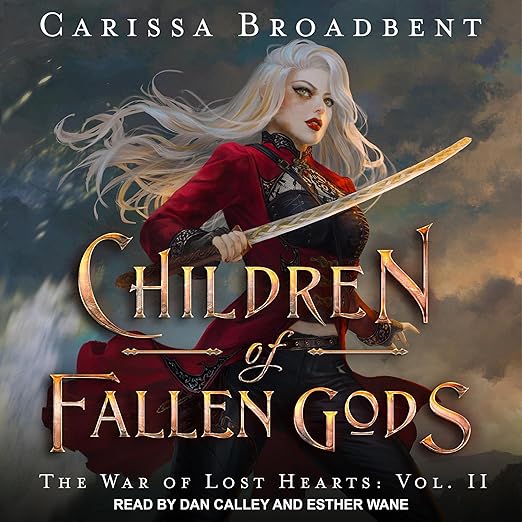
Can a single narrator credit really cover a book two reviewers independently describe as having two alternating voices? This audiobook's listing names only Dan Calley, yet Children of Fallen Gods spends nineteen hours and thirty minutes moving between perspectives in a story about war, sacrifice, and a blood pact neither lead character can walk away from.
Tisaanah's Blood Pact Drags Her to War
Tisaanah bargained away her own freedom to save the people she left behind in slavery, and that blood pact now binds her to fight the Orders' war whether she wants to or not. Max, determined to protect her at all costs, gets pulled into a bloodier conflict once betrayal tears apart Ara, forcing Tisaanah to gamble with Reshaye's power for a victory that may be impossible and forcing Max into a leadership role that makes him confront his own past and his own mysterious magic.
Reviewer Maree LaRue's specific complaint is worth taking seriously before starting: a star came off this review because the book offers almost no recap, and a listener returning after months away from book one needs to reconstruct the politics, the magic system, and conflicts like Voltaire against Soltain almost entirely from memory. For a story this dependent on an already-established fantasy world, that lack of a refresher is a real structural cost, not a minor inconvenience.
Structural ambition is still very much part of the appeal, according to a reviewer writing from Germany, Anabell, who singles out a brand-new character point of view introduced partway through and praises how two separate storylines connect back together by the end. That same review calls the plot twist genuinely strong and confirms Max and Tisaanah's relationship remains the emotional center even as the cast and the politics around them both expand.
Only Calley Is Credited, but Two Voices Appear
A closer look at the reviews reveals something the credits alone do not: reviewer Muriel Sampson describes the audiobook explicitly as having two narrators, alternating between male and female voices depending on whose perspective is active. Only Dan Calley is named on this listing, so that mismatch, one credited name against a specifically described two-narrator structure, deserves a direct flag rather than a silent correction in either direction. Listeners who care about that detail should verify it themselves before assuming either version is the accurate one.
Sampson's review also does something unusually useful for a listener trying to calibrate expectations: it breaks the book down into a plot score of four out of five and a spice score of two out of five, evaluated separately and explicitly. That kind of specific, componentized rating is rare in this dataset and gives a much clearer picture than a single overall star count could on its own. Sampson also mentions listening in tandem with a print copy, switching back and forth between formats, which is a useful data point in itself: whichever narrator configuration is actually correct, at least one listener found the audio and print experiences compatible enough to move between them without losing the thread.
Entertaining but Dreary, Per One Reviewer
Horror is the tag attached to this listing, and it does not fit what the synopsis or reviews actually describe. Nothing here points to a horror register specifically: this is dark fantasy romance built around war, betrayal, and a blood-bound partnership, with mature themes flagged directly in the synopsis, but no reviewer mentions anything resembling horror conventions. Listeners browsing by genre tag alone should not expect a scary story, and the mismatch is worth flagging plainly rather than letting a browsing listener self-select out of a book they might otherwise have enjoyed on the strength of a mislabeled category.
Reception is not uniformly glowing, and that range is worth representing honestly. Reviewer jamie marcus calls the book entertaining but dreary, praising the world and characters while admitting the new backstory material was genuinely difficult to stay interested in, even while understanding why it mattered structurally. That is a more measured take than the five-star reviews surrounding it, and it lines up with Maree LaRue's recap complaint as a second, independent signal that this entry asks more patience of returning readers than the first book did. A third reviewer, Jane, lands somewhere in between, describing an emotional rollercoaster of screaming at plot developments and being caught off guard by foreshadowing paying off, which suggests the book's intensity itself is not in dispute even where opinions differ on pacing.
Refresh Book One Before Starting This
Existing readers of The War of Lost Hearts series who finished book one recently enough to remember its politics without a refresher are the best-positioned audience here, and fans of dual-perspective dark romantasy built around real physical stakes, per Sampson's four-out-of-five plot score, should find real substance in the war-and-betrayal plot specifically, especially anyone who wants a sequel that keeps expanding its cast and its stakes rather than settling into a smaller, more contained follow-up story.
One clear task sits ahead of anyone new to this series: read or listen to the first War of Lost Hearts book first, ideally recently enough that Voltaire, Soltain, and the wider political landscape are still fresh. Skipping that step, based on multiple reviewers' independent complaints about missing context, risks losing track of a plot built to reward listeners who already know exactly who Ara's factions are, what the Orders actually want, and why any of it matters by the time Tisaanah's gamble with Reshaye's power comes due.
Before You Press Play
- Voice: credited solely to Dan Calley, though a detailed reviewer describes two alternating narrators splitting the book by POV, a discrepancy this listing does not resolve.
- Big ideas: freedom bought at the price of a binding pact, leadership forced onto someone unready for it, betrayal reshaping a fragile alliance
- Atmosphere: Tense and emotionally heavy, with real spice according to a reviewer's own separate content rating
- Worth it?: A rewarding but demanding sequel for readers already inside The War of Lost Hearts, not a workable starting point.
Good to Know
Does this audiobook actually have one narrator or two?
The credits list only Dan Calley, yet one reviewer's detailed breakdown of the listening experience specifically describes the narration switching by point of view, a male voice and a female voice trading off as the perspective shifts. That gap between the official credit and a firsthand account is real, and it is worth confirming for yourself before assuming either source has the full picture.
Do I need to listen to the first War of Lost Hearts audiobook before this one?
Yes, and recently. One reviewer took a star off specifically because this entry offers almost no recap, requiring a listener to reconstruct the political landscape, the magic system, and conflicts like Voltaire against Soltain from memory alone. Starting here without that fresh context risks losing track of the plot entirely.