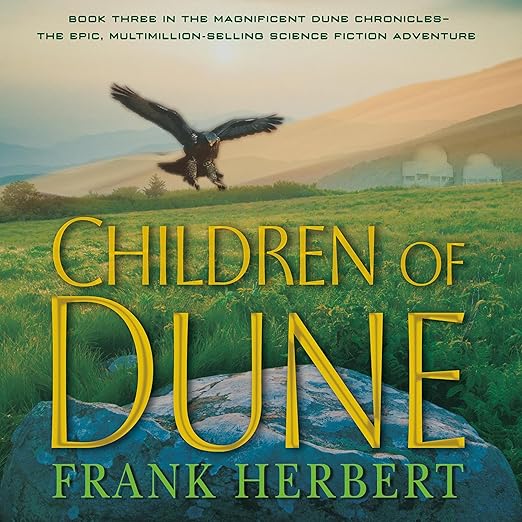
Can a desert planet survive being saved from itself? That is the bind at the center of the Children of Dune audiobook, the third entry in Frank Herbert's Dune saga, where Arrakis has turned green, watered, and fertile, and the change is quietly killing off the sandworms the whole planetary economy depends on.
Nine-Year-Old Twins Inherit a Failing Prophecy
Paul Atreides, who led the Fremen to political and religious domination of the galaxy, is gone by the time this book opens. What remains are his twin children and heirs, Leto and Ghanima, who can see possible solutions to the ecological unraveling but face fanatics challenging Atreides rule at every turn. Abhi's review lays out the shape of it plainly: Paul's own story more or less closes out in the previous book, Dune Messiah, and Children of Dune shifts the weight onto his children and the empire's fate, laying groundwork for the next book, God Emperor of Dune.
Taylor Hathcock's review picks up a detail that trips a lot of readers: the twins are nine years old, though between their prescient inheritance and the plotting around them, it is easy to forget until someone refers to them as children outright. Hathcock opens the review with a line pulled straight from the book, power attracts the psychotics, always, that is what we have to avoid within ourselves, which gives a sense of how much of this installment runs on political and psychological maneuvering rather than open combat. Hathcock also makes the case for reading order, noting that Dune Messiah makes more sense and earns more appreciation once Children of Dune is finished, and that this volume is where Paul's religion visibly starts to fail and the Fremen grow complacent in ways the earlier books only hinted at.
Schiefelbein Reads Three Books as a Single Trilogy
Abhi's review, titled around the twins facing deadly challenges, spells the family name Atriedes rather than the standard Atreides, a small slip that shows up more than once in Abhi's own write-up of the book. It does not change the substance of what Abhi describes, power struggles among rival factions closing in on Leto and Ghanima, but it is the kind of detail worth knowing before you go looking for other reviews of the same book under a different spelling.
Scott Schiefelbein's five-star review goes further, arguing that Dune, Dune Messiah, and Children of Dune work best treated as one unified trilogy rather than three separate novels, comparing the shape of it to The Lord of the Rings and crediting Herbert's cautionary instincts for tying the three together into something Schiefelbein calls incredibly satisfying, fascinating, and confounding all at once.
Nobody Reviews Brick's Voice, Only Herbert's Prose
Joe G.'s review is the one to read if you care about prose over plot mechanics. Joe G. calls the writing so poetic and ethereal that it takes a reader to another world, praising Herbert's unique voice and one-of-a-kind tone as genuinely hypnotizing, and describing the whole experience as like grasping at a dream, every step closer and yet somehow farther away. Toward what, Joe G. wonders. The Golden Path, maybe, the phrase Herbert uses for the narrow, costly future Leto and Ghanima are being pushed toward.
Scott Brick narrates. It is worth pausing on the fact that when reviewers here reach for words like voice and tone, every one of them means Herbert's prose, not the audiobook performance. Nobody comments on Brick's reading directly, which is a strange gap to leave unfilled on a book this widely praised for exactly the qualities, rhythm and atmosphere, that a narrator has the most control over.
The larger appeal, if the reviews are any guide, is momentum. This is the book where the founding trilogy's consequences land, where the empire's cracks widen into real fractures, and where the series pivots from Paul's story to his children's. Listeners already invested in Arrakis, the Fremen, and the machinery of prophecy get the payoff here rather than more setup.
Macmillan Audio put this edition out in February 2008, and at 16 hours and 51 minutes it is a noticeably shorter listen than either of the first two books in the trilogy, which fits Schiefelbein's read of it as the closing movement rather than another act of world-building. For anyone tracking the saga as a listening project, this is the point where the founding trilogy Herbert originally set out to write comes to a close, with God Emperor of Dune waiting as a genuinely separate era of the story.
Singapore's Damaged-Copy Complaint Says Nothing About Sound
This is not a starting point. The synopsis assumes a listener already knows who Paul Atreides is, what the Fremen are, and why the empire matters, and the reviews confirm it: Abhi's summary only makes sense to someone who has already sat through Dune and Dune Messiah. Coming in cold means missing the very continuity that makes Hathcock and Schiefelbein rate it so highly.
One review here is worth discounting entirely for judging the audio experience. Damien Eu, reviewing from Singapore, reports the book arriving in bad condition and requesting a replacement, a complaint about a damaged physical copy rather than anything about the story or its telling. It is useful context for the listing but tells a listener nothing about the audiobook itself.
The star rating sits at 4.6 across 21 ratings, and the five written reviews on file range from a two-star shipping complaint to several five-star reads, so the spread underneath that average is wider than the single number suggests. The reviews themselves come from three different countries and span more than a year, from Abhi's review out of India in late 2023 to Schiefelbein's in the United States in early 2025, which at least confirms the book keeps finding new listeners well after its original release.
Prose Lovers Get the Trilogy's Real Ending
This is for listeners who finished Dune and Dune Messiah and want the founding trilogy's actual ending, not a new jumping-on point. It especially rewards anyone who, like Joe G., reads Herbert for the prose itself, the atmosphere and the strange, dreamlike pull of Herbert's sentences, as much as for what happens to Leto and Ghanima next.
Skip it if you have not read the first two books, or if what you want from Dune is fast plotting rather than a slow tightening of political and religious pressure. Hathcock's point stands: this volume rewards patience, and its full weight only lands once Dune Messiah is behind you and the twins' inheritance has had two full books to accumulate its cost.