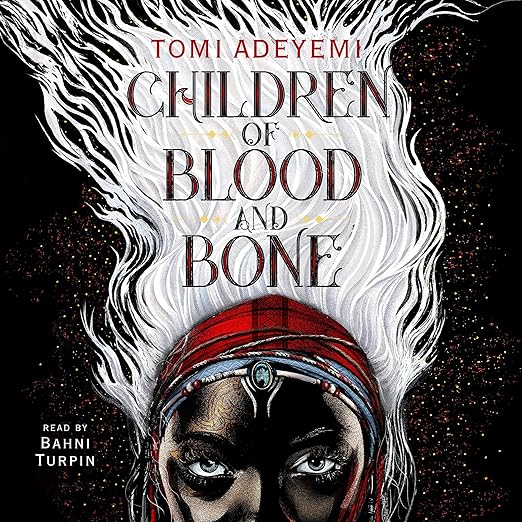
The Short Version
- Narrator: Bahni Turpin delivers a performance of extraordinary range, anchoring the multi-POV structure with distinct voices and a West African accent that grounds Orisha's world in something felt rather than merely imagined. Her work here earned the Audie Award for Audiobook of the Year for good reason.
- Subjects: Systemic oppression and resistance, the cost of reclaiming identity, grief as a catalyst for power
- Tone: Propulsive and emotionally urgent, with moments of genuine wonder
- Bottom line: A debut that earns its reputation, especially in audio form where Turpin transforms an already strong narrative into something visceral.
I started listening to Children of Blood and Bone on a Saturday afternoon when I had a long drive ahead of me, thinking I would dip in for an hour or two. I arrived home three hours later, sat in my parked car, and kept listening. That is not something I say lightly, and I say it here not as marketing copy but as the plain truth of what happened.
Tomi Adeyemi's debut pulls from Yoruba mythology and West African history to build Orisha, a kingdom where maji clans once wielded divine gifts and the king's soldiers wiped them from the earth in a single night known as the Raid. Zelie Adebola survived that night but lost her mother. Now she is a diviner, one of the magic-less children left behind, marked by white hair and social contempt. When a chance encounter puts a stolen artifact in her hands, she has one narrow window to restore magic before it closes forever.
Checkpoints and Markets Carry the Real Argument
The novel works on two levels simultaneously and manages both with unusual skill for a debut. On the surface it is a high-stakes quest fantasy with battles, monsters, a rogue princess, and a crown prince who is both antagonist and something more complicated. Underneath that, Adeyemi is writing about race, about what governments do to the bodies and spirits of people they fear, and about the psychological cost of surviving systems designed to destroy you. The social commentary is never clumsy or didactic. It lives in the texture of how characters are treated at checkpoints, in markets, in the way certain people can move through Orisha and others cannot. Teen Vogue described it as dealing with themes of race and power being discussed in real time, and that framing is accurate.
Turpin's West African Accent Grounds the Fantasy
Bahni Turpin is the reason this audiobook won the Audie Award for Audiobook of the Year, and the distinction feels earned on every page. She does not simply perform the book. She inhabits it. Zelie's voice carries exhaustion and fury and love in precise proportions. The crown prince Inan sounds like someone at war with himself. The rogue princess Amari sounds like someone discovering she has been lied to her entire life. Turpin's West African accent gives the language of Orisha a sonic weight that grounds the fantasy elements in cultural specificity rather than generic medievalism. AudioFile Magazine called it breathtaking and that word is not an overstatement. Booklist gave her narration a starred review, praising how she customizes her voice for each character's unique personality across a very long runtime.
Every POV Switch Shifts the Moral Orientation
The multi-POV structure is worth paying attention to. Adeyemi rotates among Zelie, Amari, and Inan, and each switch is a shift in moral orientation. Zelie wants vengeance and redemption. Amari wants to be someone her father's kingdom could never allow her to be. Inan believes, genuinely at first, that he is protecting Orisha by suppressing magic. Watching those three perspectives collide, and slowly contaminate each other, is where the novel's real tension lives. There is also a developing romance that some listeners will find essential and others will find secondary. Neither reaction is wrong. It is present but not dominant. Reviewers who came to the book not particularly interested in YA have found themselves unable to put it down, which says something about the pace Adeyemi maintains across nearly 18 hours.
Book One Ends on a Real Cliffhanger
If you have any investment in fantasy that draws from non-European mythology, this is a priority listen. If you are a parent looking for YA that handles themes of institutional violence and identity with intelligence rather than simplification, it earns that recommendation too. Readers who find that racism-as-metaphor in fantasy can feel evasive will appreciate that Adeyemi is not using metaphor here at all. The social dynamics of Orisha map directly onto real history and she does not look away from that. Skip it if you need standalone closure: this is book one of a trilogy and it ends on a cliffhanger that will make you want book two immediately.