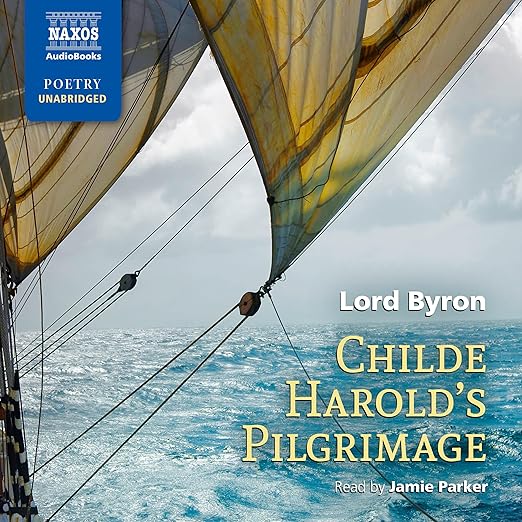
Naxos gives Byron four cantos and one voice, which is a strange bargain to look at on a listing page: an audiobook of a poem, unaccompanied, with nothing standing between you and the Spenserian stanza. Childe Harold's Pilgrimage is the work that made Byron famous in London society, and it is also a travelogue, a political argument and a long complaint about the condition of Europe after the Napoleonic wars. Four hours and fifty-five minutes with Jamie Parker is not how most people meet it. It may be closer to how it was meant to be met.
Byron's Itinerary of Opinions and Roadside Wreckage
Byron wrote the protagonist as a near-transparent screen for himself, and the description is right to say that the journey eerily echoes his own life story. The traveler forgoes his destiny back home for the exciting unknown, and what follows is less a plot than an itinerary with opinions attached to every stop along it. On the page the poem can feel like a monument you are expected to admire from a respectful distance. Heard aloud in one continuous line, it turns back into what it began as: a young man talking, at length, about the places he passes through and the wreckage he keeps finding in them.
Jamie Parker Alone Sustains an Unbroken Spenserian Form
Jamie Parker takes the whole thing alone, and the column contains something rare enough to be worth naming: an entry that reviews the Naxos audio version explicitly, by name, and calls the performance masterful in its own heading. That same response does the useful work of listing who the poem is for, running through European history, geography, travel, political thought and Greek and Roman mythology as the available doors into it. Reading testimony and listening testimony are not the same evidence, and this page happens to carry both.
Spenserian stanza runs eight lines and then a longer ninth that refuses to let you stop early, and sustained across four cantos that shape becomes the main technical demand on any reading of it. It is also why one unhurried voice suits the material better than a cast would: the form is already doing that job. Naxos hands the four cantos to Jamie Parker and lists nobody else, which for a poem of this scale reads as a decision rather than a default.
Postrevolutionary and Napoleonic Europe Is the Real Subject
Poetry read well is one of the few things audio does better than print, and this is the clearest case for it I have met on the classical shelf in a long time. The line breaks stop being visual furniture. The rhyme stops being something you notice and becomes something that carries you forward whether you meant to keep going or not. Readers who have stalled on Byron in a paperback should consider that the stall may have been the format's fault rather than the poem's.
Europe is the actual subject, and it is a Europe that has only just finished tearing itself apart. The poem moves through countries disillusioned and ravaged by the wars of the postrevolutionary and Napoleonic years, and the traveler's reaction to each of them is the closest the work comes to an argument. If you have any appetite at all for the period, the recording doubles as a guided tour narrated by someone with strong and frequently unfair opinions about everywhere he goes.
Cantos accumulate rather than escalate, and by the third one the rhythm is doing work that no summary can reproduce for you. The runtime is brief for a canonical long poem, which means the density never lets up for long. That is a feature if you already lean toward the material and a warning if you do not. Nothing about this recording was built to sit in the background while you do something else with your hands.
Losing the Thread Here Costs You a Stanza
Newcomers should know that the listing describes the poem and nothing around it. No introduction, no commentary and no glossary are promised anywhere in the copy, so what you are buying is four cantos and a voice. One written response says outright that the next step is to go and find commentary elsewhere before the work can be properly appreciated, which is both a reasonable plan and an accurate account of what this recording leaves you to do on your own.
One entry in the column is not about this product at all. A note filed from Germany reviews a printed paperback: the quality of the printing, the way numbering and parts of a single verse fall across two facing pages, and a warning that the English involved is not for beginners. It is a fair review of a book. It is simply a review of a different object, stacked under the same grade as the recording, and a reminder that a star average on a listing like this one can be pooling editions rather than opinions.
Verse also punishes divided attention far more than prose does. Lose the thread in a novel and you can pick it up two paragraphs later; lose it here and a whole stanza's argument has gone, while the rhyme has already moved on without you. Plan for shorter sessions than the runtime suggests, and expect to rewind more than you are used to. That is not a criticism of the reading, which is unhurried enough to follow. It is a property of the form itself.
Wrong Purchase for Anyone Chasing a Plot
Curious readers who want to understand why Byron mattered so much so quickly will get their answer here faster than any biography can give it to them. The audience here is anyone with a standing interest in Romantic poetry, in the Napoleonic aftermath, or in travel writing from before travel writing existed as a category. Students working on the period get a clean, followable reading they can run alongside a printed text.
Those who need footnotes to enjoy nineteenth-century verse should pair this with an annotated edition rather than expect the recording to carry them across the references. It is the wrong purchase for anyone who wants a narrative with a plot to follow, and equally wrong for anyone who has never enjoyed poetry read aloud and is quietly hoping this will turn out to be the exception. The form is the experience; if the form is not for you, no runtime saves it.
Weigh it instead against what else a comparable stretch of listening could buy you. Very little on the literary shelf packs a canonical long poem into a single sitting's worth of attention, in a form that was written to be spoken and that stops making full sense the moment it is silent. Poetry survives a good reading better than almost anything else in the catalog.