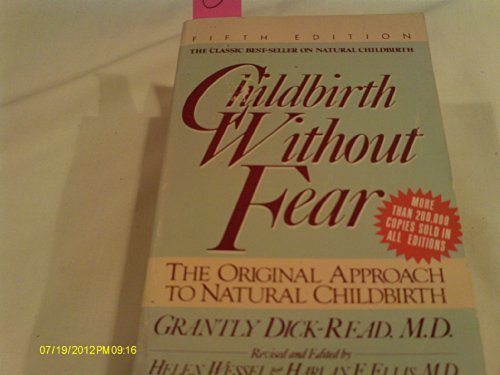
Grantly Dick-Read developed his central argument through clinical observation of women in labor at a time when obstetric intervention was becoming the default framework for birth in Western medicine. What he saw repeatedly was a pattern he called the fear-tension-pain cycle: women who approached labor with fear, absorbed from cultural messaging and clinical environments designed around pathology, experienced muscle tension that amplified pain, which deepened fear, which tightened muscles further. Women who approached labor with knowledge and confidence consistently experienced something qualitatively different. This audiobook, narrated by Claudia Dunn across just under eighteen hours, delivers Dick-Read's still-relevant argument to a contemporary audience that has accumulated decades of additional medicalization since he first wrote it.
The persistence of this book is itself a kind of argument. Childbirth Without Fear has remained in print and in use by childbirth educators, midwives, hypnotherapists, and parents-to-be across multiple generations of obstetric practice evolution, which is an unusual longevity for any book in the birth education space. Reviewer B. Michelle Bailey, identifying herself as a professional birthing coach and instructor, recommends it specifically for those seeking naturalistic birth preparation, and the reviewer who is a hypnotherapist notes it as essential reading for that practice. These are not casual endorsements. They reflect a text that continues to do practical work in clinical and educational settings.
Breaking the Fear-Tension-Pain Cycle With Evidence
Dick-Read's approach is empirical rather than ideological, which is one reason the book has lasted. He does not argue that all medical intervention in birth is harmful or that women who choose or require obstetric support have failed. He argues that fear is a physiological factor with measurable effects on labor progress and pain experience, and that education can address fear in ways that pharmacological pain management alone cannot. That distinction, between reducing fear and managing pain after it has produced tension, is the clinical heart of his contribution.
The chapters devoted to unpicking the root causes of fear in pregnancy and childbirth are the book's most valuable section for contemporary readers. Dick-Read identifies cultural inheritance, clinical language designed for pathology management, inadequate preparation for the physiology of labor, and the isolation of birthing women from experienced support as compounding factors. Each of these remains a recognizable feature of contemporary maternity care in varying degrees, which explains why the book's diagnosis retains its relevance even where obstetric practice has evolved considerably since Dick-Read's era.
Claudia Dunn Finds Heart Without Sentimentality
Dunn's narration is a significant asset for this particular text. Dick-Read writes with what the synopsis accurately describes as "overwhelming heart and empathy," and a narrator who fails to find that register transforms his careful clinical observations into something detached and abstract. Dunn does not make that mistake. Her pacing through the longer theoretical passages is steady and grounded, and she finds the emotional weight in Dick-Read's case histories and clinical reflections without sentimentalizing them. For listeners using this as preparation rather than professional development, the warmth Dunn brings to the narration matters as much as the accuracy.
The audiobook format also suits this material for its primary audience, expectant parents and birth professionals, because it allows engagement during circumstances where reading is impractical. Dick-Read writes accessibly enough that the text works in audio without requiring reference to diagrams or clinical notation. At nearly eighteen hours, it is a substantial preparation resource, but one that can be broken across weeks of listening without losing coherence, since the argument builds chapter by chapter rather than requiring sustained uninterrupted attention.
Breastfeeding Chapters Extend the Argument Postpartum
Dick-Read's historical context shapes his language in ways contemporary readers will notice, particularly in his framing of women's social roles and some of the cultural assumptions embedded in his clinical observations. These moments are worth noting rather than ignoring: they are part of how a mid-twentieth century physician understood birth, womanhood, and society, and tracing them gives the text intellectual texture beyond its core argument. None of them compromise the central clinical insight about fear and physiology, which stands independently of its historical scaffolding.
The breastfeeding chapters are the least widely discussed part of the book but are among the more interesting from a historical perspective, showing Dick-Read extending his fear-tension argument into the postpartum period with the same methodical observation he brings to labor. Listeners preparing for new parenthood rather than solely for the birth itself will find these sections particularly valuable, and Dunn handles the intimacy of that material with the same matter-of-fact warmth she brings to the labor chapters.
Essential Background for Doulas and Hypnotherapists
This audiobook is well suited for expectant parents who want to understand the physiology of labor from a perspective that centers confidence and preparation over intervention management. Birth professionals, including midwives, doulas, childbirth educators, and hypnotherapists, will find it essential professional context regardless of their specific practice orientation. The reviewer who identifies as a hypnotherapist and calls it a must-read for that practice is pointing at something real: Dick-Read's fear-tension-pain model is foundational for any practice that addresses the psychological dimensions of labor.
Listeners who want a contemporary natural birth guide with current clinical evidence and updated cultural framing should supplement this with more recent resources. Dick-Read is foundational, not comprehensive of everything that has been learned since he wrote. As a conceptual framework and a historical document of the physiological argument, however, it retains a clarity that many successors have not matched.
- Narration: Claudia Dunn delivers Grantly Dick-Read's prose with a warmth and steadiness that suits its clinical empathy, making nearly eighteen hours of birth philosophy feel like companionable guidance.
- Themes: fear-tension-pain cycle in labor, the medicalization of birth, natural physiology and confident preparation
- Mood: Reassuring and quietly authoritative, grounded in decades of clinical observation
- Verdict: Grantly Dick-Read's foundational work on fear and childbirth remains a powerful argument for physiological confidence, and Dunn's narration makes it accessible as both preparation and professional reference.
Is the Childbirth Without Fear audiobook current enough to be useful for contemporary birth preparation?
The core argument about fear, tension, and pain in labor is clinically durable and remains foundational in natural birth education. Some of Dick-Read's cultural framing reflects its historical moment, but the physiological model he describes has been consistently supported by subsequent research. Birth professionals continue to recommend it alongside more current resources.
Does the Childbirth Without Fear audiobook cover breastfeeding, or only labor?
The book extends Dick-Read's fear-tension argument into the postpartum period, including dedicated chapters on breastfeeding. Listeners preparing for the full new parenthood experience rather than solely for labor will find these sections a natural continuation of his central argument about confidence and physiological function.