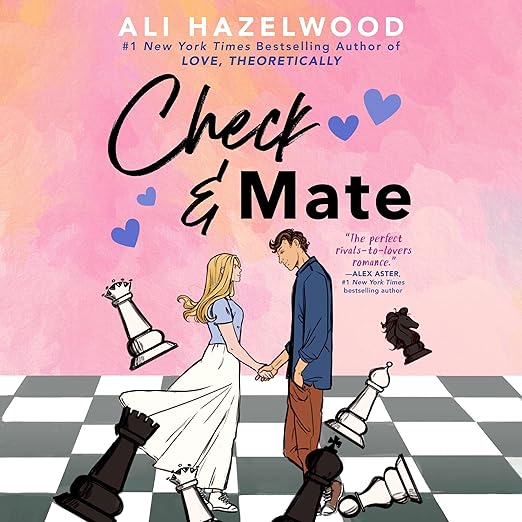
Sports romance usually asks you to care about a body in motion. Check & Mate asks you to care about a board, which is a harder sell and the reason Ali Hazelwood's first young adult novel is more interesting than its logline suggests. Listening Library published the audiobook in November 2023, nine hours and thirty-one minutes with Karissa Vacker credited as the reader, and it arrived off the back of Hazelwood's adult bestsellers. Mallory Greenleaf has quit the game before the story starts. The book's whole job is making you want her back at the table.
Hazelwood builds this on a debt rather than on a meet-cute. Chess destroyed Mallory's family four years before the book opens, and what she has instead is a dead-end job that keeps the lights on, a mother, two sisters, and a resolve not to touch a board again. One charity tournament breaks that, and she beats Nolan Sawyer, the reigning world champion the copy nicknames Kingkiller. The romance grows out of a competitive humiliation rather than out of attraction, which gives the first act a spine that most opposites-attract setups lack.
A January 2024 five-star names the tension in the shelving before anyone else does: the leads are eighteen and twenty, the conversations are adult, and the classification still reads young adult. That same response volunteers two useful things, that it does not usually read YA and loved this anyway, and that it knew nothing about chess going in and came out feeling included. Both admissions point at the same strength, which is that Hazelwood teaches the game through character pressure rather than through instruction.
Closed-door is the register, and it changes the physics of the book. Without explicit scenes to release pressure, every advance has to happen in dialogue and in what the two of them do across a table, so the slow burn is structural rather than decorative. Readers arriving from the author's adult titles should recalibrate before starting. The wit survives the crossing intact; the heat does not, and the book is better built for the audience it was actually written for than for the one that followed the byline.
The Strengths
The caretaking thread is what lifts this above tournament romance. An April 2024 four-star lays out the shape plainly: an eighteen-year-old holding a household together, two younger sisters, a mother who needs her, and a love of the game buried out of sight. That entry also praises an unapologetic female lead, though its sentence breaks off before it says what she was unapologetic about. What survives the cut is the priority order, family first and ambition smuggled in behind it.
Hazelwood's crossover instincts are the second reason. The description sells this as a young adult debut from the writer of The Love Hypothesis, and what carries over is competence as attraction: two people who are unusually good at one specific thing, watching each other be good at it. Teen and young adult is the only shelf the record uses, with no tag under it, which undersells how much of the appeal is aimed at adults who read romance and want a break from the bedroom.
A September 2024 five-star gives the clearest short account of the effect, calling it sweet and enchanting, crediting the slow-burn chemistry and the signature humor, and landing on emotional depth as the thing that stayed. Worth noting that the same entry writes the title as Check and Mate, spelled out, which is how a fair number of listeners will search for it. The record uses the ampersand. If a store lookup comes back empty, that punctuation is usually why.
What to Watch For in Check & Mate
Star lines deserve a second look here. A Spanish-language response filed in February 2026 carries four filled stars and one empty one in its own headline, while the grade attached to it on the page reads five. Two of the five visible entries are not in English at all, the other being written in German, so the average a browser sees is pooled across editions and languages. None of that makes the enthusiasm false. It does mean the number is doing less work than it appears to.
Then the format question, which this book raises more sharply than most. Not one of the five responses describes the reading itself, so the recording arrives unreviewed. More particular to this title: the description's jokes are typographic. A rook-ie who wipes the board, a parenthetical that swerves from fierce to fiercely attractive mid-word, a resign and game over gag set as stage directions. Those land on a page for the eye. Whether they land in a voice is exactly what the sample is for.
Content weather is worth checking too. Nothing on the record carries a note, and the premise is a family the sport destroyed four years earlier, a teenager working a dead-end job to keep the lights on, and a return to the thing that hurt her. The romance is light; the ground under it is not. Younger listeners who are handed this because of the shelf label will meet more grief and more financial fear than the cover category prepares them for.
Recommended For
This suits listeners who want longing without explicit content, and who like watching two clever people negotiate through a shared discipline. It suits chess-curious readers particularly well: the German-language response arrived here after reading only Bride, praises the writing and the way both leads develop, and reports finishing with a better feel for the game than it started with. That is a specific and repeatable outcome, and it is the strongest single argument for putting this in a teenager's ears.
Give it a pass if you want spice, because the book is deliberately built without it. Give it a pass if tournament plots bore you regardless of who is playing, since the competitive ladder supplies most of the structure. And approach with care if the setup, a household held together by a teenager after a family rupture, sits close to your own year. The prose is warm about all of it, which helps, but warmth is not distance.
Settled on the page: a short file, one credited voice, and a closed-door romance under a young adult label with two leads who are legally adults. Left open is the thing a chess novel can never quite hand you in audio, which is the board. You cannot glance back at a position, and the puns that make the copy sparkle were designed for eyes. Sample it before you buy, then let Mallory talk you into the game the way she gets talked into it.
Before You Listen
Is the Check & Mate audiobook suitable for younger teens?
Teen and young adult is the only shelf the page uses, and the romance stays closed-door throughout. The harder material is emotional: a family the sport destroyed four years earlier, a mother and two sisters depending on her, and a teenager working to keep the lights on. Confident middle-school readers will manage; sensitive ones may want company.
Do I need to know how chess works to follow this audiobook?
No. The game is taught through pressure rather than through notation, and the copy's own chess vocabulary runs to a gambit, a resignation and a couple of puns. The tournament ladder does the structural work instead. What you lose in audio is the ability to see a position, not the ability to follow one.