
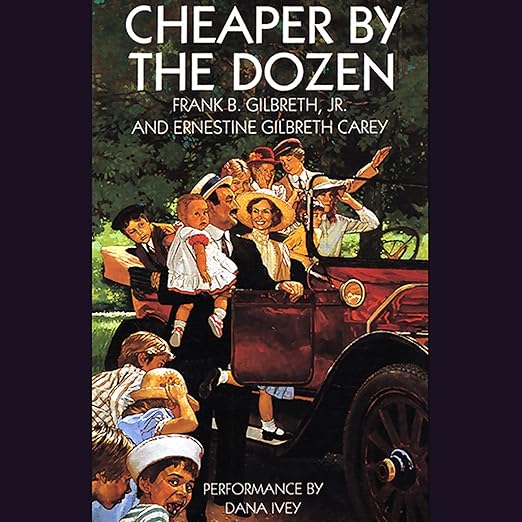
Key Details
- Narration: One credited voice, Dana Ivey, for a cast of fourteen across six hours and four minutes.
- Themes: Family memoir, industrial efficiency brought home, sibling logistics, period American optimism
- Mood: Brisk, affectionate, faintly museum-lit
- Verdict: A durable household comedy worth the short runtime, as long as you ignore the star bar.
Twelve children, one efficiency expert father and one psychologist mother, all living inside a house run on stopwatch principles: Cheaper By the Dozen reads like a sitcom pitch until you notice who is telling it. The audiobook runs six hours and four minutes and comes from inside the household, written by people who grew up as the test subjects of their own parents' research. Dana Ivey holds the credit for the reading. What the product page never quite makes clear is how much of the comedy depends on that inside position, and how much of the rest of the listing can be trusted.
How Cheaper By the Dozen Holds Up
The Gilbreths were not amateurs playing at organization, and the copy assumes you already know that. A five-star response from August 2015 supplies the background the description leaves out: Lillian and Frank Gilbreth were time and motion study experts in the early part of the twentieth century, Frank came to the field without a college education and was very outgoing, Lillian was the more introverted of the pair and eventually earned a doctorate, and the twelve children were a decision taken before the first of them arrived, six boys and six girls by design. Knowing that changes the register of every set piece the copy advertises. A whole clan having their tonsils out at once, a first date conducted with a father sitting in the backseat, a son left behind at a roadside restaurant: none of it is household chaos. It is a system, applied at home by two of the people who built it for industry.
Where the page turns slippery is the credit line. The author field reads Frank B. Gilbreth, and one of the episodes the description advertises is how Frank Jr. gets left behind at that restaurant, so the same name sits on the page in two roles with nothing to separate them. A browser cannot tell whether the credited writer is the father the book is about or a son who lived through it, and the collective voice the book uses, a family remembering together, suggests more hands than a single byline can hold. The shelving compounds it: the genre field says teen and young adult while the tags call the same title biography and lifestyle, and the recording itself dates from October 2003.
Why Cheaper By the Dozen Works as an Audiobook
Durability is the honest argument here. The oldest response on the page, five stars in February 2015, describes first reading the book as a young teenager and coming back to it decades later, still finding it humorous, well written and appropriate for all ages, and singling out how the household worked together, kept itself orderly and still managed what that account calls fantastic adventures. Books that survive that kind of gap usually do so because they are built on incident rather than on style, and this one is nothing but incident. Every chapter is a self-contained operation: a plan, a deployment, and a result the plan did not anticipate.
Six hours and four minutes is a lot of household to move through one throat. Fourteen people live in this book and the comic engine is interruption, with children talking across each other, parents issuing rulings and a family council taking votes. The reading is credited to Dana Ivey, and what the material asks of any single voice is timing rather than impersonation, because the laughs sit in the deadpan of a father who schedules the whole clan's tonsillectomies for one morning. Four of the five signed responses name the format they came through, and every one of those is a reading format: aloud to children, on an e-reader, and in repeat readings stretched across thirty years. The verdicts stacked under the star bar are reading verdicts, one and all.
Weak Spots in Cheaper By the Dozen
The optimism in this book is period optimism, and one of its warmest admirers says so. The newest voice here, a five-star from June 2025, credits the book with capturing the spirit of America before the First World War, and notes that it radiates a belief that progress is inevitable and the world perfectible, a belief the same response concedes may seem helplessly naive to us today. That reading is fair. Efficiency applied to human beings has a history the book does not know it is standing at the front of, and a modern listener will hear the father's experiments differently than the book's first readers could. The children here are also the book's authors, which means the affection is genuine and the critical distance is simply not on the menu.
Then the numbers. The star bar reads 4.6 from two ratings, while five separate signed responses sit underneath it, which is three more people than the counted population allows. The visible grades run five, five, four, five, five, so the writing on this page averages higher than the figure printed above it rather than lower. Whatever those two counted votes are, they belong to a population the listing does not show you, and the average is not a summary of the reviews you can actually read. The four-star adds a small note of its own, saying it would have gone to four and a half if the scale had allowed halves, which is a reader trying to be precise on a page where precision is not available.
The Right Listener for Cheaper By the Dozen
Take this one if you want a family comedy with an unusual spine: a memoir of childhood written by people who were also the data. Six hours is a comfortable single-weekend length, the episodes are self-contained enough to survive interruption, and the household logic stays interesting whether or not you care about industrial engineering. It suits a household listening together too, with a caveat: the humor belongs to the early twentieth century, the mother's career sits at the edges of a book told by the children, and the episode the copy calls treeing a peeping Tom is played entirely for laughs.
Give it a pass if you want the parents' work examined rather than celebrated, or if you want a reckoning with what efficiency thinking did once it left the Gilbreth dining room. Pass on it too if you buy on recorded evidence, because everything written under this listing was written about the book on the page. What you get instead is a durable piece of comic reporting, a short runtime, and a group of readers who keep returning to it across decades.
Before You Listen
Does the Cheaper By the Dozen audiobook work for a family listening together with younger children?
Mostly. Six hours and four minutes splits neatly into self-contained episodes, and the mass tonsillectomy and the roadside restaurant are built for shared laughing. Two cautions: the humor and the household attitudes belong to the early twentieth century, and the peeping Tom episode the copy advertises is treated as another family adventure.
Does the audiobook cover the whole series or only this volume?
Only this one. The series field marks it as the first title in the Cheaper by the Dozen Series, and the recording runs six hours and four minutes, a single-volume length. Nothing in the listing bundles a sequel, and no second title is named anywhere on the page.
Is the audiobook a single-reader recording or a full-cast production?
A single reader. The listing credits Dana Ivey alone for the full six hours and four minutes, covering a household of fourteen, so the twelve siblings are separated by one voice rather than by casting. If you came expecting a dramatized family memoir with multiple performers, adjust before you press play.







