In Brief
- Narrator: Adam Verner keeps the emotional register honest, letting the Southern warmth come through without overselling the sentiment.
- Subjects: Foster care, identity, the weight of unasked questions, and what it costs to finally ask them.
- Tone: Warm and quietly aching, built for long drives or slow evenings.
- Bottom line: A well-constructed Southern healing novel that earns most of its hope, with an ending that plays it safer than the setup demanded.
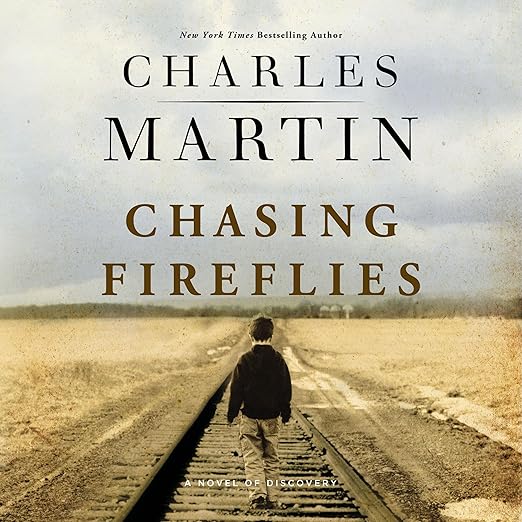
The summer evening Chase Walker first sees the mute boy from the hospital window, something clicks loose in him that years of journalism had kept locked tight. This audiobook catches you in exactly that moment of suspension: a six-year-old clutching a battered notebook, refusing to speak, found near the wreckage of a burning Chevy on the outskirts of a Southern town where a train erased every secret the driver had. Charles Martin sets Chasing Fireflies in motion with a detail that feels both devastating and precisely observed, and Adam Verner's narration holds that tension from the first chapter onward.
Where This One Lands
Charles Martin is the kind of Southern novelist who writes warmth without sentimentality, at least until the final chapters. Chasing Fireflies pairs a present-tense mystery, who is this silent boy and why was he pushed from that car, with Chase Walker's buried past in the foster care system. The pairing works because Martin never lets either thread feel like decoration for the other. Chase's assignment to cover the story becomes an excavation of his own childhood, and the McFarland family of Willie, whose impoverished but fiercely proud household frames much of the novel's Southern texture, gives the book its emotional anchor outside of Chase himself.
The result is a novel that functions partly as a healing narrative and partly as a Southern Gothic mystery, though 'Gothic' overstates the darkness here. Martin writes toward hope. He earns most of it. The journey through Chase's forgotten early years unfolds at a careful pace, revealing the source of his disconnection from his own story through encounters that feel rooted in place and character rather than plot convenience. The Willie McFarland subplot in particular carries real weight, showing the shame and pride of poverty with specificity that elevates the book beyond its genre conventions.
Adam Verner's delivery suits the material well. He keeps the emotional temperature low enough that the moments of feeling hit with genuine force rather than feeling orchestrated. His handling of child characters and older Southern voices alike is assured, and he knows when to slow down and when to let a scene breathe. A narrator who oversold this material would ruin it; Verner mostly does not oversell anything.
Why Chasing Fireflies Works as an Audiobook
The listening experience rewards patience. Martin structures the novel so that revelations arrive organically rather than through manufactured suspense, and Verner's pacing reflects that structure. If you have been burned by Christian fiction that announces its message before delivering its story, Chasing Fireflies is more restrained than that. The faith element is present but not foregrounded in a way that crowds out the human questions the novel is actually asking.
At just over ten hours, this is a single-weekend listen or a comfortable week of commute sessions. The Southern setting, the specific geography of the railway, the summer heat, the way the McFarland farm smells and sounds, is rendered with the kind of sensory specificity that makes audio fiction work better than a quick summary. Martin has written a novel that benefits from being heard rather than skimmed.
Listeners who responded to his earlier novels, particularly When Crickets Cry, will recognize the architecture here: a man with a secret wound, a child who forces the wound open, a community that either helps or hinders the healing. That template is present, but the mute boy's specific circumstances, the notebook he will not release, the question of who kicked him out of that car before the train hit, give this iteration of the Martin formula enough of its own texture to stand alone.
What Gives Us Pause
The ending has divided readers. Several reviewers note that the resolution arrives tied too neatly, with loose threads gathered into a bow that the book's earlier tension did not quite earn. That observation is fair. Martin is a writer who trusts his readers to accept comfort as a valid destination, and some will, but listeners who prefer ambiguity in their resolutions will feel the finale over-explains what had been effectively implied.
The pacing in the middle section also occasionally stalls. The mystery of the boy's identity is not developed at the same rate as the emotional backstory, which means the novel occasionally feels like it has two rhythms running slightly out of sync. The boy himself, compelling as a presence, remains somewhat underdeveloped as a character compared to Chase, and some listeners may find that imbalance frustrating.
None of these caveats sink the book. They are worth naming because Chasing Fireflies is good enough to be worth reading critically rather than just recommending wholesale. A novel that plays it safe with its ending has not failed; it has simply made a choice. The question is whether you are the listener for whom that choice lands.
The audiobook's greatest asset beyond Verner's performance is Martin's specificity about place. The Southern setting is not generic; the novel's landscape carries the same weight as its characters, and the novel's titular metaphor works precisely because fireflies are both real and evanescent, the kind of thing children chase and adults remember chasing. That specificity of feeling, rooted in a particular geography and a particular kind of Southern summer, is what elevates Martin above writers who use the South as decoration. This is a novel that knows exactly where it is set and uses that knowledge at every level of its construction. The Willie McFarland thread in particular carries authentic period detail about the economics of Southern poverty that adds dimension to what could otherwise read as a simpler backdrop for Chase's personal story.
Should You Listen to Chasing Fireflies?
Listeners who responded to novels like The Help or A Man Called Ove, stories where an outsider disrupts a closed community and forces a reckoning, will find Chasing Fireflies a natural fit. Readers of Charles Martin's previous work will want this one. It is also well suited to anyone navigating questions of identity and belonging, the book's actual subject beneath its mystery surface, without needing those questions resolved in ways that leave scars. Clean fiction readers will appreciate the absence of graphic content. This is not a difficult listen emotionally, but it is a substantive one.
Questions Listeners Ask
Is the Chasing Fireflies audiobook suitable for listeners new to Charles Martin?
Yes, it stands alone without requiring familiarity with his other work, though fans of When Crickets Cry will recognize his signature approach immediately.
Does this audiobook deal with heavy subject matter involving children?
The premise involves a malnourished, mute child found near a fatal accident, and the novel addresses foster care and neglect with emotional honesty. It handles these subjects with care rather than graphic detail.
How does the audiobook handle the mystery element compared to the emotional storyline?
The emotional backstory of Chase Walker receives more development than the mystery of the boy's identity. Listeners seeking a tightly plotted thriller will find the pacing uneven; those drawn to character-driven narratives will find the balance rewarding.
Is this audiobook appropriate for faith-based listeners?
Yes. The faith dimension is present throughout but does not crowd out the human story. It is accessible to secular listeners while being clearly rooted in a Christian worldview.