
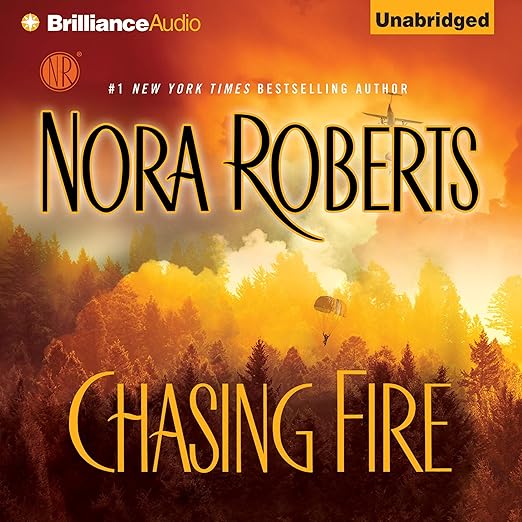
Smoke jumpers parachute into the edge of a wildfire, then dig and saw for days to hold a line, and the audiobook spends fifteen hours and ten minutes inside that job. Nora Roberts built Chasing Fire around the Missoula crew and around Rowan Tripp, who has been fighting fires since her eighteenth birthday and whose father is a legend in the trade. Rebecca Lowman reads it for Brilliance Audio, and the recording has to carry both the operational detail and the romance without letting either flatten the other.
Our Take on Chasing Fire
Occupational detail is what lifts this above standard romantic suspense. Roberts does the unglamorous parts properly: the hours of shoveling, the days at a time, the physical grind that follows the spectacular part everyone pictures. The response filed on September 25, 2011 gets at the same thing from another angle, using the crew's own word for themselves, Zulies, and describing Rowan as the tough and likable daughter of Iron Man Tripp before noting the rule she has built her life around, that she does not get involved with fellow jumpers or trainees. Written in the same season as the recording, that response calls this the latest novel by Nora Roberts, a description now fourteen years out of date on a page still selling the book.
Gulliver Curry exists to break that rule, and Roberts makes him more interesting than the assignment requires. A hotshot firefighter with a large vocabulary and a winter job at a children's arcade is a genuinely odd construction, and it works because the contradiction is never explained away. He came to Missoula chasing Rowan's father's reputation and reoriented on Rowan within about a day.
A suspense line runs underneath all of it. Somebody wants Rowan blamed for the partner she lost the previous season, and the threat escalates while she is doing a job in which distraction is lethal. That is a smarter integration than most romantic suspense manages, because the danger from the fire and the danger from the stalker compound each other rather than alternating. A threat that would be survivable in an office becomes lethal at the edge of a burn, and Roberts keeps that math in front of you.
Why Listen to Chasing Fire
Fifteen hours is a serious commitment, and this is a book that earns the length by teaching you a profession. Rebecca Lowman has to hold a large named crew apart in a story where several of them are in the same clearing shouting over the same fire, and then turn on a dime into scenes with two people and a lot of silence. The technical vocabulary is relentless and unglossed, so the reading carries the burden of making jump procedure legible on first hearing, without a diagram and without the option to reread a paragraph.
No response on the page speaks to that performance, which leaves the case for the recording resting on the material rather than on any listener's report. The material argues for it. Fire is a sound before it is a sight, the crew talk in overlapping shorthand, and the danger scenes are built from radio traffic and shouted instruction, all of which live more naturally in the ear than on the page.
A response filed on July 23, 2025 describes it as a fantastic read with a good story line and ends on being sad it was over, which is the reaction long-form Roberts is engineered to produce. Fifteen hours of company with a crew is the point, not an obstacle.
What to Watch For in Chasing Fire
Six ratings and a posted 4.6 do not fit together. That average cannot be produced by six whole-star votes: twenty-seven stars land on 4.5 and twenty-eight land on 4.7, with nothing in between. Whatever the 4.6 measures, six star ratings did not generate it, and in any case five written accounts sit below a counter of six.
Six counted ratings is itself the odd part on a novel the copy identifies as a number one bestseller, from an author with a catalog most readers could not exhaust. The counter is measuring something narrow, an edition or a storefront rather than a readership, and it should carry no weight in your decision either way.
Quirks run through the visible column too. The response filed on January 24, 2026 opens by misspelling the author's name outright, then calls this among the most suspenseful novels that reader has finished and praises the attention to detail, so the enthusiasm survives the typo. Every visible response uses reading language, so the format question is one you will have to settle for yourself.
Who Should Listen to Chasing Fire
Romantic suspense readers who want the professional world taken seriously are the core audience. The November 2025 five-star names storyline, character and setting in that order, which is the right order for this book, since the Montana season and the crew hierarchy do as much work as the pairing does. Anyone who reads Roberts for competence porn about a difficult job will be well served.
It also suits listeners drawn to wildfire and wilderness writing regardless of the romance. The training sequences, the jump procedure and the grind of holding a line are researched and specific enough to hold interest on their own, and the book is unusually willing to let a fire simply be a fire for long stretches.
Foregrounded suspense is the wrong expectation, because the threat against Rowan surfaces in pulses and spends long stretches offstage. Fifteen hours of ensemble cast also deserves thought, since the crew is large and the shorthand comes fast. Anyone who listens in short bursts will spend the first minutes of each session working out who is on the line again. Readers sensitive to grief and to on-the-job death should know the previous season's loss is present throughout rather than resolved in a chapter.
Questions Listeners Ask
How much of the Chasing Fire audiobook is romance versus firefighting?
The split runs close to even, with the job slightly ahead. Jump training, the Missoula crew hierarchy and long stretches of holding a fire line get real page time, and the pairing between Rowan and Gull develops inside that schedule rather than pausing it. The suspense thread takes the smallest share.
Does the listing's rating of 4.6 across six ratings make sense?
No, and it is worth settling before that number influences anything. Six whole-star votes cannot land on that average at all, and five written accounts sit beneath a counter of six. Treat it as a broken field on a novel the copy calls a number one bestseller, not as a measure of reception.
Is the firefighting jargon hard to follow in the audiobook?
It arrives fast and mostly unexplained, which is a real consideration over fifteen hours. Roberts teaches the trade through action rather than through definitions, so the first two hours ask the most. Once the crew and the equipment settle, the vocabulary stops being an obstacle.
Do you need to have read other Nora Roberts books first?
Not at all. This is a standalone with no series fields on the record and no connections to the rest of the catalog. The Missoula setting, the crew and the Tripp family history are all built from scratch inside these fifteen hours.







