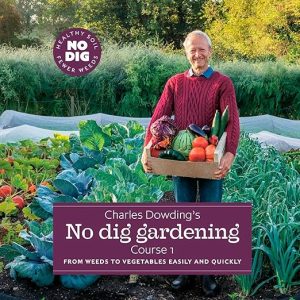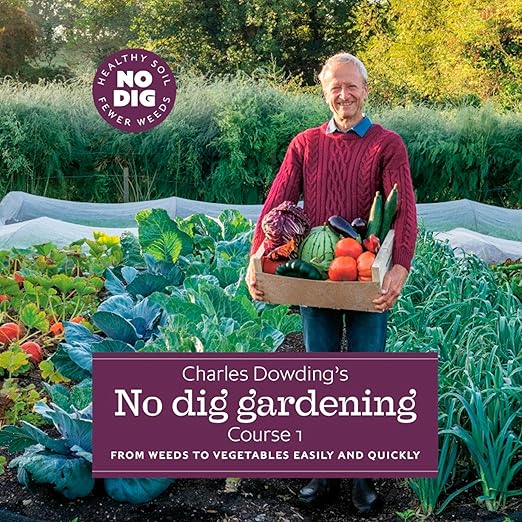
My relationship with the vegetable garden started the wrong way. For the first three years I dug it every spring, loosened the soil, watched the weeds come back within weeks, and assumed that was simply the unavoidable toll of growing food outdoors. I did not encounter Charles Dowding's work until a friend mentioned his YouTube channel over dinner, and I spent a weekend going down that particular educational rabbit hole. So when I found his Course 1 audiobook, I came to it already converted to the no-dig approach but genuinely curious about what ten hours of structured audio would add to what I had gathered piecemeal from video and articles.
The answer is: more than I expected. Dowding narrates his own material, and the effect of hearing the method explained by the person who has done more than almost anyone else to mainstream no-dig practice in the English-speaking world is significant. He has a farmer's directness and a teacher's patience for repetition that translates exceptionally well to audio format. He knows which mistakes his listeners are likely to make before they make them, and he addresses those mistakes proactively rather than waiting for questions he cannot receive in a recorded medium.
Active Soil Management Behind a Passive-Sounding Name
The title can be misleading to new gardeners, and Dowding is careful to address this directly early in the recording. No-dig is not a passive approach to growing food. It is a specific and active method of managing soil health by keeping the soil structure undisturbed and relying on surface compost application rather than mechanical intervention or chemical inputs. The eighteen sections of this course work through the reasoning behind this approach with a rigor that separates it from the looser gardening advice that circulates freely online.
Dowding traces a history of no-dig vegetable gardening over the last one hundred years that helps listeners understand why the method fell out of favor in the era of mechanized agriculture and why it has returned to serious consideration among both smallholders and larger operations. This historical context is not academic padding. It addresses the reasonable question any gardener will ask: if this method is demonstrably better for soil health, why has it not always been mainstream? The answer involves economics, scale, and a set of assumptions about what growing food is fundamentally for, and Dowding navigates it without becoming polemical or dismissive of conventional approaches.
Real Harvests From Dowding's Own Growing Seasons
The course structure covers site evaluation, bed and path creation, weed clearance through mulching, compost types and production, and detailed planting plans for small spaces. The planting plans are drawn from Dowding's own successive seasons of growing on specific plots, which gives them a credibility that hypothetical plans in most gardening books lack. He is reporting what he grew, how much he harvested, and how the no-dig method contributed specifically to those results, rather than extrapolating from general horticultural theory.
Reviewer Kate, who discovered Dowding through his YouTube channel before purchasing the audiobook, noted that his free content alone was sufficient to successfully grow a garden, and that the audiobook represents a more systematic version of what is available in fragmented form across his online output. That is an accurate description of the course's value proposition. It is not a revelation if you have already consumed his other work extensively. It is a consolidation and a deepening, organized in a logical sequence that builds from first principles through growing practice in a way that scattered video content cannot replicate. Reviewer Anne T described it as great common-sense information, and common sense delivered in a direct voice by someone who has lived the method for decades is exactly what this audio course provides.
Unpolished Narration From Gardening's Own Godfather
Reviewer MN76 called Dowding the godfather of no-dig gardening before purchasing one of his books, and that framing captures something about how his audience relates to him and why self-narration matters for this specific material. He has built his reputation over decades of documented practice and public education, and the audiobook format benefits substantially from that accumulated credibility. When he recommends a specific mulching depth or explains how to distinguish between different compost types and their respective uses, listeners familiar with his wider work accept those recommendations based on established trust. New listeners will find the explanations thorough enough to stand alone without the prior familiarity.
The narration is not polished in the way a professional audiobook production would be. Dowding is not a voice actor and makes no pretense of being one. He is a gardener explaining his method directly to someone who wants to know, and the slight informality of that quality is consistently a feature rather than a defect. The lack of theatrical delivery actually reinforces the book's central argument that no-dig gardening is fundamentally practical and unpretentious, that good results come from consistent simple methods applied with attention rather than from complicated interventions.
Existing Diggers Face the Switching Decision Here
Listen to this if you are starting a vegetable garden and want to begin with a coherent and well-tested method rather than assembling advice piecemeal from conflicting sources. Listen if you are an existing gardener who digs annually and wants to understand whether switching to no-dig is worth the transition investment in time and compost materials. Listen if you are a Charles Dowding follower who wants his most comprehensive audio treatment of the foundational principles in one place.
Consider a different resource if you are an advanced gardener already well-versed in no-dig principles looking for cutting-edge research or crop-specific deep dives into particular vegetables. The course is explicitly about fundamentals, and Course 1 of a series is exactly what its title suggests.
The Short Version
- Voice: Charles Dowding reading his own course material brings an authority and practical ease that suits the conversational teaching style throughout.
- Big ideas: Soil health and the no-dig philosophy, weed management through mulching, sustainable vegetable production from first principles
- Atmosphere: Calm and methodical, patient with fundamentals in a way that reassures beginners without boring experienced gardeners
- Worth it?: The most thorough audio introduction to no-dig gardening available, made considerably more useful because it comes from the method's most prominent practitioner.