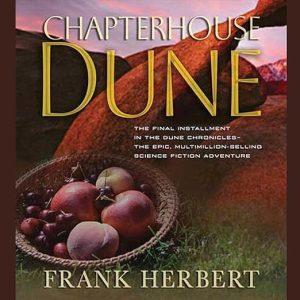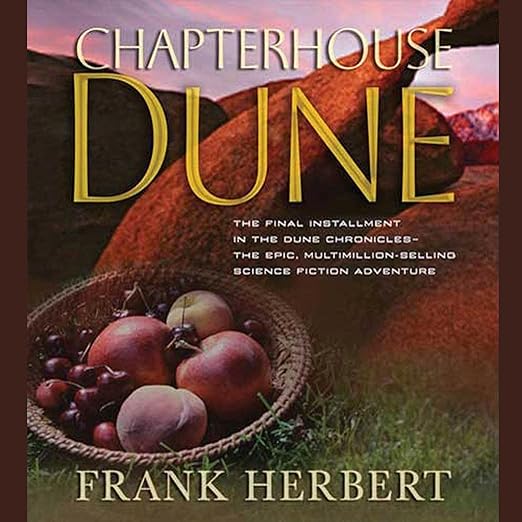
I finished Chapterhouse Dune on a Sunday evening after working through the series over several months, and the experience of arriving at a novel that ends mid-sentence, because Herbert died before completing what he intended as a two-book finale, is genuinely strange. It is a book that feels unfinished because it is, and yet what is here is among the most concentrated thinking in the entire Dune saga. That tension between incompletion and ambition is the thing you have to make peace with before you begin.
Euan Morton narrates the sixteen-plus hours with a stillness that suits the material. Chapterhouse Dune is, as one reviewer accurately described it, the most introspective novel of the series. Large sections unfold as internal dialogue. Characters process their circumstances through the accumulated layers of Bene Gesserit training, genetic memory, and political calculation. Morton tracks those interior shifts with care, and the narration never collapses into monotony despite the deliberate pace.
This is the sixth and final book Frank Herbert wrote in the Dune sequence, and it marks a significant departure from the action-driven plotting of the original novel. Where Dune moved through political intrigue and physical danger, Chapterhouse is primarily a survival narrative: the Bene Gesserit sisterhood, having lost Arrakis itself, are terraforming a new green world into desert mile by mile, recreating the conditions that produced the spice and the ecological power that sustained their order.
The Honored Matres, brutal descendants of the Bene Gesserit sent out during the Scattering and returned violent and corrupted, serve as the external threat. Murbella, an Honored Matre who was captured at the end of Heretics of Dune and is now integrating into the Bene Gesserit, is one of the most interesting points of view in the series at this stage. Her internal conflict between two forms of disciplined power is where Herbert's philosophical argument about the nature of control and transformation runs deepest.
Highlights
Because the density of Herbert's thought rewards the audiobook format in a specific way: Morton gives you time to process. Print readers can skim or rush; audio forces you to sit inside each paragraph. For a novel this concerned with how characters think rather than what they do, that slower rhythm is actually an advantage. One reviewer wrote that reading the series a third time surfaced things they had missed twice before, and the audiobook creates a comparable slowdown through different means.
The prose here is what multiple reviewers called visceral and vividly rendered, and Morton's voice finds the current beneath Herbert's often aphoristic sentences. The Bene Gesserit planning sequences, which could read as dry political calculation, become something closer to liturgy in the audio version.
Before You Commit to Chapterhouse Dune
New listeners should not begin here. This is emphatically book six of a sequence, and it assumes intimate familiarity with the political and theological history of the Dune universe accumulated across the previous five novels. Even readers who know the series well may find the opening hundred pages demanding as the post-Rakis situation establishes itself.
The ending is the other significant caveat. Herbert died in 1986 before completing what he planned as a duology. The novel ends with the protagonists escaping into the unknown, a cliffhanger that was never resolved in his lifetime. His son Brian Herbert and Kevin J. Anderson later wrote sequels to close the narrative, but these are contested additions. Listeners should know they are arriving at an intentional incompletion.
Is This One for You?
Dune series completists and readers drawn to philosophical science fiction will find this essential. It is not the place to start, but for those who have followed Herbert from the original through to this point, the novel rewards the investment with some of his most concentrated ideas about ecology, power, and the limits of human institutions. Not suited to listeners seeking action-driven space opera or those new to the series.
At a Glance
- Read by: Euan Morton handles Herbert's dense, introspective prose with intelligence, finding the internal rhythms of a novel that lives largely inside its characters' minds.
- At its heart: survival and transformation, the corruption of power, ecological devastation as deliberate strategy
- Vibe: Brooding and cerebral, carrying the weight of a series at its end
- Short version: The final book Herbert completed is also one of his most inward-looking, and Morton's narration gives it the patience it demands.