
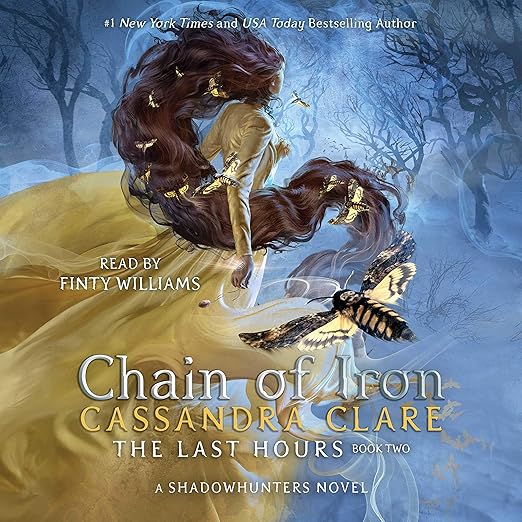
I will confess that I approached Chain of Iron as someone who had not read Chain of Gold first, which turned out to be a mistake I quickly diagnosed and then committed to fully anyway. By hour three I had enough context from Clare's immersive Edwardian London to track the major relationships, and by hour five I had stopped needing to reconstruct what came before because the present tense drama was sufficient to carry me forward. That is a testament to how fully Clare renders her world, even for readers who are not coming in with the full background.
The novel is set in 1903 London, where Shadowhunters, half-angel warriors who police the boundary between humans and demons, are being killed by a mysterious entity that leaves no trace. Cordelia Carstairs is the primary POV, engaged to James Herondale in an arrangement that was designed to save her reputation rather than to reflect what either of them actually feels. James is in love with Grace Blackthorn. Cordelia is in love with James. Her sword Cortana, which should mark her as a legendary hero, burns her when she holds it. And someone is killing Shadowhunters with a method that looks, uncomfortably, like James himself might be responsible.
The Verdict, Briefly
Clare is, as one reviewer accurately observed, a character-first writer. The serial killer plot is structurally present and serves its purpose, but it is not the reason you listen to this book for 23 hours. The reason is the impossible geometry of who loves whom and cannot say so, and the multiple secrets that each main character is actively concealing from the others. There are three significant hidden agendas running simultaneously across the central trio, and Clare orchestrates them so that the reader always knows slightly more than the characters do, which is precisely the condition required for dramatic irony to sting.
Why Listen to Chain of Iron
Finty Williams has been narrating Clare's Shadowhunters books for long enough that she has developed a fluency with the material that serves the listener well at this length. The Edwardian register of the dialogue, which could become arch or stilted, lands comfortably under her narration. She handles the emotional register shifts between action sequences and the quieter, more devastating moments of unspoken feeling with a consistency that matters a great deal across 23 hours. The pining, which is the engine of this book and which one reviewer described as enough to destroy a person's soul, is rendered not as comedy but as genuine suffering. That interpretive choice is correct for this material.
Points to Consider
The three secrets Clare is concealing on behalf of her three protagonists are each revealed at carefully staged intervals, and each revelation changes your understanding of what you have been hearing. Lucie's attempt to raise the dead is the most plot-significant. Cordelia's oath to a mysterious power is the most philosophically troubling. James's possible connection to the killings is the most emotionally costly. Clare times these reveals with the skill of someone who has been writing long series for a long time. Also worth noting: some reviewers felt that certain characters acted inconsistently in the middle sections of the book. That frustration is understandable, though what reads as inconsistency is usually a character under pressure doing something they would not do in a calmer state, which Clare treats as a feature rather than a flaw.
Should You Listen to Chain of Iron?
Established readers of the Shadowhunters universe who have completed Chain of Gold should simply start immediately. Everyone else should read Chain of Gold first, at minimum, and ideally should have some familiarity with the wider universe. The book does not function as a standalone entry point. Its emotional payoffs depend on investment in relationships that were built elsewhere. Listeners who commit to the appropriate entry point will find this a rich and consuming listen. Those who bounce off Clare's style in the first few hours should accept that this particular author's approach is not for everyone, and that is entirely fine.







