In Brief
- Narration: Kendi narrates his own research with first-hand authority; reviewers describe the twenty-hour runtime as surprisingly fast paced.
- Themes: great replacement theory, global authoritarian politics, ideological history
- Mood: Urgent and argumentative, built on documented case studies
- Verdict: A demanding but well-structured listen for readers already invested in Kendi's work, not a neutral primer for listeners wanting both sides argued equally.
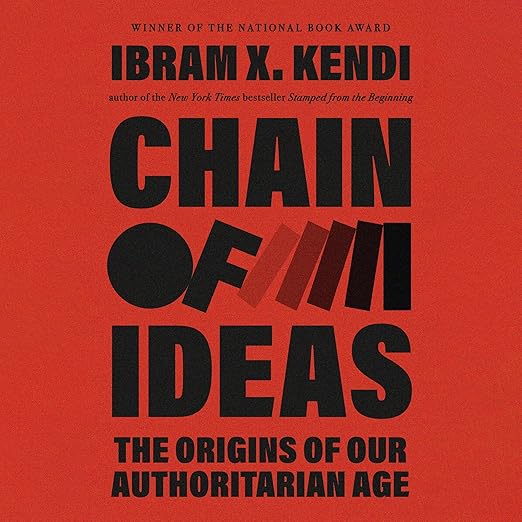
Twenty hours is a serious commitment for any nonfiction audiobook, and Chain of Ideas spends nearly all of them earning it. Ibram X. Kendi, the National Book Award-winning author of Stamped from the Beginning and the bestselling How to Be an Antiracist, narrates his own global history of great replacement theory, tracing the idea from a 2011 book by a French novelist through Charlottesville chants, a string of mass shootings, and a growing list of national governments that have absorbed some version of its logic. The scale is genuinely global, moving through the United States, Russia, El Salvador, Brazil, Italy, and India, and Kendi's own framing throughout is that this once-fringe theory has become one of the defining ideas shaping this authoritarian political moment.
Renaud Camus and a 2011 Book's Long Reach
Kendi traces the term to a 2011 book by French novelist Renaud Camus, who argued that Black and Brown immigrants were, in his words, invading Europe. From there, in Kendi's telling, the idea migrated and mutated: American and European politicians repackaged it as a story about globalist elites, migrant criminals, and demographic replacement targeting White populations, then widened further to include claims about threats to Jews, Christians, heterosexuals, and various national majorities. One reviewer, identifying themselves as an academic historian of anti-racism, corroborates the throughline directly, naming Renaud Camus by name as the theory's originator and confirming that Kendi's account tracks the idea's real documented spread rather than inventing connections between unrelated events.
Oslo to Pittsburgh, Each Its Own Link
The book's structure follows the same city-by-city, incident-by-incident method Kendi used in Stamped from the Beginning, anchoring the larger argument to specific, named events rather than staying at the level of abstract theory. Oslo, Christchurch, Buffalo, El Paso, and Pittsburgh are not treated as an undifferentiated list of tragedies; each gets its own place in the chain the title refers to, connected forward and backward to the political rhetoric that preceded it and the rhetoric it went on to influence. That case-by-case rigor is a hallmark of Kendi's earlier historical work, and one reviewer draws the connection explicitly, noting the same root-tracing method carried over from his prior books into this new, more explicitly global subject.
Kendi's own voice reading his own argument is a genuine asset here, not just a marketing choice. He has spent his career researching exactly this kind of ideological history, and hearing the case made in the voice of the person who assembled it lends the narration a kind of first-hand authority a hired narrator, however skilled, could not fully replicate. One reviewer calls Kendi 'an auto-queue author for me,' meaning they requested the audiobook sight unseen based on his track record alone, which speaks to how much trust his prior books have built with returning listeners. None of these reviews critique his vocal delivery specifically, but the pacing across a twenty-hour history clearly did not exhaust listener patience.
Fast-Paced Despite Being Anything but Succinct
As the Los Angeles Times put it in a cover blurb reproduced in the audiobook's own description, 'Kendi argues brilliantly that we must work across race and class lines to eradicate social ills and eliminate fascism.' That framing captures the book's ambition: this is not a narrow case study of one conspiracy theory but an attempt to explain how a single idea, born in one novelist's book, became a load-bearing part of authoritarian politics on five continents. One reviewer writes that the book 'transitioned from a fringe notion to a major worldwide political influence.' That is exactly the arc Kendi spends twenty hours documenting, chapter by chapter, region by region.
Despite the length, one reviewer notes 'though this book is NOT succinct, it's so fast paced,' which matches the structural choice Kendi makes throughout: short, tightly focused chapters rather than one sprawling argument, each one anchored to a specific country, shooting, or political figure before moving on. That structure suits audio well, since a listener always has a clear unit of material to hold onto rather than an unbroken lecture. The same reviewer notes the sheer amount of research is obvious throughout, and that shows in how many distinct national case studies Kendi manages to cover without the book ever feeling like a list.
Named Among the Year's Most Anticipated Books
Chain of Ideas was named one of the most anticipated books of its year by outlets including the New York Times, Oprah Daily, LitHub, Foreign Policy, and The Millions, which signals real anticipation ahead of release rather than a quiet niche title. That attention is worth knowing about going in, since it means the book arrives with expectations attached, both from Kendi's existing readership and from critics watching to see how his approach to this specific, more overtly political subject compares to his earlier work on race in America specifically.
The subject matter is inherently contested political territory, and Kendi does not write from a neutral remove, nor does the book pretend otherwise. Listeners should know this is an argument against the spread of a specific, real ideology tied to documented violence, not a dispassionate academic survey weighing competing views on its merits. The book's own synopsis names the connection between the theory and mass shootings directly, and Kendi builds his case on that documented record rather than speculation, but readers seeking a value-neutral history of the idea, as opposed to a case against its spread, should adjust expectations accordingly before starting.
Kendi is also, by his own public profile, a genuinely polarizing figure to some listeners well before they hit play, and that reputation will likely shape how this book gets received more than the actual content does for a portion of the audience. That reaction says more about the current political moment than about the book's own rigor, but it is worth naming plainly rather than pretending the audiobook will land the same way with every listener regardless of what they already think of its author.
Twenty Hours Paced Across Weeks of Commutes
This lands best with existing Kendi readers, and with anyone trying to understand how one novelist's 2011 argument metastasized into language now used by mainstream political figures across multiple continents. The twenty-hour length is a real ask, but the chapter-by-chapter structure and Kendi's own steady narration make it a manageable one, especially for listeners who already know how to pace his denser books across a week or two of commutes rather than trying to finish in a single sitting.
A book that steelmans the theory's proponents on their own terms, or that treats the subject as open to genuine debate rather than documented harm, will not be found here, and that is worth knowing before committing twenty hours. This is Kendi writing and narrating from a clear point of view, built to persuade rather than simply survey, and it is most rewarding for listeners who come in already interested in how ideas travel from the margins into mainstream politics rather than looking for a strictly balanced accounting of the theory's defenders and critics.
Questions Listeners Ask
Does Ibram X. Kendi narrate the Chain of Ideas audiobook himself?
Yes. Kendi reads his own book, the same way he has narrated his other major titles, which gives the twenty-hour argument a first-hand quality a hired narrator would not carry.
Is this audiobook a neutral history of great replacement theory or an argument against it?
It is an argument. Kendi documents the theory's spread and its ties to real political violence, and he writes from a clear point of view rather than presenting a value-neutral survey of competing views.
Is twenty hours a lot to commit to one nonfiction audiobook?
It is substantial, but the book is organized into short, focused chapters built around specific countries and events, which makes it easier to break into manageable listening sessions than the runtime alone suggests.