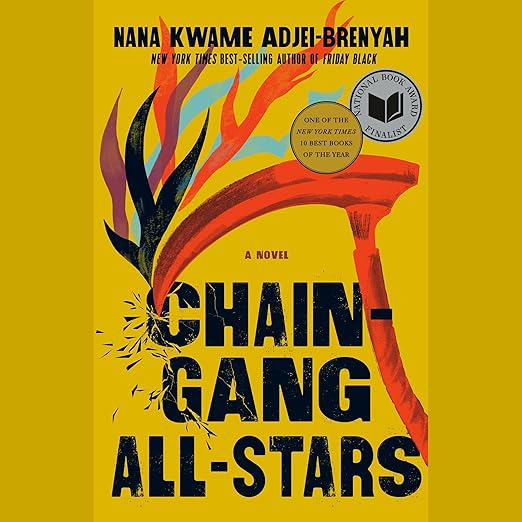
Eight separate publications get named as calling this a Best Book of the Year in the synopsis alone: The New York Times, The Washington Post, NPR, Elle, Esquire, Chicago Tribune, Lit Hub, and Kirkus Reviews, before Stephen King's own cover blurb even enters the conversation. This audiobook of Chain Gang All Stars arrives as a National Book Award finalist and New York Times bestseller, about as much literary-establishment weight as any title in recent memory. It is also, per its own synopsis, Nana Kwame Adjei-Brenyah's debut novel, following an earlier short story collection, Friday Black, that had already built a readership for that particular voice well before this specific book existed on any shelf.
What Nana Kwame Adjei-Brenyah Delivers
Thurwar and Hamara "Hurricane Staxxx" Stacker headline a cast that the synopsis describes moving "from the Links in the field to the protestors, to the CAPE employees and beyond," a kaleidoscopic structure that mirrors the private-prison-as-entertainment system it critiques. Stephen King's blurb doesn't hedge: "This book is so good. Brutal subject matter, beautiful writing. This one is from the heart." That is blunt enough to work as both a content warning and a recommendation inside the same three sentences. Tommy Orange's own cover praise, quoted in the synopsis, calls Adjei-Brenyah "a new and necessary American voice," a claim the book club attention and awards recognition both seem to back up in practice.
Patti's three-star review, the sharpest dissent among the visible ratings, still engages seriously with the book's ideas: a research scientist who "perfected the science of inflicting pain" in prison, a torture instrument called the Influencer, and gladiator spectacle framed as entertainment for a public that has apparently made peace with it. That is a notably substantive dissent, focused on craft and premise rather than a simple thumbs-down, and it reads as a genuine critique of the world Adjei-Brenyah builds rather than a complaint about pacing or length. Patti's own summary lands closer to admiration than rejection despite the middling score, describing the gladiator spectacle itself as "a comeback" the culture has apparently made room for.
What Nana Kwame Adjei-Brenyah Gets Right
One performer, Shayna Small, ends up carrying Thurwar, Staxxx, the Links, the protesters, and the CAPE employees the synopsis describes moving through in sequence, a wider vantage-shifting structure than a typical single-protagonist novel asks of a narrator. Not one review in this column brings up Small's performance, an absence worth naming here specifically because so much of what reviewers do praise, the "many layers" Traci C describes, depends on tonal control across that many distinct vantage points.
Critics reach for heavyweight comparisons on this one: The Washington Post's blurb likens the book's "dystopian vision" to Orwell's 1984 and Atwood's The Handmaid's Tale, both already-canonical dystopias, while reviewer Amirah C describes the experience more casually as "gladiators meets hunger games." Between the prize-committee language and a listener's plain description, both land on the same core comparison: recognizable dystopian machinery repurposed for a story about American incarceration specifically. Stephanie's review lands somewhere in between the two registers, calling the setup "WWE for prisoners" while still calling Thurwar and Staxxx characters that reviewer "will never forget."
Where Nana Kwame Adjei-Brenyah Loses Some Ground
Shannan's review adds a useful outsider perspective: "I'm normally not a dystopian type of reader," borrowing an audio copy from the library rather than seeking the genre out, and still coming away "pleasantly surprised." That is a different kind of endorsement than enthusiasm from an already-converted dystopian reader, evidence the book's appeal extends past its own genre's built-in audience. The same review admits to being "a little confused" by parts of the plot despite the overall positive reaction, a fair warning that this is not always an easy book to track scene to scene, especially with the perspective shifting as often as the synopsis promises it will.
Literary-prize pedigree this heavy can occasionally signal a book more admired than enjoyed, but Traci C's five-star review pushes back on that assumption directly, describing marking up the book "with so many dogears" tracking footnotes and character details worth revisiting. The 4.2-star badge sitting across six votes reads as consistent with that split: readers here are engaged and thinking hard about the book, working through footnotes and structural choices rather than skimming for plot, not uniformly rating it a perfect score along the way.
Who Should Pick Up Chain Gang All Stars
Book club readers and literary fiction fans comfortable with graphic violence in service of social critique are the clearest audience, especially anyone drawn to Adjei-Brenyah's debut short story collection, Friday Black, and curious how that same voice and sensibility scale up to a full-length novel format. The prize attention and its "Read With Jenna" book club pick status both suggest this crossed well beyond a niche science fiction audience despite its speculative premise, landing instead on mainstream literary-fiction shelves and best-of lists that rarely reach for anything speculative at all.
Genre-averse readers who typically skip dystopian fiction entirely should still seriously consider making an exception for this specific one, per Shannan Harper's own account of finding far more depth here than the genre label alone initially suggested going in. Prison-system critique, media spectacle, and the year's most decorated debut novel all wait here for anyone willing to sit with genuinely difficult, uncomfortable material, awards committees, major newspapers, and Stephen King's own cover blurb all included as backup for that decision.