Goehring's Clean Diction Suits Thirteen Chapters
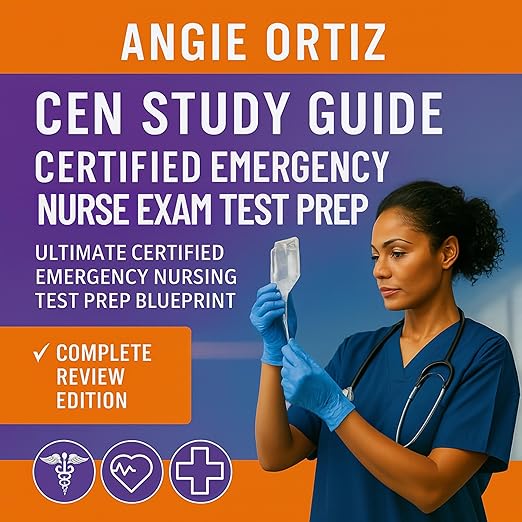
Nursing exam prep in audiobook format addresses a real logistical problem: emergency nurses rarely sit still long enough for traditional study sessions. Angie Ortiz, a nursing professional herself, designed this CEN Study Guide around that reality, structuring the content to work on a commute, during a workout, or in the fragments of downtime that characterize the schedule of a working nurse preparing for certification. Jon Goehring narrates with clean, unhurried diction that suits the clinical register, and the chapter-by-chapter organization maps directly onto the CEN exam's domain structure.
The Certified Emergency Nurse credential covers a broad span of clinical territory, and the table of contents here reflects that: thirteen chapters moving from cardiovascular emergencies through respiratory, neurological, gastrointestinal, genitourinary, endocrine, hematologic, toxicological, trauma, orthopedic, ENT and facial, psychosocial, and professional practice domains. Each chapter subdivides further to ensure complete coverage. For a nursing professional who knows this territory clinically but needs to systematize that knowledge for an exam context, the structural comprehensiveness is the product's main selling point.
Repeated Listening Reinforces Procedural Recall
The audio format has a genuine advantage for this kind of content. Clinical scenarios and intervention sequences benefit from being heard rather than read; the ear often retains procedural sequences differently than the eye, and hearing a cardiovascular emergency scenario narrated step by step can reinforce the kind of rapid-retrieval recall that emergency nursing actually demands. Goehring's pace is measured without being slow, which helps with retention without turning the listening experience into a drag.
For nurses who have strong clinical foundations but find traditional print study guides difficult to fit into their schedules, this audiobook provides a practical alternative that does not require sitting at a desk. The option to listen repeatedly through specific chapters while commuting or exercising means that high-density sections like the endocrine and metabolic crises chapter or the multi-injury trauma content can be revisited multiple times in the weeks before the exam without requiring additional scheduled study sessions.
Zero Written Reviews Exist for This Guide
Audio exam prep has inherent limitations that are worth naming. The CEN exam requires application of clinical judgment to scenario-based questions, and listening to content narrated sequentially is a different cognitive activity from working through practice questions under timed conditions. This audiobook works best as a complement to active practice question sets and simulation exercises, not as a standalone preparation method. At five hours and thirty-eight minutes, the runtime is not long enough to cover any single domain at the depth the actual exam will test; it is designed as a review and orientation tool rather than a comprehensive primary resource.
This particular listing carries no written listener reviews yet, which means only limited feedback exists from candidates who have actually used this to prepare for and pass the exam, and anyone considering it is relying more on the format's general logic than on peer confirmation that it works. Nurses considering this as part of their CEN preparation would benefit from cross-referencing with established preparation resources such as the official CEN review published by the Emergency Nurses Association. Ortiz writes from nursing professional experience, which gives the clinical framing credibility, but prospective buyers should verify alignment with the current exam blueprint before committing.
The organization of the content into thirteen numbered chapters, each divided into further subsections, is the book's clearest structural asset. It allows nurses who have identified weak areas in their clinical knowledge to navigate directly to those sections without listening through the entire production sequentially. The cardiovascular and respiratory chapters, which tend to generate the highest volume of emergency nursing interventions and therefore the densest exam coverage, are well-suited to repeated listening; the audio format allows a nurse to replay specific intervention sequences while performing tasks that do not require full cognitive attention.
Goehring's narration handles the technical terminology with the same precision it brings to the scenario descriptions. Clinical terminology read aloud by someone who clearly understands the words rather than parsing them phonetically makes a meaningful difference in a study context; mispronounced or hesitantly delivered clinical terms interfere with the memory anchoring that repetitive listening is supposed to produce. This is a subtler benefit than listeners unfamiliar with audio medical education might expect, but for a nurse who has heard these terms spoken correctly in clinical environments, accurate pronunciation in the study material reinforces rather than disrupts the learning association. Goehring delivers throughout with that standard of precision.
Working ER Nurses Get the Most Value
Working emergency nurses who want a structured audio review to supplement their existing preparation will get the most value here. The format suits nurses whose work schedules make traditional study sessions difficult to sustain consistently. Nursing students who have not yet worked in emergency settings should approach with caution; the review format assumes clinical familiarity that a student may not yet have, and the content may be more disorienting than clarifying without that grounding. For exam prep professionals and test preparation coaches, this audiobook offers a convenient domain-by-domain orientation that can be assigned as supplementary listening. The audiobook's practical value is ultimately contingent on how the listener integrates it with a broader preparation strategy. Used as a passive replacement for active study, it will underperform; used as a domain-review layer on top of practice question work and simulation exercises, it provides a meaningful additional dimension of preparation that fits into the irregular schedules that most working emergency nurses actually have. Any nurse who has found traditional study methods difficult to sustain alongside shift work will find the audio format a practical alternative worth building into a structured preparation timeline.
Good to Know
Can this audiobook replace traditional CEN study guides and practice question banks?
No. It works best as a supplement. The audio format is effective for domain review and clinical scenario orientation, but the CEN exam tests applied judgment through scenario-based questions that require active practice. Use this audiobook alongside a question bank and the ENA's official review materials for comprehensive preparation.
Is this audiobook aligned with the current CEN exam blueprint?
The chapter structure maps to the standard CEN domain categories, but the Emergency Nurses Association updates its exam blueprint periodically. Prospective buyers should verify that the content edition they are purchasing reflects the current blueprint before using it as a primary review resource.
How does listening to exam content in audiobook format compare to reading it?
For clinical procedure sequences and emergency scenarios, audio review can reinforce rapid-recall memory differently than reading. The ability to replay specific chapters during commutes or exercise allows for repeated exposure without additional scheduled study time. However, the passive listening format is less effective for content requiring visual processing, such as drug dosage tables or ECG interpretation.
Is this audiobook suitable for nursing students or only for practicing emergency nurses?
It is designed for nurses with clinical emergency nursing experience who are preparing for certification. Students without hands-on ED experience may find the review format assumes familiarity with conditions and interventions they have not yet encountered in practice. Practicing nurses or new ED hires with at least some emergency nursing exposure will get significantly more from the content.