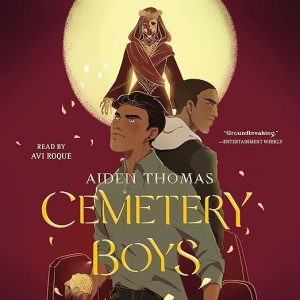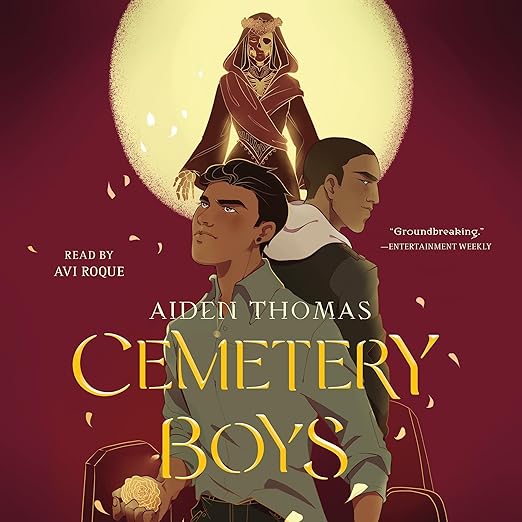
I listened to Cemetery Boys over two evenings in October, which felt appropriate. The book has a seasonal quality, a Day of the Dead atmosphere that Aiden Thomas builds carefully through its rituals, its marigolds, its brujo mythology, that made it feel like the right audiobook for a week when the light was going early and I was in the mood for something between spooky and tender. What I was not expecting was how genuinely funny it would be, or how much I would care about Julian Diaz specifically, who starts the book as a complication and ends it as something considerably harder to classify.
Cemetery Boys is a YA paranormal romance and a debut novel. Its protagonist, Yadriel, is a trans boy from a traditional Latinx brujx family who performs a summoning ritual to prove himself a real brujo and accidentally summons the wrong ghost. The ghost is Julian Diaz, the school's resident bad boy, who died under unclear circumstances and has no intention of leaving quietly. What follows is a dual investigation, into Julian's death and into the boundaries of what Yadriel thought he wanted, that unfolds against the backdrop of a richly imagined Latinx spiritual tradition.
Where This One Lands
Thomas is a confident debut novelist, and the book's confidence shows most clearly in the way it handles Yadriel's trans identity. It is not a book about being trans in the sense of centering the external conflict; Yadriel knows who he is. The conflict is with the community he loves and wants to belong to fully, not with his own self-knowledge. That distinction matters enormously, and it gives the narrative an affirmative quality that reviewer Mark Oshiro called necessary. The community element is also handled with genuine care; Yadriel's family and the wider brujx world are not simply obstacles but people with their own traditions, fears, and love for him.
The mystery plot is pleasingly functional without being the book's real focus. Julian's death has a solution and the investigation moves forward with appropriate pacing, but what Thomas is actually writing about is the emotional cost of helping someone you are falling for leave. That premise generates a specific kind of tension that the plot mechanics serve rather than define. Reviewer Kelly praised the realistic characters and the depth of the worldbuilding, noting that every character helped give the brujx world extra texture, and that observation is accurate; Thomas populates the margins of the story with people who feel genuinely alive.
What Makes Cemetery Boys Worth Hearing
Avi Roque's narration is one of the audiobook's essential qualities. They bring both Yadriel's earnestness and his capacity for dry humor to the surface simultaneously, which is a difficult balance to achieve. Julian, in Roque's performance, is cocky in a way that reads as a defense mechanism rather than simply as arrogance, and that reading makes his gradual openness much more moving than it would be with a flatter interpretation. Reviewer Inkslinger described still feeling raw after finishing, and that emotional residue is very much a function of the performance as well as the writing.
The bonus conversation with the author included at the end of this production is a genuine addition rather than marketing filler. Thomas speaks directly about the intention behind the book's trans representation and the Latinx spiritual framework, and that context enriches a second listen in particular.
Points to Consider
Reviewer Issis, who grew up in East LA and appreciated the geographic specificity, also noted that the writing included some repetition that approached redundancy. That observation is fair; Thomas returns to certain character descriptions and emotional states with a frequency that reflects debut writing more than the tightness of a polished multi-book author. It does not undermine the story's emotional impact, but attentive listeners will notice it. The plotting in the final act also moves faster than some readers want; the resolution of Julian's mystery feels slightly compressed relative to the space Thomas gives the emotional relationship.
The book is the first in a series, and while it ends with a satisfying resolution rather than a cliffhanger, there are threads left open for the sequel. Listeners who prefer complete standalone experiences will find this more resolved than many YA series openers, but there is clearly more story to come for these characters.
Who Should Listen to Cemetery Boys
This audiobook is essential listening for LGBTQ+ YA readers, particularly those who have been looking for trans representation that centers affirmation rather than crisis. It works equally well for readers drawn to paranormal romance, Latinx cultural fantasy, or Day of the Dead aesthetics who do not typically read LGBTQ+ fiction. The humor and warmth make it accessible across a broad audience. Anyone who prefers their YA without any queer content should look elsewhere; the romance between Yadriel and Julian is central and unambiguous. Young adult listeners thirteen and up should find it appropriate, with some parental awareness that the romance, while not explicit, is emotionally intense.
Does Avi Roque's narration capture both Yadriel's earnestness and Julian's bravado effectively?
Yes, consistently. Roque handles the tonal shift between Yadriel's interiority and Julian's performative confidence with real skill, and the scenes where Julian's defenses start dropping are among the strongest moments in the narration. Their performance is one of the main reasons the ending hits as hard as it does.
Is Cemetery Boys a standalone or do I need to commit to the full series?
It functions as a satisfying standalone. The central mystery is resolved and the romantic arc has a genuine conclusion. The sequel exists for readers who want more time with these characters, but newcomers will not feel stranded by ending here.
How does the book handle Yadriel's trans identity within the traditional Latinx brujx family?
With significant care and nuance. The family conflict is real but rooted in love and tradition rather than simple hostility, and Yadriel's self-knowledge is never in question. The tension is about belonging and recognition within a community he loves, which gives it emotional depth that straightforward rejection narratives often lack.