
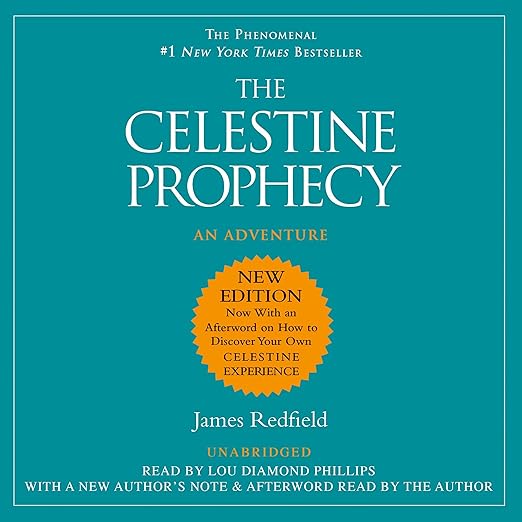
Peru's rain forest supplies the frame for this audiobook, but the manuscript at its center is really a syllabus. James Redfield's novel sends a searcher after an ancient document containing nine key insights, which the copy says every human being is predicted to grasp one after another on the way to a fully spiritual culture. Lou Diamond Phillips reads the Grand Central Publishing recording, out since October 2018. Nine and a half hours later you will have been told a story and taught a course, and the second of those is the one the book cares about.
The Review
Nicole Mackow's response is the most useful thing on the page, and it is a small confession. A self-described exclusively nonfiction reader had this pressed on them by a spiritual coach, read it anyway, enjoyed it, then wrote that they would give it four and a half stars on nonfiction preference and would round up to five. The scale holds no half marks, so the recorded grade and the written one cannot agree. That gap is the honest reading of this book: better than a skeptic expects, not quite what it claims.
Listed here as Celestine Prophecy, The, with the article shunted to the end, while the description inside the same record calls it The Celestine Prophecy and the series field does too. Same page, two spellings of one title. The series field then repeats the book's own name and marks this as volume one, which tells a buyer nothing about what follows. Small things, but they are the kind of thing that makes a listing hard to search for and easy to mistake for a different edition.
Then the counter. An average of 4.6 across twelve ratings pins the total to exactly fifty-five stars, since fifty-four would display as 4.5 and fifty-six as 4.7. Five of those twelve votes are visible, and every one of them is a five, which accounts for twenty-five. The seven votes nobody can read therefore total thirty between them, five stars of deduction spread across seven people. The page's perfect written record sits on top of a quieter, more mixed set of numbers.
Sequential material suits audio better than most spiritual writing does, because a numbered list survives being heard. Redfield builds the whole novel as a ladder: insight one arrives, then the plot moves the searcher into a position to receive insight two, and so on through nine. You always know where you are in the argument, which is more than can be said for most books that promise to crystallize your perceptions. A listener who loses the thread can count.
Circulation tells you something too. A five-star note filed in Spain in October 2022 explains that every lent copy fails to come home, leaving the writer on a fifth copy, and calls it a very spiritual book written as an adventure. That is exactly how this title has moved for decades, hand to hand rather than shelf to cart, and it explains why the plot machinery is so light. The book is made to be handed on before anybody finishes arguing with it.
Lou Diamond Phillips carries the recording alone, and the material asks for a specific kind of solo work. Most of the book is conversation in which one character explains something and another asks the follow-up question a reader would ask, so a single reader has to hold the teacher, the skeptic and the pursued fugitive apart across nine and a half hours of dialogue-heavy prose. Casting one voice for that is a real decision, not a default.
Weak Spots in Celestine Prophecy, The
J. Gray's five-star response comes with the bluntest headline on the page: bad writing, great insights. That reader spends the review defending the ideas while conceding the prose, and notes the book held a place on the bestseller list for over three years because of what it collated from many religions, philosophies and psychologies rather than because of how it was composed. If sentence-level craft is what you listen for, take the warning seriously.
Read the dates before you read the praise. Two of the five written responses were posted in 2013 and 2015, three and five years before this recording existed, and the pool's vocabulary belongs to paper: pages turned, copies lent, a book read cover to cover in a day. What accumulates under the average is a judgment on a novel that has been circulating since long before anybody put a microphone in front of it.
One structural caution. The book withholds its ninth insight until the end, which is a legitimate way to build a curriculum and a difficult way to build a listen, because you cannot flip forward to check where the ladder is going. The copy also promises that the story will let you see what is going to happen to you in the years to come, a claim no novel can keep, and the distance between that sentence and the book you actually get sets up most of the disappointment this title generates.
Who It's For
Give this one to the reader who suspects the world is arranged rather than random and wants that suspicion dramatized. G. Williams describes finishing it in a single day, growing concerned partway through that it was a work of fiction, and then going looking for research to confirm the incidents. That collision, between wanting a document and being handed a novel, is the experience this book reliably produces, and enjoying it depends on being able to hold both at once.
Avoid it when you need your spirituality and your storytelling kept in separate rooms. Literary listeners will find the characters thin because the characters are delivery systems, and readers who want sourcing will find none of the ancient wisdom attributed to anything checkable. The adventure is real but it is a chassis.
As a piece of audio, the recording is only as good as your tolerance for being taught by fictional people in a jungle. Take the nine insights as a sequence of prompts rather than a set of findings and the hours pass usefully. Take them literally and you will spend the back half arguing with a book that has no interest in arguing back.
Does the audiobook include the new preface the description advertises?
The description opens by announcing a new preface, and nothing else on the record says whether the recording carries it. No contents list, no chapter breakdown, no note either way. If the preface is the reason you are buying this particular edition, that question stays open until you press play.
Is the audiobook a fair entry point if you are skeptical of the genre?
Depends on your tolerance for its register. A December 2025 response from Paul Stryer describes the book arriving not by accident but by a subtle tug in the fabric of the day, and says the story reminded rather than taught. If that sentence reads as evocative, you will get on with the book. If it reads as vague, you will not.







