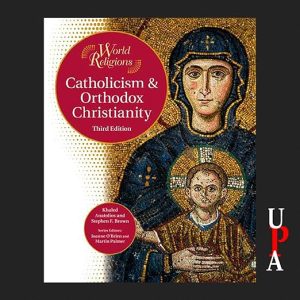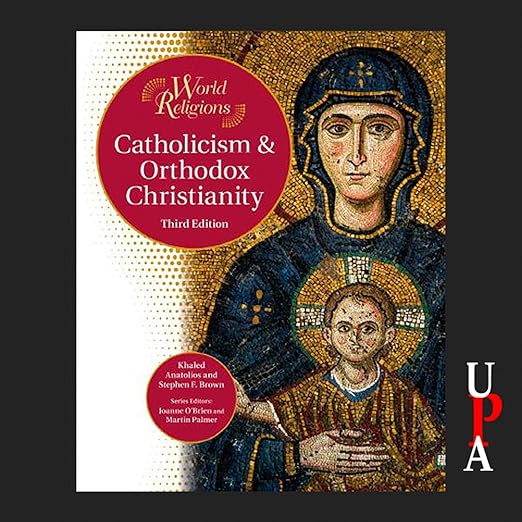
A classroom encounter with the Council of Nicaea and Pope Benedict XVI is approximately the world this audiobook inhabits. Catholicism and Orthodox Christianity, Third Edition, authored by Khaled Anatolios and narrated by Tim Lundeen, is a Chelsea House educational title covering the historical arc of both faiths from the early church through the present day. The recording runs three hours and forty-two minutes, a length consistent with supplemental classroom material rather than deep theological inquiry, and the format makes clear it is written for a student audience rather than scholars or adult readers seeking comparative theology.
What Khaled Anatolios Delivers
The book's stated scope is ambitious: tracing both traditions from their roots in early Christianity through the East-West Schism to contemporary issues including the child abuse scandals in the American Catholic Church, debates over abortion and gay marriage, and the philosophy of Pope Benedict XVI. For a three-hour audio experience aimed at a middle-school reading level, that is an enormous amount of ground to cover. The coverage, predictably, is introductory. One reviewer described it as readable for grades six through eight, and the simplified language confirms that audience.
The ratings are instructive. This title sits at 2.2 out of five across four reviews, and the critical responses are pointed. One reviewer with apparent Orthodox background described the text as functioning more like a Catholic Church pamphlet than a balanced comparative study, arguing that non-Catholic communities, including Orthodox and Protestant groups, are portrayed as departures from a Catholic norm rather than as traditions with their own internal coherence. Another notes that Anatolios, identified as an Eastern Catholic priest, brings a perspective that may not serve the Eastern Orthodox tradition fairly. Whether you weigh those concerns depends on what you are using this audiobook for. As an introduction to Catholic history and doctrine for a general student audience, the material is serviceable. As a genuinely balanced comparative study of two equally weighted traditions, it falls short of what the title promises.
Tim Lundeen's narration suits the textbook format well. He reads the dense historical material at a pace that allows comprehension without becoming soporific, which is a genuine skill for educational audio. The chapters on the historical passage from early Christianity through the schism between Eastern and Western churches are informative at the introductory level, covering the doctrinal disputes around papal authority, iconoclasm, and the filioque controversy in language accessible to a student audience. For a young person approaching this material for the first time, having it delivered in a clear narration rather than encountered in dense print provides a useful entry point.
The contemporary sections, covering ecumenism, interreligious dialogue, and the role of lay communities, bring the history into the present in ways that can prompt productive classroom discussion. The coverage of the child abuse scandals, handled carefully given the intended audience, contextualizes a real institutional crisis without dwelling on graphic specifics. These sections are where the audiobook's educational purpose is clearest, providing background that helps a student reader make sense of news coverage they may already have encountered. The philosophy of Pope Benedict XVI receives dedicated attention, which reflects where the book's center of gravity consistently lies.
Where Khaled Anatolios Loses Some Ground
The imbalance between Catholic and Orthodox coverage is the central limitation here. Listeners expecting roughly equivalent treatment of both traditions should know that the proportions tilt heavily toward the Catholic perspective. The Orthodox Church's distinct theology, its approach to sobornost, its understanding of theosis, its relationship to national churches across Greece, Russia, and the Middle East, receives far less development than its Catholic counterpart. This is partly a function of the author's background and partly a structural choice that prioritizes Roman Catholic institutional history, which is more familiar to American student audiences, over the Eastern tradition's own self-understanding.
For a student preparing for a comparative religion assignment in an American public school context, this imbalance may not matter. For an Orthodox student or any reader genuinely curious about the Eastern tradition on its own terms, the one negative reviewer's warning that the book contains roughly five percent Orthodox content is worth taking seriously before purchasing. The third edition does include updated contemporary material, but the foundational proportional problem the earlier reviewers identify appears unresolved.
Who Should Pick Up Catholicism and Orthodox Christianity
Middle-school students needing an accessible overview of Catholic history and doctrine for classroom purposes will find this audiobook functional. Adults seeking a rigorous comparative theology of the two traditions should look elsewhere; the format and reading level are not designed for that audience. Orthodox listeners should approach with calibrated expectations: this audiobook provides context on the historical schism and the Catholic perspective on reconciliation efforts, but it does not give equal time to the Orthodox self-understanding. For the specific use case of an educational listener encountering this material for the first time, Tim Lundeen's clear narration makes the three-hour-and-forty-two-minute listen manageable.
Parents and educators looking for a concise audio resource to introduce middle schoolers to the historical relationship between Eastern and Western Christianity will find the format functional for that limited purpose. The three-hour runtime makes it manageable as a classroom supplement. The important caveat remains: this audiobook should be paired with additional resources that give the Orthodox tradition its own voice, particularly if the listener or student has any personal connection to Eastern Christianity or is drawn to understanding it on its own terms rather than through the lens of its relationship to Rome.
Key Details
- Voice: Tim Lundeen delivers a clear, textbook-style narration suited to the educational register, though it cannot compensate for the structural imbalance reviewers flag between Catholic and Orthodox coverage.
- Big ideas: church history and schism, doctrinal comparison, contemporary controversies in American Catholicism
- Atmosphere: Academic and measured, though unevenly weighted
- Worth it?: Catholicism and Orthodox Christianity works as a basic introduction for grade-school students but carries a documented pro-Catholic lean that more advanced students or Orthodox listeners will notice quickly.
Common Questions
Is this audiobook appropriate for adults, or is it written specifically for younger students?
The text is written at a grade six to eight level, per reviewer descriptions, and published by Chelsea House, an educational press. Adult listeners seeking theological depth or scholarly rigor will find the material introductory and the approach simplified.
Does this audiobook give equal coverage to both Catholicism and Orthodox Christianity?
No. Multiple reviewers flag a significant imbalance, with one arguing the Orthodox tradition receives approximately five percent of the coverage. The Catholic historical and doctrinal framework dominates, which may reflect the author's background as an Eastern Catholic priest.
Does this audiobook cover modern controversies, or does it focus only on historical doctrine?
The third edition includes contemporary issues including the Catholic child abuse scandals in the United States, debates over abortion and gay marriage, Pope Benedict XVI's philosophy, and the state of ecumenism and interreligious dialogue, alongside the historical material.