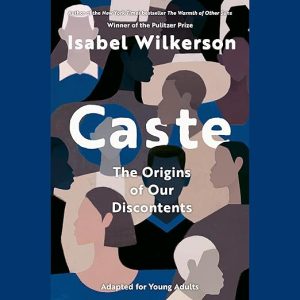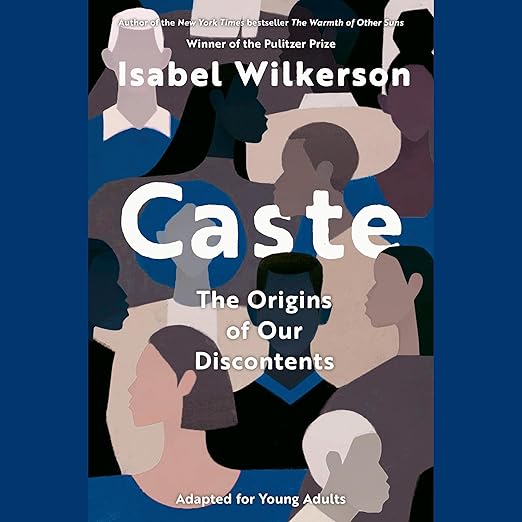
An adaptation has to decide what a younger audience can carry, and this one keeps the hardest comparisons exactly where they were. The audiobook runs a little over ten hours, which is not the shape of a book thinned out for teenagers. Isabel Wilkerson's account of a hidden American caste system arrives with India and Nazi Germany still standing beside it, and Robin Miles reads for Listening Library. What changed between the original and this edition is the framing rather than the difficulty, and that turns out to be the right decision.
Robin Miles is the credited reader and Listening Library is the imprint, and beyond those two lines the listing says nothing about how the recording was made. What it also leaves out is who performed the adaptation. On a book whose entire existence is an editorial act carried out on an earlier text, an absent adapter credit is not a small gap, and the byline carries only Wilkerson's name while the description leans on the parent book's Pulitzer and bestseller credentials.
Wilkerson's central move survives the transfer completely intact. Caste, in this account, is neither race nor class but the ranking underneath both, a structure that decides which groups hold power and which do not and then invents its justifications afterward. Gabriela Santiago, who went through the adult book and this one side by side in 2023, came away preferring this version outright. That is unusual praise for an adaptation, and it matches how the argument sounds aloud: cleaner rather than smaller.
Power is the word doing the labor here, and hearing it recur across chapters has a cumulative effect that the printed page dilutes. The two comparisons carrying the book, the caste order of India and the racial hierarchy of Nazi Germany, sit right in the description, so nobody arrives unwarned. What catches listeners off guard is the third leg of the argument: that the American version works precisely because it is hidden, unspoken, and almost never named out loud.
What Stands Out
Listening Library's production is straightforward single-voice nonfiction, which is what this material needs and all it needs. Wilkerson's method is to build a structural argument out of stories about actual people, and those stories are the reason the book works for a younger audience at all. A story about a person has a beginning and a consequence; a structural claim has neither, and the constant conversion of the second into the first is what keeps a long stretch of social analysis moving forward.
Comparison is where the young adult framing pays off most. The book sets the United States beside two systems that American teenagers are generally taught to think of as foreign and finished, then refuses to let either comparison stay comfortable for long. A response from May 2025 passes on the verdict of a twelve-year-old in one line, calling it a good book that spreads enlightenment and saying everyone should read it. Twelve is young for this material, and that response reports it landing fine.
Structure is the other argument for taking this in audio. The description promises masterful narratives about real people, and narrative nonfiction is the sub-genre that loses least when it comes off the page. Nothing here depends on a chart, a table, or a note you have to see to follow. The case is carried by episodes and by repetition, and a voice holds both of those together more naturally than a paragraph does.
Weak Spots in Caste (Adapted for Young Adults)
Credit is the first thing missing. No adapter is credited anywhere on the page, so a buyer cannot tell whether Wilkerson reworked the original or handed it to another writer, and that difference matters to anyone deciding between this edition and the adult one. Two books share a title, an author line, and a thesis, and the page gives you no way to establish what separates them beyond a parenthetical in the title.
All five written responses describe reading rather than listening, and several describe products that are not this one. Honest Pen recommends the book and the workbook together and throws in the movie as an added bonus, and neither of those is part of what you get here. That is the shape of the pool in miniature: warm, print-shaped, and orbiting a small cluster of related editions and adaptations that a recording does not include.
Companion habits keep surfacing too. A December 2024 response describes writing out a personal summary of the book in order to avoid going back through the whole thing every time it was needed. That is a print behavior, and it names a genuine limitation, because this is a book people want to return to selectively and audio is the worst format ever devised for selective return. Plan on notes if you intend to use this rather than simply hear it.
Best Suited For
Classrooms are the obvious home, and the responses bear that out repeatedly. A June 2024 response describes buying this edition to share with a seventeen-year-old after watching Origin, and the pairing of one adult with one teenager is the recurring picture across the page. The recording suits that use particularly well, because it can run in a car with two people in it, which is a harder thing to arrange with a printed book.
Adults who already own the original should think carefully before doubling up, because the argument is the same argument and the differences appear to be of framing rather than of substance. Readers who want the full apparatus, the extended case studies and the sourcing, should compare the two editions directly rather than assume they match. And a listener hoping for a memoir or a straight narrative history will find this is neither of those things.
Where this edition earns its place is with someone who has heard the word caste used loosely and wants to know what it means used precisely. The comparisons are hard, the American chapters are harder, and nothing has been softened on the grounds that teenagers are listening. A sustained argument about hierarchy is a real ask of any teenager, and the responses here suggest the ask gets repaid.
Common Questions
How is this audiobook different from the adult edition of Caste?
The framing targets younger listeners while the argument stays intact, comparisons to India and Nazi Germany included. One 2023 response went through both editions side by side and preferred this one. What the listing never states is who performed the adaptation, so compare the two directly if the distinction matters to your purchase.
What age is this audiobook actually suitable for?
The description aims it at young people already engaged with the world, and one response passes on a twelve-year-old's verdict with no reservations attached. The content includes dehumanization, Nazi racial hierarchy, and American violence, handled without sensationalism. Younger listeners will follow it comfortably; whether they hear it alone is a household call.
Is Caste a narrative or an argument?
Both, and deliberately so. Wilkerson builds the structural case out of narratives about real people, then draws the claim from them, which is why the material moves rather than lectures. Expect episodes rather than chapters of theory. That construction is also what makes this easier to follow than most argument-driven nonfiction in audio.
Can I study from this, or do I need a print copy as well?
Audio is a poor format for selective return, and this is a book people revisit rather than finish once and shelve. If you plan to quote it, teach from it, or write about it, pair the recording with a searchable text. For a first pass through the argument, the recording alone does the job.