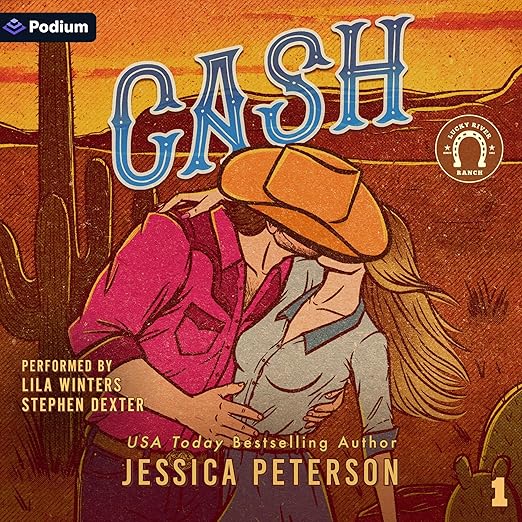
Key Details
- Read by: Stephen Dexter's unhurried, grounded voice suits the Texas ranch setting and handles the tonal shift from antagonism to tenderness without forcing it.
- At its heart: Enemies-to-lovers, city-versus-rural identity, inheritance and belonging, grumpy-sunshine cowboy dynamics.
- Vibe: Warmly contentious early, genuinely tender late, consistently steamy throughout.
- Short version: A well-constructed cowboy romance that commits to its enemies phase before earning its warmth, with a protagonist who has her own agency from the start.
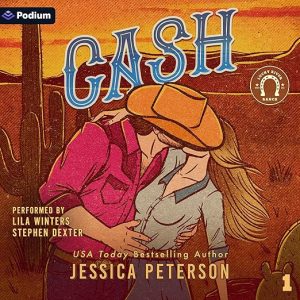
Grumpy-sunshine enemies-to-lovers cowboy romance has its own established conventions, and Cash, Jessica Peterson's first book in the Lucky River Ranch series, leans into them with evident affection and enough self-awareness to keep the formula from feeling rote. Stephen Dexter narrates this audiobook, and his voice is a reasonable match for the Texas cattle-ranch setting: unhurried, grounded, with a quality that suggests open space rather than urban hustle. At twelve hours and one minute, this is a full-length romance with room to develop both its comedy and its emotional stakes.
The setup is efficient: Mollie inherits her estranged father's Texas cattle ranch on the condition that she live there and manage it for a year before accessing her inheritance. She has not been to Hartsville, Texas since she was six. Cash Rivers, the ranch foreman, is rude, excellent at his job, and not remotely interested in a city girl learning to run cattle. The situation is as combustible as a Texas summer, which is the point.
Our Take on Cash
What Peterson does well here is establish Mollie as someone with genuine agency rather than simply a plot device in need of rescuing. The inheritance stipulation is her father's mechanism, not Cash's; she makes clear decisions about her presence at the ranch throughout the novel. Her city-versus-ranch identity is played for both comedy and vulnerability without reducing her to the joke. She is competent in her own domain, genuinely curious about the ranch, and aware of her own limitations in ways that make her appealing rather than simply functional as a romance lead.
Cash himself is drawn with some care. The grumpy cowboy archetype risks becoming a collection of traits rather than a person, and Peterson avoids the worst version of that by giving him a clear internal logic: his protectiveness of the ranch and its operation is not just personality but history. Reviewers consistently mentioned the line about wanting someone to talk to and take care of, someone who would take care of him too, as a moment that humanizes Cash beyond his abrasive exterior. It is a simple line but it does real work.
One reviewer noted that the early antagonism between Mollie and Cash was intense enough that she 'almost couldn't continue with the book.' That is a calibration the reader should make going in. Peterson commits to the enemies phase rather than rushing past it, and the enemies-to-lovers arc is longer here than in romance novels that use the trope as a light grace note. If you want the payoff, you earn it through the conflict.
Why Listen to Cash
Stephen Dexter's narration is a solid choice for this material. His pacing through the more contentious early scenes between Mollie and Cash is measured without being flat, and he handles the shift to tenderness in the later chapters without the tonal change feeling forced. The Texas setting benefits from a voice that does not rush; the narrative geography of a working cattle ranch is one of the book's genuine pleasures, and Dexter lets the listener settle into it.
The romantic arc earns its resolution. The conversations beneath the stars and the 'cheek-to-cheek dancing at the local dive bar' (the synopsis's own description) are rendered with the kind of specificity that distinguishes well-executed small-town romance from its generic equivalents. Peterson is writing a place as much as a relationship, and the sense of Hartsville, Texas as a community with its own texture and social life gives the romance a context that grounds it.
What to Watch For in Cash
The 'everything really is bigger in Texas' line in the synopsis is an accurate signal of the novel's spice level. This is a steamy romance, and listeners who prefer less explicit content should factor that into their expectations. The explicit scenes are distributed throughout the narrative rather than concentrated in a single late section, and they are part of how the characters' relationship evolves rather than separate from it.
The novel's central tension, between Mollie's temporary stay and Cash's permanent commitment to the ranch and its life, is set up well but resolved somewhat cleanly. The 'cowboys break hearts' note in the synopsis suggests the emotional stakes are real, and they are, but the resolution arrives with the confidence of a romance novel that knows its genre obligations. Listeners who want genuine ambiguity about the outcome may find the final act a little inevitable. That is not necessarily a criticism; it is a genre characteristic.
As the first book in the Lucky River Ranch series, Cash introduces an ensemble of ranch-adjacent characters who presumably get their own stories in subsequent installments. The world-building for those future books is visible without becoming intrusive; Peterson manages to establish the community without distracting from the central romance, which is a harder balance than it looks.
One element Peterson handles with more care than the formula might lead you to expect is Mollie's relationship to the ranch itself, separate from her feelings about Cash. Her gradual attachment to the landscape, the routines, and even the difficult aspects of cattle ranching gives the novel a sense of place that grounds the romance. The inheritance stipulation that brought her there starts as a purely financial arrangement and becomes something more complicated, which is a quieter but more interesting story than the central love plot. The two threads are well-woven rather than competing.
Who Should Listen to Cash
This audiobook is a strong recommendation for listeners who enjoy cowboy romance with genuine antagonism in its early chapters, a sense of place that extends beyond the central couple, and a satisfying, steamy resolution. Fans of Jessica Peterson's other work will find Cash consistent with her established style. Readers new to the small-town cowboy romance subgenre will find it a solid introduction that does not require prior familiarity with either the author or the setting conventions.
If you need your romantic leads to be civil to each other from early on, the first third of this novel will be a challenge. If the enemies-to-lovers arc being genuine rather than perfunctory is part of the appeal for you, Cash delivers on that promise across a twelve-hour audiobook that earns its own warmth by first earning its conflict.