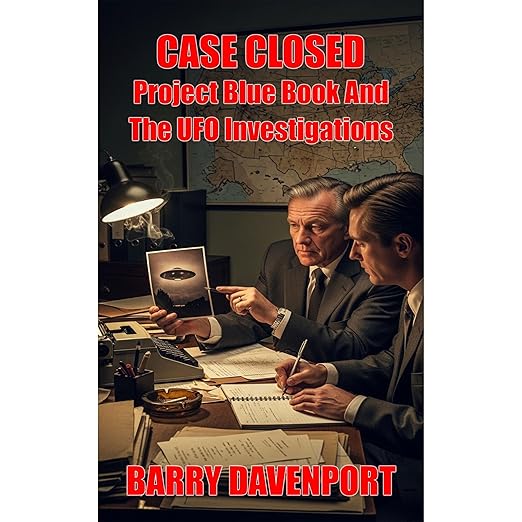
Virtual Voice fills the narrator field on this audiobook's page, and that one line changes what any honest review is able to promise you. No human reader is credited anywhere on the page. The words arrive by synthesis, which is a fact about the product rather than a verdict on it, and it is the first thing a buyer weighing four and a half hours of American institutional history should know. Everything else here is more encouraging than that, because the description underneath is unusually specific for an independently published title, and specificity is very nearly the only signal on offer.
Project Blue Book began with something in the skies over America in the summer of 1947, and with an Air Force that, by the description's account, already knew it. The program promised answers about the objects that pilots, police officers and ordinary citizens were reporting from coast to coast. What it delivered instead, the copy argues, was two decades of institutional failure, suppressed evidence and a collapse of credibility still shadowing official Washington. That is a thesis stated plainly in the opening paragraph of the listing, which is more than most pages manage, and it sets terms clear enough to be argued with.
Roswell sits at one end of the span and recent Pentagon videos sit at the other, which tells you the book refuses to confine itself to the program's own years. The reach is deliberate. A history stopping when Blue Book stopped would be a filing exercise, while a history running to the present is making a claim about continuity, namely that the credibility problem manufactured then is the same one operating now. Whether four and a half hours can carry that span is a fair question to ask. The alternative, a chronological catalog of sightings, would be markedly less interesting.
Why Case Closed: Project Blue Book And The UFO Investigations Works as an Audiobook
Institutional history is the genuinely good idea at the center of this, and it is why the book deserves anyone's afternoon. The interesting story about official investigation of the phenomenon was never whether the objects were real. It was what a bureaucracy does when ordered to produce a reassuring answer to a question it cannot actually answer. The description promises precisely that material: the offices, the airfields, the classified briefings, and the political pressure determining what the public would be told. Handled properly, that is a story about how governments talk to citizens, and it has a great many modern parallels.
Debunkers and believers fought each other inside the military, according to the copy, and the sharpest illustration it offers is a single reversal. The astronomer brought in to explain sightings away became the phenomenon's most credible scientific advocate. That is a strong hook, and exactly the sort of detail capable of carrying a short book. A person changing position under the weight of evidence makes a better narrative engine than any quantity of lights in the sky, and it lets the book take the believers seriously without joining them, which is the hardest balance in this subject.
Weak Spots in Case Closed: Project Blue Book And The UFO Investigations
Zero is the figure in both rating fields on this listing. No average, no count, and no written responses of any kind. For a title released in March 2026 that is unremarkable, and it still leaves you with nothing at all to check the description against. My usual advice is to weigh publisher copy against what actual listeners report afterward; here the copy is the entirety of the evidence. Read it as a pitch, notice how confident it sounds, and keep in mind that confidence in a description costs nothing while accuracy costs a great deal.
Occult is the tag attached to this page, and the genre sitting above it reads religion and spirituality. Both are wrong. A book about Air Force procedure, suppressed reports and press management belongs under history, or politics, or military affairs, and the shelving here will offer it to browsers hunting for something else while concealing it from the readers most likely to want it. Misfiling of this kind is common on independently published pages, and the cost is real: the audience that would grade this fairly may never encounter it at all.
Synthetic reading is the other question to settle before buying. Four hours and thirty-three minutes is a modest commitment, which cuts in both directions, being short enough that a reading you dislike costs you little and long enough that you will certainly notice. Nothing on this page offers a human-read alternative. If machine-read nonfiction has worked for you before, nothing here ought to change your view. If you have never tried it, sample first, because official titles and dates come thick in this kind of material and the density is where synthetic reading is tested hardest.
The Right Listener for Case Closed: Project Blue Book And The UFO Investigations
Believers and skeptics can both use this, which is unusual for the subject. The description positions the book against the mythology in both directions at once: it refuses the flying saucers and little green men framing outright, and it declines the official explanations just as firmly, since the whole argument is that those explanations were manufactured for public consumption. Listeners interested in official secrecy, in how classification actually functions, or in the origins of modern distrust of federal institutions will find the material relevant far beyond its ostensible subject.
Hold off if you want evidence about the phenomenon itself, because this book is about the paperwork and says so from the first line. Hold off, equally, if a machine-read edition is a deal breaker, since nothing on this listing suggests another version is coming. What remains on offer is a compact, clearly argued account of a program that promised answers and produced a credibility problem instead, at a length that respects your afternoon. With no ratings and no responses on the page, the description does all the persuading, and it at least states its case plainly enough to be tested.
At a Glance
- Big ideas: Institutional secrecy, official debunking, suppressed evidence, public distrust of government
- Atmosphere: Brisk, declassified and quietly indignant
- Worth it?: A short and clearly framed history, undercut by a listing that shelves it under the occult and reads it by machine.