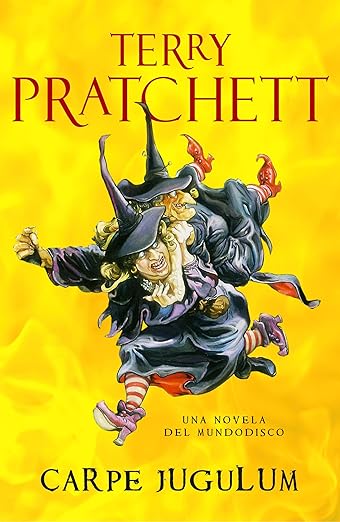
I came back to Pratchett during a particularly heavy month, which is where I usually end up when the world requires more wit than it's offering. Carpe Jugulum sits near the top of the Discworld rankings for a reason. It is simultaneously one of the funniest and one of the most philosophically serious things he wrote, and Indira Varma's narration, available in the English edition, treats both of those qualities with equal care and equal intelligence.
The premise is vintage Pratchett in the way only the later Discworld novels manage: it sounds absurd and is actually piercing. King Verence of Lancre has invited a family of modern vampires, the Magpyr family (who style themselves Magpyre to signal their progressive credentials), to his daughter's christening. These are vampires who have worked to overcome their traditional weaknesses through exposure therapy and positive thinking. They are immune to garlic, crucifixes, sunlight, and the usual arsenal. They wear the language of self-improvement while pursuing the oldest project of the powerful: complete domination of those beneath them. Pratchett finds his satirical target and closes on it with precision.
The Verdict, Briefly
The Magpyres are Pratchett at his most precise as a satirist. They have adopted the contemporary vocabulary of liberation and modernity while remaining parasitic and controlling in every meaningful way. The Old Count who preceded them kept the old contracts with the village: take enough to survive, maintain the visible forms of threat that allowed the village to organize its life around them. The Magpyres have abandoned even that minimal honesty. They have innovated past accountability and called it progress. This is a point Pratchett makes with complete seriousness underneath the comedy, and it rewards sustained thinking about what kinds of power arrangements it describes.
One of the Spanish-language reviews noted the book is "fresh and different within Discworld but always entertaining," and the freshness is real. This is among the more willing of Pratchett's late-period novels to sit in genuine darkness before finding its way back toward the light. The threat feels credible, and the cost of resisting it is shown to be real.
What Makes Carpe Jugulum Worth Hearing
The book's philosophical and emotional center is Granny Weatherwax's working definition of sin: the unexamined, comfortable version of oneself that refuses to acknowledge what it's doing. The Magpyres sin in exactly this way. So, more surprisingly, do some of the human characters. And Granny herself, whose certainty is her greatest weapon, must reckon with its limits when certainty proves insufficient against an opponent who has learned to mirror its logic back at her.
Indira Varma's Granny Weatherwax is a tremendous performance. She catches the character's essential quality, the severity that is also a form of love, the bluntness that is also a form of honesty, and holds it through the book's considerable tonal range, from broad comedy to the quietly devastating passages about faith and doubt that arrive in the novel's final third. These passages, involving a young priest named Mightily Oats and his struggling relationship with his religion, are some of the best things Pratchett ever wrote about belief, and Varma reads them with the gravity they deserve and the lack of sentimentality they require.
Points to Consider
The coven's other members are well-served by the narration throughout. Nanny Ogg is a creature of robust physical comedy and unsuspected warmth, and Varma handles both registers without condescension toward either the character or the audience. Agnes Nitt, who carries an alternative personality named Perdita that tends toward more dramatic self-expression, gives the narrator a double-characterization challenge that Varma navigates with evident relish. The comic byplay between characters, which in lesser hands becomes a relay race of funny voices, is here rendered as an actual ensemble. The rhythm between them feels observed rather than constructed.
At approximately eleven and a half hours, Carpe Jugulum is substantial Pratchett that rewards the investment. This is not a slim comic novel but a fully developed late work with real weight. The English audio edition narrated by Indira Varma is the version to seek.
The Right Listener for Carpe Jugulum
Carpe Jugulum is the twenty-third Discworld novel and the sixth focused on the Lancre witches, meaning first-time Pratchett readers will be missing significant character context. The book makes internal sense but is richer for familiarity with Granny, Nanny, and Agnes from Lords and Ladies onward. For longtime Discworld readers who somehow haven't reached this one, it belongs in the essential pile. The English audiobook is available on Audible, making it an accessible entry point for listeners new to Varma's narration of the series. For listeners who want comedy that takes its own ideas seriously, this is where Pratchett is working at the height of his powers. What separates Carpe Jugulum from the merely funny Discworld novels is its willingness to let the philosophical content matter, to let Granny's crisis feel real and Oats's doubt feel genuine, without abandoning the humor that makes the medicine go down. Pratchett understood that comedy and tragedy share a substrate, that the funniest moments and the saddest ones often live in the same sentence. Carpe Jugulum is one of his clearest demonstrations of that understanding. Listeners encountering Pratchett for the first time through this book should know they're entering at the deep end of a very rich pool, but it's a rewarding entry point for anyone who wants to understand what made Discworld more than an extended comedy franchise. It was always more. This book proves it.
A Few Questions About Carpe Jugulum
Is Carpe Jugulum among the darker Discworld novels, or is the tone primarily comic?
It's darker than most. Pratchett's comedy is always present and often very funny, but the book also engages seriously with questions about evil, self-deception, and the nature of belief. The vampire antagonists are played for satire but their threat is real within the narrative, and the resolution involves genuine moral complexity.
Is this the English narration by Indira Varma, or a different edition?
The audiobook performance listeners should seek is the English Discworld edition narrated by Indira Varma. Some metadata associated with this listing reflects a Spanish-edition ISBN; confirm the edition when purchasing to ensure you receive the English narration that this review describes.