Quick Take
- Narration: Grace Puma narrates her own career framework, and the first-person authority of a former Fortune 500 COO delivering her own strategy carries real weight.
- Themes: Long-range career strategy over job-hopping, women navigating corporate advancement, building a leadership identity
- Mood: Direct, mentor-voiced, practically motivational
- Verdict: A genuinely useful, executive-tested career framework for women on corporate paths, with real crossover value for men despite its female-first framing.
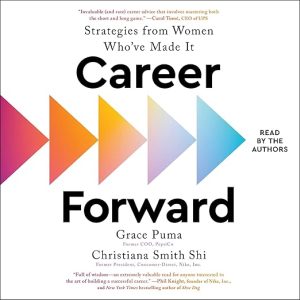
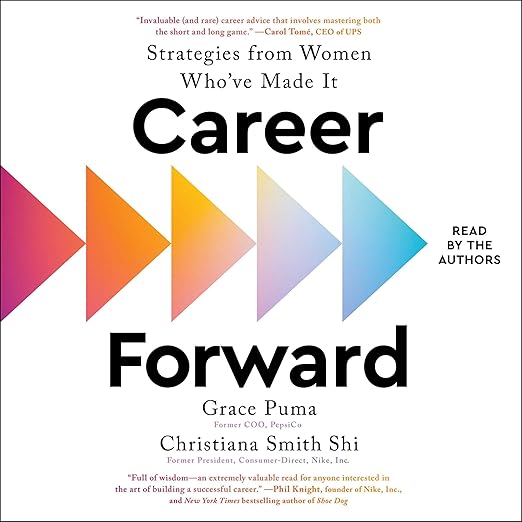
Grace Puma spent decades rising to become PepsiCo's chief operating officer, and this audiobook, which she narrates herself across six hours and twenty-six minutes, distills that career into a specific, repeatable argument: focus on your career, not just your next job. Career Forward, co-written with former Nike President of Consumer Direct Christiana Smith Shi, is a USA Today bestseller built around the idea that women in particular benefit from treating their professional life as a long-range “growth stock” rather than a series of title-and-salary transactions.
Forbes called the book “a compass for those navigating their professional journeys,” and the New York Post credited it with revealing “often surprising work advice,” both citations that point to the same core appeal: this is not a generic motivational career guide but a specific, tested framework from two women who reached the top of Fortune 500 companies and are naming exactly how they did it.
Comprehensive, Usable, and Equally Useful for Men
The book's central distinction, career first, job second, sounds simple stated plainly, but Puma and Smith Shi build a genuinely useful case for it: chasing an immediate title bump or salary increase can pull a career sideways, while accepting a difficult assignment or deliberately broadening a skill set compounds into something more durable over a decade or two. The quizzes and self-evaluation checklists mentioned in the synopsis suggest the book is built for active engagement rather than passive listening, though audio necessarily changes how a listener might use that interactive material.
Reviewer Julia Velichko calls it “the most comprehensive, yet usable and easy to follow set of strategies on career advancement” and adds that it is “a unique and probably one of a kind books that targets the female audience, but it will be equally useful for men.” That crossover appeal is worth naming explicitly, since a book marketed specifically to women navigating gendered workplace obstacles could easily be dismissed by male listeners as not relevant to them, and this review suggests that would be a mistake.
Evaluating a Role Like a Growth Stock
The “growth stock” metaphor the synopsis highlights is worth unpacking briefly: rather than evaluating a job purely on its immediate compensation, the framework asks a listener to evaluate a role's long-term appreciation potential, what skills it builds, what visibility it creates, what doors it opens later, the same lens an investor would apply to a stock rather than a single transaction. That reframing is the book's most exportable single idea.
The book's framing around Fortune 500 experience is honest advertising rather than exaggeration, and that specificity, naming PepsiCo and Nike directly rather than speaking only in vague terms about successful executives, gives the advice a concreteness that more generalized career guides often lack.
Puma's Own Voice Narrating Her PepsiCo Years
Puma narrating her own material gives the advice a first-person authority that matters enormously for a book explicitly built on the authors' own career trajectories rather than on abstract theory. Reviewer Annabelle t. makes a sharp observation about the broader genre here: after purchasing “a number of ‘career help’ books over the past decade,” she found “the information they contain is fairly ‘gender-generic.’”
Reviewer MIchelle Ann wardian's account is especially striking: “nearing 60 and often viewed as someone who ‘made it,’” she still calls the book's perspective “deeply meaningful,” striking enough that she “bought copies not only for my two daughters in their 20s, but I'm also sharing it with the women I mentor.” That is a meaningful signal about the book's durability beyond early-career listeners specifically, that its framework holds up as relevant even for someone who has already had the career the book is describing how to build.
Co-author Christiana Smith Shi's background at Nike, where she led the company's Consumer Direct division, gives the book a second executive perspective beyond Puma's own PepsiCo experience, and though Puma alone narrates, the text itself clearly draws on both women's careers, retail and consumer goods on one side, food and beverage operations on the other, which broadens the book's applicability across industries rather than reading as advice specific to one company's culture.
Puma's own voice narrating case studies and personal anecdotes from her PepsiCo years gives those specific stories a lived-in authenticity that would be harder to sell through a hired narrator performing someone else's career history secondhand.
Delivery That Runs Through Without Curdling
This is explicitly framed around Fortune 500, corporate-ladder career paths, and Puma and Smith Shi are writing from the specific vantage point of two executives who reached the very top of major public companies. Listeners building unconventional careers, freelancers, entrepreneurs, or anyone outside a traditional corporate hierarchy entirely, may find some of the specific tactics, navigating internal promotions, building a leadership identity within one company's structure, less directly transferable to their own situation.
At six hours and twenty-six minutes, this covers a lot of conceptual ground relatively quickly, which suits listeners wanting a clear framework more than listeners wanting granular, step-by-step tactical detail on any single career challenge. The quizzes and checklists the synopsis mentions are presumably easier to engage with in print or ebook form than in audio, so listeners who want to actually complete that self-evaluation material as they go might consider pairing the audiobook with the physical book.
The book's closing argument is direct enough to state plainly: asked whether working hard is really worth it, Puma and Smith Shi's “emphatic answer is ‘yes,’” a conviction that holds provided the effort follows the blueprint the book lays out rather than chasing scattered wins, and that optimism runs through the delivery without ever curdling into empty cheerleading.
Real Traction Beyond the Book's Target Demographic
Women navigating corporate career paths, particularly those feeling pressure to choose between ambition and a full life outside work, are the book's most direct audience, and the reviews from Julia Velichko and Annabelle t. both suggest genuine relief at finally finding career advice that treats gendered workplace obstacles specifically rather than generically. The 4.4 rating across 44 ratings, combined with the book's USA Today bestseller status, points to real traction beyond just its target demographic.
Mid-career listeners feeling stalled or unsure whether to make a lateral move, take on a stretch assignment, or hold steady in a current role will likely get the most immediately actionable value, since the book's central framework is built precisely around evaluating those kinds of decisions against a longer career arc rather than an immediate title or salary.
Entrepreneurs and freelancers charting a path outside traditional corporate ladders will find less direct application here, since the framework assumes promotion structures, internal politics, and leadership tracks specific to larger organizations. For anyone climbing that more traditional ladder, though, especially women tired of career advice that ignores the specific obstacles they actually face, reviewer MIchelle Ann wardian's instinct to buy copies for the next generation says a great deal about how this one lands.
Good to Know
Does Grace Puma narrate this audiobook, or is it read by a professional narrator?
Puma narrates it herself, giving the strategies a direct, first-person delivery from the former PepsiCo COO whose own career the book draws on.
Is this audiobook only useful for women in corporate careers?
It is written primarily for women, but reviewer Julia Velichko specifically found it equally useful for men, so the framework has real crossover value beyond its stated audience.
Does this audiobook work for freelancers or entrepreneurs outside traditional corporate jobs?
Less directly. The framework assumes promotion structures and leadership tracks specific to larger organizations, so entrepreneurs and freelancers may find some tactics less transferable.
How long is the Career Forward audiobook?
Six hours and twenty-six minutes, covering the book's core career-first framework at a pace suited to grasping the concepts quickly rather than working through granular tactical detail.