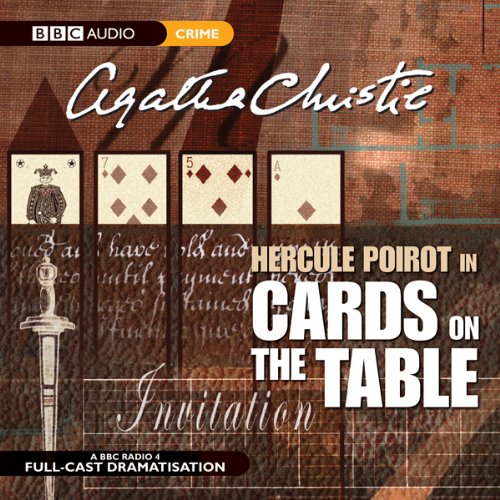
Bridge is not a game I play, but I sat with this audiobook on a grey afternoon when the outside world felt distant and I needed the specific pleasure of watching a puzzle being assembled from the inside. Christie had an unusual relationship with the game: she understood that bridge reveals character, that the choices a player makes under pressure at a card table are not so different from the choices a murderer makes when cornered. Cards on the Table, dramatized here with a full cast including Stephanie Cole and Donald Sinden, uses that premise with quiet precision, and the audiobook format gives it an intimacy that the page cannot quite replicate.
The setup is crystalline. Dr. Shaitana, a somewhat sinister London socialite, invites Hercule Poirot and three other crime-solving luminaries to dinner, alongside four dinner guests he describes as his personal collection of people who have committed murder and gotten away with it. The evening ends with Shaitana dead in his armchair, stabbed while the bridge game continued in the next room. Four detectives, four suspects, one body, no witnesses. Christie was not particularly hiding the structure: this is a story about method, about how four different investigative minds arrive at truth by different routes.
Where This One Lands
The full-cast dramatization is the right format for this material. Christie's novel spreads the investigation across multiple perspectives, and the audio drama captures that collaborative, sometimes rivalrous energy between the detectives without the slightly artificial dialogue-attribution mechanics that print requires. Donald Sinden's presence as one of the key performers grounds the production; his particular brand of clipped authority serves Christie's world well. Stephanie Cole brings the kind of controlled warmth that the story also needs, a human register alongside the procedural machinery.
What Christie is really doing in this novel, and what the dramatization preserves, is examining the epistemology of detection. Each investigator applies a different framework: Poirot focuses on the psychological signature of a particular kind of killer, Colonel Race takes the military analytical approach, Mrs. Oliver applies intuition that looks chaotic but is actually quite systematic, and Superintendent Battle works the evidence documentation. The pleasure is watching the same facts produce different conclusions, and then watching those conclusions converge.
The Best Parts of Cards on the Table
This is Christie doing something she rarely does: acknowledging the other great detective fiction traditions of her era and putting her own creation in dialogue with them. The conceit of four detectives working the same case is not just a gimmick; it is an argument about the nature of truth in detective fiction. The evidence is fixed. The interpretations vary. Which framework gets there first?
The runtime is short at one hour and twenty-seven minutes, which reflects the dramatization rather than the full novel. New listeners to Christie should understand they are getting an adaptation that compresses and makes staging choices. The production is tight and intelligent, and for listeners who know the novel it is a pleasure to hear how the dramatizers solve the problem of interiority, capturing Poirot's thought processes in a medium that typically demands externalization. The solution they arrive at works: they give him dialogue partners that function almost as sounding boards rather than true interlocutors.
What Gives Us Pause
One listener review noted that the language was sometimes difficult to follow, which is worth acknowledging honestly. Christie's novels carry the social idioms of 1930s England, and the dramatization does not modernize the dialogue. Listeners who have not spent time with Golden Age British mystery will sometimes need context they have to supply themselves. The social hierarchy implied by how characters address each other, the specific nuances of what constitutes a breach of etiquette versus an outright lie, these are embedded in period detail that the audio production does not stop to explain.
The bridge game mechanics are not explained in the dramatization either. You do not need to understand bridge to follow the plot, but the production assumes you understand at minimum that bridge is a partnership game where signals between partners are significant. That structural knowledge informs why the murder was possible and why the suspects each have such different accounts of what they noticed.
The Golden Age mystery format at its best is not really about murder at all. It is about the construction of a sealed world where logic is the only operative force, where the evidence points somewhere specific if you have the right framework to interpret it. Christie understood this better than almost anyone in the genre, and Cards on the Table is one of her more explicit meditations on the subject: four detectives with four frameworks, one body, and the demonstration that truth is accessible by multiple routes even if the routes are radically different. The dramatization captures that intellectual argument without overstating it, which is the right instinct.
Who Should Listen to Cards on the Table
Christie fans who have not encountered this particular title will find it one of her more formally interesting works: the multi-detective conceit is unusual in her catalog, and the bridge-table setting is genuinely clever. Listeners new to Poirot should start elsewhere in the series first; the pleasure of this production increases proportionally with familiarity with the detective. The runtime makes it a natural choice for a single sitting, an afternoon or an evening commute, and the full-cast production gives it a quality closer to radio theater than audiobook narration.
A Few Questions About Cards on the Table
Is this a full audiobook reading of the Christie novel or a dramatization?
It is a dramatization with a full cast, including Stephanie Cole and Donald Sinden. The runtime of one hour and twenty-seven minutes reflects a compressed adaptation rather than a complete novel recording.
Do I need to understand bridge to follow this audiobook?
No, but basic awareness that bridge is a partnership card game with player signals will help you appreciate the setup. The murder mechanics depend on understanding the social dynamics of the bridge table, not the rules of the game itself.