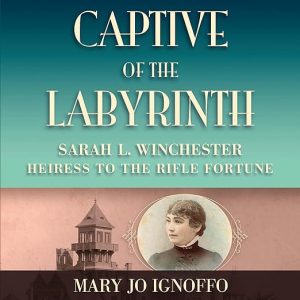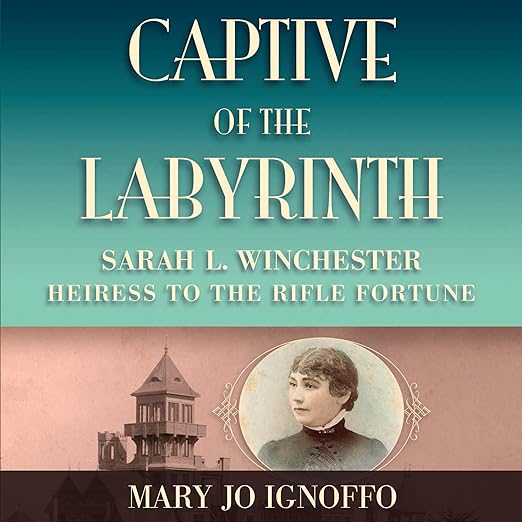
There are buildings in the world that attract myth the way certain coastlines attract fog. You can know, intellectually, that the fog is just weather, but it is still hard to see what is underneath it. The Winchester Mystery House is one of those places, and I say that having visited it years ago during a research trip to Northern California. The tour guides there are skilled at maintaining the atmosphere of enigma, and I left with a vague impression of Sarah Winchester as a guilt-ridden eccentric who spent thirty years building a sprawling mansion to confuse the ghosts of the Winchester rifle's victims.
I also left suspecting that impression was mostly invented. Mary Jo Ignoffo's biography confirms that suspicion in full, and does so with the patience and rigor of a scholar who has spent years in the primary sources. This is the first full-length biography of Sarah Winchester, and based on what Ignoffo demonstrates about how badly the historical record has been distorted, it is a book that needed to be written.
The biography's central thesis is that the haunted-widow mythology was constructed not by Winchester herself but by the entrepreneurs who purchased her home after her 1922 death and turned it into a tourist attraction. Ignoffo makes this case through archival research: personal correspondence, legal records, the papers of Winchester's lawyers and family, and her own documented financial decisions. What emerges is a portrait of a woman who was intelligent, articulate, fiercely private, and actively philanthropic, not a maddened spiritualist with guilt money to burn.
The architectural evidence is particularly compelling. The supposed mystery of the mansion's sprawling layout, stairs to nowhere, doors opening onto walls, windows looking into interior rooms, has long been attributed to Winchester's desire to confuse spirits. Ignoffo demonstrates that Winchester's real financial priority was not the San Jose house at all but her investment portfolio, which she managed with considerable sophistication, and her philanthropic ambitions. The mystery was manufactured by the tourist industry.
McNamara Gives Winchester a Voice at Last
The audiobook runs 10 hours and 40 minutes, which reflects the depth of Ignoffo's research. Nan McNamara's narration is well-suited to the scholarly register of the text. She reads with authority and clarity, allowing the archival evidence to carry its own weight rather than dramatizing it. The moments where Ignoffo quotes from Winchester's personal letters are particularly effective in audio, since hearing Winchester's own words, described by one reviewer as giving the heiress a voice for the first time since her death, lands with the appropriate resonance when spoken aloud.
The book also places Winchester within her historical context as one of the wealthiest women in California during the Gilded Age. The section on the Winchester Repeating Arms Company, including the rifle's role in westward expansion and the marketing innovations that made it dominant, gives listeners enough background to understand what kind of fortune Winchester inherited and what the social weight of that fortune meant in the late 19th century. A reviewer who describes herself as not a history buff found this material fascinating, which speaks to how well Ignoffo contextualizes without overwhelming.
Rehabilitating Winchester, Sometimes at Complexity's Expense
Ignoffo's argument is persuasive, and the research is substantial, but listeners should be aware that the book has an advocacy orientation. It sets out to rehabilitate Winchester's reputation, and it succeeds, but the prosecutorial energy directed at the tourist industry that distorted her legacy occasionally comes at the expense of even-handed treatment of the more genuinely ambiguous aspects of her life. Winchester was unusual for her time in ways that do not reduce simply to private and philanthropic, and some of those complexities might have been more fully explored.
That said, the corrective function of this biography is exactly what was needed. A former Winchester Mystery House tour guide who reviewed the book describes coming to respect Mrs. Winchester deeply, and that trajectory from mythology to respect is precisely what Ignoffo achieves for the careful listener.
Not for Readers Chasing the Winchester Curse
This audiobook is for anyone who has visited or is curious about the Winchester Mystery House and wants to understand the real woman behind the legend. It is also for readers interested in Gilded Age American history, female biography, and the mechanics of how historical myths get manufactured and maintained. The scholarship is serious but the writing is accessible.
Skip it if you are looking for ghost stories or atmospheric true crime about the Winchester curse. Ignoffo is deliberately doing the opposite of that, and listeners who came for the supernatural will find the documentary sobriety frustrating. But for those who want the truth of who Sarah Winchester actually was, this is the only place to find it in full.
How does the biography handle the question of whether Winchester was involved in spiritualism at all?
Ignoffo addresses this directly. She acknowledges that spiritualism was common among women of Winchester's class and era but argues the evidence does not support the idea that it drove her architectural or financial decisions. The spiritualist mythology, she demonstrates, was amplified by the tourist industry after Winchester's death.
Nan McNamara is the narrator. Does her reading style suit a scholarly biography?
Yes. McNamara's delivery is measured and clear, suited to the documentary register of the text. She handles the passages from Winchester's personal letters with appropriate gravity. Listeners who prefer high-energy narration may find her reserved, but the material itself does not call for dramatization.
Is this related to the 2018 film Winchester starring Helen Mirren?
The biography predates the film and is listed as the first full-length biography of Sarah Winchester. The film draws on the popular mythology that Ignoffo specifically sets out to correct. The book and the film offer essentially opposite interpretations of the same woman.