Quick Take
- Voice: Van Edwards narrates her own book, and one five-star reviewer credits the recording specifically, calling her engaging, charming and clear.
- Big ideas: Microexpressions, conversational openings, networking strategy, charisma as learnable technique
- Atmosphere: Upbeat, systematized, cheerfully confident
- Worth it?: A useful toolkit for reluctant networkers, oversold as science and better heard than read.
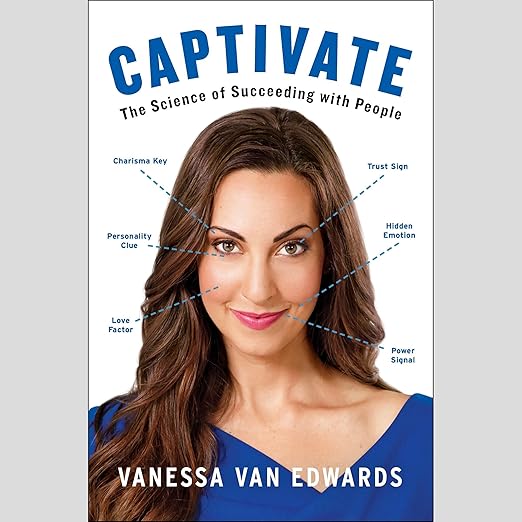
Vanessa Van Edwards works under the title human behavior investigator, which reads like something invented for a business card until you hear what she means by it. She runs a lab. She studies what actually drives the way people behave around one another, and Captivate is the manual assembled out of that work. Seven hours and twenty-one minutes, narrated by Van Edwards, on an audiobook Penguin Audio issued in April 2017.
Unusually for a listing of this age, one reviewer addresses the recording directly rather than the text. A five-star notice headlined around the audio says: 'I particularly LOVE the audiobook because the author is the one that is dictating the book and she is so engaging, so charming and so clear in her communication'. On a page where most comments describe reading, that is the single most useful sentence available.
Naming the Mechanics of a Conversation
The book is organized as a set of named systems, and the copy leads with three of them: the 7 Microexpressions, for speed-reading universal facial signals; Conversation Sparks, built on the idea that certain words generate dopamine in the person you are talking to; and the Social Game Plan, which maps a party or networking event as terrain with a sweet spot for making connections. The framing throughout is that people can be solved for, like a formula, and the copy leans on that comparison deliberately, invoking chemistry and programming languages as models for social life.
That framing is the book's biggest asset and its biggest liability at once. It gives an anxious reader something concrete to do, which is genuinely valuable, and it also promises more precision than social life supports. The description bills it as 'the first comprehensive, science backed, real life manual on human behavior', which is publisher language rather than a citation, and I would read the confidence of the claims as marketing rather than as evidence.
Where it earns its keep is observation. Van Edwards is good at noticing the specific mechanics of an interaction, the placement of a hand, the timing of a question, the difference between an answer and an invitation, and naming them so they become visible. Once you have a name for something you can notice it happening, and once you can notice it you can practice it. That is the actual mechanism by which this kind of book works, whatever the lab framing suggests, and it is why the chapters on questions and openings hold up better than the ones promising to decode a face across a room.
A reviewer who filed on publication day put the surprise well, having expected a book that would set about converting them into an extrovert and finding instead that 'This book celebrates introverts, extroverts, and those in between'. That matches my reading. The advice is about deliberate, repeatable technique rather than about becoming louder, which makes it more useful to quiet people than the cover suggests.
Van Edwards's Self-Narration Fits the Material
The audio-specific testimony is the strongest argument, and it is worth taking seriously because it is so specific. That five-star reviewer describes being 52, a lifelong shy person and a beginner real estate investor, and credits the recording specifically rather than the book in general. Reviews that name the format at all are uncommon. Reviews that explain why the format helped are rarer still.
Self-narration also fits the material unusually well. This is a book about vocal warmth, timing and conversational openings, written by a professional speaker and trainer. Having those principles delivered by the person advocating them lets a listener hear the technique operating rather than only hearing it described, which is a rare alignment between subject and format.
Comedy is the flip side, and audio raises the stakes on it. A four-star reviewer notes that some negative responses objected to Van Edwards's tone, describing the sort of corny office humor that gets a polite laugh, and adds that jokes in nonfiction do not bother them in principle. Written jokes can be skimmed. Spoken ones cannot, so this is a question to settle with a sample.
Formulas for Charisma Promise More Than They Give
That bonus PDF needs locating before you start. The description notes a supplementary document containing quizzes, graphs and illustrations, and a book that asks you to identify seven facial expressions is obviously going to need pictures. Anything visual sits in a separate file, so anyone planning to work through the quizzes should locate that document before starting rather than midway through a chapter.
The star average carries almost no information here. Three ratings produced it, which is far too small a base to carry meaning, while five written responses alongside it say considerably more. Read those instead, and give particular weight to the one that discusses the recording, since it is the only comment addressing what you would actually be buying.
Age is worth factoring in as well. Published in 2017, the social scenarios assume a world of conferences, parties and in-person networking that many listeners now encounter far less often. The observational material about faces, questions and conversational openings transfers intact. The room-working choreography reads as more of its moment, and nothing in the description points to remote or hybrid interaction at all.
Finally, the promise on the tin is larger than the delivery. Formulas for charisma, hacks for decoding people, a way to know exactly what to say to a boss or a date: that is a great deal to guarantee, and no book gets there. What you get instead is a well-organized set of things to try, which is worth having, provided you have not paid for certainty.
Shy Professionals Get the Most out of This
This is aimed at shy professionals, people who dread networking, anyone starting a role that suddenly requires meeting strangers, and readers who prefer explicit technique to vague encouragement. It also suits listeners who enjoy popular psychology delivered in named systems and numbered lists rather than as narrative.
It is a weaker purchase for anyone who wants rigorous behavioral science with sourcing they can follow, for readers already deep in the social-skills literature, and for listeners allergic to the hack framing or to jokes in nonfiction. The tone is confident and upbeat throughout, and that is not to everyone's taste over seven hours.
If the audio-specific review is the thing that tipped you toward this edition, I think that instinct is sound. A book about how a voice lands is better heard than read, the author is a professional at exactly that, and seven hours is a reasonable investment for a vocabulary you will use in every meeting afterward. Sample a chapter for the humor first.
Good to Know
Is the bonus PDF of quizzes and graphs included with the audiobook?
The description states that a supplementary PDF with quizzes, graphs and illustrations is included. Since the book asks you to recognize seven facial expressions, the PDF is where those images live. Find it before you start, because the quizzes are difficult to complete from spoken instructions alone.
Is Captivate actually useful for introverts?
Reviewers say yes, and one who expected to be told to become an extrovert reported the opposite, noting that the book celebrates introverts, extroverts and everyone between. The advice centers on repeatable technique rather than on higher energy, which tends to suit quieter readers better than the cover implies.
Does Vanessa Van Edwards narrating her own work make a difference?
One five-star reviewer says it does, specifically praising the author's delivery as engaging, charming and clear, and crediting the recording rather than the text. Given a book about vocal warmth and conversational timing, hearing the author demonstrate the principles carries an advantage a hired performer could not supply.
Is this audiobook still relevant given its 2017 publication date?
Mostly. The material on facial expressions, question design and conversational openings transfers without difficulty. The sections mapping parties and networking events assume frequent in-person gatherings, and remote or hybrid interaction is not covered, so expect the room-working chapters to feel more of their moment than the rest.