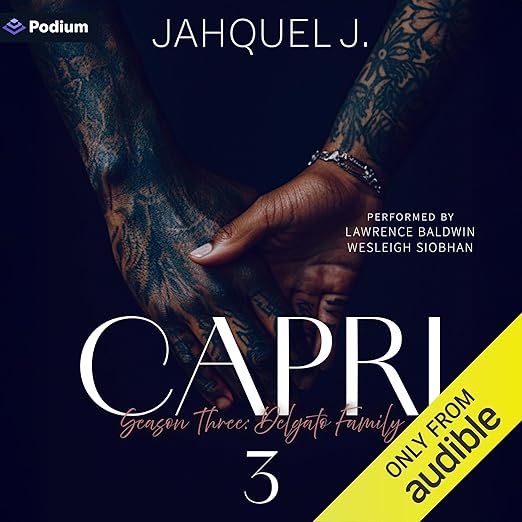
- Narration: Wesleigh Siobhan reads five hours and fifty-four minutes alone, holding a husband, a sister by choice and three surnamed households in one voice.
- Themes: chosen sisterhood, a three-family alliance, retribution, marriages under strain
- Mood: Maximal and unapologetic, melodrama with real weight underneath it
- Verdict: A strong late-season entry, and a genuinely poor place to meet this family for the first time.
Whatever happened in the house of horrors, this audiobook's description declines to say. It hands you blood on the narrator's hands, a knife in somebody's head, a room full of people looking at each other, and one phone call to a husband named Meer. Then it stops: all you need to know is that it was handled. That is either the boldest blurb move in serialized fiction or a confession that the plot cannot be summarized without ruining it, and the column underneath argues hard for the second reading.
Jenine Corneal Says Genres Are Tough Here
Jenine corneal opens a response with the most useful sentence on the page. Genres are tough, it says, because books like this fall into so many categories. It is urban, the same entry goes on, but it runs from gutter to upper class and everywhere in between, a full rotation of life with situations lifted from a thriller movie. The catalog files it under literature and fiction with an African American tag, which is accurate and conveys almost nothing. The reader's description beats the catalog's by a distance.
Blood on Her Hands Makes Her a Sister
Three family names arrive inside a single sentence of the description: the Delgatos, the Infernos and the Casellis. The narrator watches a best friend standing with blood on her hands and decides she has shed the best-friend title and become a sister, someone who will protect all three houses as her own. That one sentence carries the book's whole architecture. Three families, one loyalty, and a new member admitted by an act of violence and not by a ceremony.
Five hours and fifty-four minutes is the runtime, and the responses suggest it goes on people more than on plot machinery. They name characters constantly: Morgan and Rich and their crooked deals, Jesse and David and what one reader calls their dusty antics, Brandi and her conniving ways, Capella and Aimee and a marriage nobody saw coming, and Tasha, described flatly as the ultimate snake. That is a cast list, no kind of synopsis, and the cast list is what people come to these books for. What the description withholds is any account of the plot, and the reviewers, who have all read the thing, mostly decline to supply one either. They allude. They ask each other questions. They warn. The result is a page that transmits temperature beautifully and information hardly at all, which reads as a warning or a recommendation depending entirely on how you shop for books.
MB5 Turns a Review Into Discussion Questions
MB5 does something no other entry here attempts. The review turns into a numbered list of discussion questions addressed to other readers: was the family too easy on Aimee, was Capella wrong for sleeping with Shante given the situation, what do you make of Core wanting both Jeffie and Skyler. Question four begins, should Quameer kill Brandi, or should he, and there the text is severed. A review that has turned into a book club agenda, cut off mid-question, is a strange and rather wonderful artifact of how these serials actually get read.
Siobhan Alone Holds This Many Households
Wesleigh Siobhan is credited with the reading, and on a book keeping this many households in the air at once, a single credit is worth pausing over. The description by itself puts a husband, a best friend turned sister, a woman named Zoya and three surnamed families into one short passage. Nothing anywhere describes how one reader separates them. What the page does confirm is that no second voice was brought in to help with the load.
Korcia Lewis writes that the author outdid herself weaving this messy, jaw-dropping drama, and admits to being ready to throw a Kindle over what Jesse and David get up to. Tiffany Mullen, filing from Canada, credits the author with writing about real things, real struggles and mental health, and calls the stories relatable on many levels. Both are five-star responses and both build the same case from opposite ends: the melodrama is the delivery mechanism, and something considerably more sober is riding inside it. Between them those two responses also settle the question of tone. Nobody here is reading this book ironically or from a safe distance. They are arguing with it.
Every Visible Grade Is Five, Yet the Badge Reads 4.8
Count the dates before you count the stars. Four entries out of five carry dates earlier than this recording's own release on August 26, 2025: one from March 2025, one from January 2025, and two from late 2024. A single entry, filed in January 2026, arrives after the audio existed. The calendar runs backward against the product here, the usual sign that a book's reception has been inherited from an earlier edition and parked beneath a later one.
All five visible grades are five stars while the badge on the page reads 4.8, and both facts hold at once. Ten whole-star votes produce a total of forty-eight out of fifty, so two of the ten withheld a star and neither of them wrote anything down. The dissent on this book exists purely as arithmetic. Every voice you can actually read agrees with every other, which is worth remembering before treating this column as a representative sample of anything.
Reviewers Admit These Cliffhangers Cause Real Stress
Anybody who has followed the Delgato seasons this far will want this volume, and the enthusiasm here is specific enough to be credible. People are naming the betrayals they want avenged and the couples they want repaired, which is not how anyone writes about a book they merely liked. Readers who want their family drama maximal, with a killing and a marriage inside the same installment, get under six hours that never eases off. The runtime doubles as a manageable re-entry point for anyone returning to the series after a gap, and at least one reader is deliberately slowing down to make the season last, describing a slow read undertaken to savor every detail. The cliffhanger warning is explicit too: one response states plainly that the endings in this series are causing real stress.
Look elsewhere if you want a book that resolves, if profanity and violence are barriers, or if you need a listing that tells you what happens before you spend anything. This description deliberately withholds its own plot while the reviews spoil freely, so no comfortable middle ground exists between learning nothing and learning far too much. Bring the whole season with you if you possibly can, because this volume assumes every earlier one and repays the assumption generously.