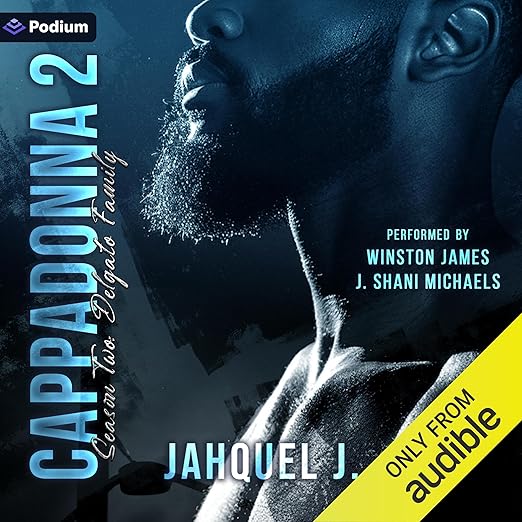
A reviewer here remembers two voices. Loved the combo of J. Shani and Winston, the entry reads, they elevated this stellar read. The credit line on this audiobook names exactly one person, Winston James, and offers no second reader anywhere. Either the recording is a dual narration and the listing has misplaced half of it, or somebody is remembering a different edition, and nothing on the page lets you settle which. That is an odd thing to leave hanging over a four hour and forty-two minute novel written entirely in first person, where the whole experience depends on whose voice is doing the talking.
Big Capp Is Big Unhinged, Reviewers Say
Winston James is the entire credit for those four hours and forty-two minutes, which is short by any measure you like. The blurb is written from inside Cappadonna's head and never steps outside it: I came home and ended up with two enemies because of the women I choose to love. It never says who Kendra is, or Alaia, or Tweety. It tells you how the man narrating feels about each of them, and then it closes on a promise to put his hands around somebody's throat. Bold way to sell a book, and a heavy demand on one reader.
Four hours and forty-two minutes is short enough to finish in an afternoon, and the responses below suggest that is by design rather than by accident. One of them describes the experience as watching a series unfold episode by episode. Another calls it a page turner that could not be put down. Installments released in sequence and built to be swallowed whole are a publishing model in their own right, and the runtime here fits that model exactly rather than looking like a book cut short.
Readers who wrote in are remarkably consistent about what they came for, and it is not plot. Big Capp is big unhinged, runs one headline, and the entry beneath it explains that the menacing scenes produced laughter rather than dread, that Capp is missing screws and his crew is missing more, and that the same man loves his family fiercely. Another calls Cappadonna unhinged in the best and most chaotic way possible. The appeal on record is a character delivered at volume, by a single performer.
War for Love, Blood for His Seeds
Kendra, Alaia and Tweety are the three names the blurb throws at you, and not one of them arrives with a role attached. For anyone starting here that is a problem, and for the audience this page was built for it is not a problem at all. The series field reads Season two: Delgato Family: Cappadonna with the number field left blank, so a browser cannot work out whether this is a second book, a second season, or the second half of something larger. The numeral in the title is the only ordering information on offer.
Podium Audio issued this on April 15, 2025, and the reader response arrived mostly in the following winter: one entry in October 2025, then a cluster in February and March 2026. That pattern reads like a series catching on after the fact rather than a launch week, which matches what the entries themselves describe. One ends on a straightforward demand for the next book. Another opens by ranking this against Capone and finding it better, which tells you a whole shelf sits behind this page that the listing never maps.
Short books reward strong readers, and a first-person crime novel narrated by its most volatile character is close to the maximum demand the form can make. Menace and tenderness have to live in the same chapter, because the blurb explicitly sets one against the other: war for the woman he loves, blood for his seeds. Whether the recording pulls that off is the single question this page cannot answer, and the only listener who addressed the performance at all remembers a name that is not on the credit.
Cappadonna Spelled Four Different Ways
Series bookkeeping is the practical hazard. The entries spell the lead four different ways between them, Cappadonna, Capadonna, Cappodonna and Capp, while the family name arrives as Delgato in the metadata and Delgado in at least one response. Charming in a review column, useless if you are trying to locate book one. No link to a previous installment appears anywhere on the page, and a numeral in a title is doing all the work that a series number field exists to do.
Because the badge sits at 4.8 across twelve votes with five of them written out, the arithmetic here stays genuinely open and no particular distribution is forced. What the visible grades do show is one four sitting among four fives, and that four is the most useful text on the page. It praises the bond between Cappadonna and Cappella, mourns a mother, promises to keep going, and then breaks off mid-word at Ca, where the display simply stops carrying it.
You should also know what the tags decline to say. The listing files this under literature and fiction with one tag reading African American, which is accurate as a shelf and silent as a warning. The blurb ends on a man promising to touch every person his enemy has ever loved until his hands are around that enemy's throat. Violence is the engine here rather than the backdrop, and anyone buying off a bare category label should read the closing two sentences of the description first.
Four Hours Makes a Cheap Trial Run
Urban fiction readers already following the Delgato books are the obvious audience, and the column here is largely a group of them talking to each other in shorthand. If you want a lead who is funny and frightening inside the same paragraph, and you can accept a novel that opens mid-conflict with no orientation whatsoever, this was assembled for you. The runtime also makes it an unusually cheap trial run for anyone curious about the series but unwilling to commit to a full-length novel on spec.
Hold off if you have not met these characters before, because the blurb assumes you know three names it never introduces and the series field cannot even tell you where this falls in the order. Hold off as well if a single credited reader set against a listener's clear memory of two is the kind of thing that will nag at you, since nobody on this page can resolve it. Everyone else gets a compact, loud, unapologetic installment with a devoted readership behind it. Four hours forty-two is a small bet on a very big voice.