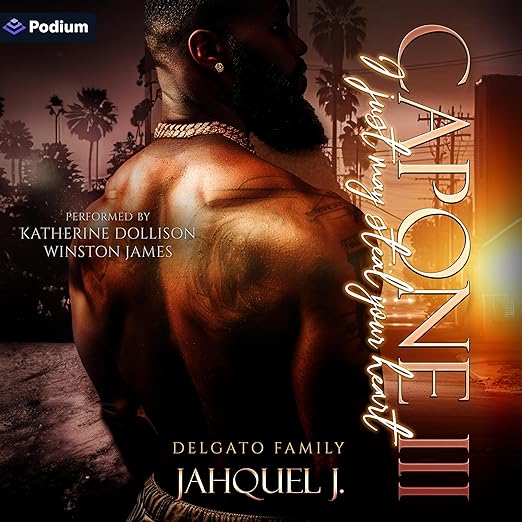
Two people appear to be speaking in the description of this audiobook, and the listing never says which of them is telling the story. The first talks about a family taken away, about protecting a sister and an unborn niece or nephew, about basketball mattering less than getting blood back for Joie and a lost child. The second is preparing to marry Capone and enter the Delgato family, and has decided to stand beside him rather than against the life he leads. Both voices sit in the same blurb, separated by nothing more than a paragraph break, with eight hours and fifty-six minutes of recording behind them.
Dollison Voices Two Contradicting First-Person Narrators
Podium Audio is the publisher, the runtime is eight hours and fifty-six minutes, and Katherine Dollison is credited with the reading. That last detail deserves a moment of attention. A description carrying at least two first-person voices, attached to a series the responses describe as an ensemble of family members, arrives with a single name in the narration credit. One reader is handling the whole cast. That is a structural fact about the recording rather than a judgment on the performance, and it is worth knowing before you commit an evening to it.
Season one: Delgato Family is the series line on this page, with a 3 beside it and Capone III on the cover. The readers treat that number as final. Salene Whyte calls it the conclusion to Delgato season 1. Tenika calls it the perfect ending to this roller coaster story. Anonymous Buyer skips the individual book entirely to praise the series, headlining the response Menace II Society meets Juice and signing off with ten out of ten. If this page is where you are starting, you are starting at the last chapter of something.
Most of what these readers actually care about never appears in the description. Towana Powell writes about Capone and Erin, and about watching Ella grow across the series. Salene Whyte's highlight is Capri, Erin, and Jaiden hopping off the porch, and the same response singles out how the situation panned out with Capone and Trilla. Not one of those names is in the blurb, which mentions Joie, Cappadonna, and the Delgato family and stops. Readers arriving at a third volume already carry the cast in their heads. This page quietly assumes the same and offers no help to anyone who does not.
Tenika Roots for a Family Over Revenge
Anyone who reads street fiction for the family dynamics rather than the shootouts is being addressed directly here. Tenika's phrasing is the most revealing line in the column: this series was the first to have me rooting for a family. Nobody describes a revenge plot that way. Whyte's run of adjectives, gritty and emotional and funny, points in the same direction, and both responses spend far more of their length on character growth than on the plot machinery the description leads with.
Once you accept that this is a finale, the case for hearing it rather than reading it gets simple. Eight hours and fifty-six minutes is one long evening or two comfortable ones, and the payoffs the column describes, the growth in Ella, the resolutions around Capone, Erin, and Trilla, land harder spoken than skimmed. A first-person novel read aloud also does something the page cannot manage: it puts an actual voice on a character who has been talking straight at you for three books.
Where the material earns its runtime is in the tension the second voice describes. This is a romance shelved beside literary fiction, tagged African American, built on revenge, protection, and marrying into a family whose business the speaker used to reject on principle. Wanting the man without wanting the life he comes with is the engine of the thing, and the readers who call the book emotional are responding to that rather than to anything violent. The description states the bargain plainly: the only rule is that Capone has to make it home.
Which Voice Opens the Recording Stays Unclear
Listeners should know that the description does not survive a careful reading. Its two voices contradict each other on basic facts. One has lost Joie and a child and wants the person responsible dead; the other is planning a wedding and asking only for a husband who comes home. Both may well be in the novel, since a series like this can carry more than one point of view. What the page will not tell you is which voice opens the recording, or whether the reading marks any difference between them. A sample will settle that faster than the blurb ever could.
If you lean on the review column to decide, notice that one response stops in the middle of a word. Salene Whyte's four-star write-up runs through the plot, praises the character growth, then breaks off mid-sentence on the subject of Tasha and prison. Whatever the reservation was, the page swallows it, and the four stars go unexplained. Towana Powell's criticism is the only one that survives intact: a sense that the book was drag out.
A second discrepancy sits in the same column. The description names Cappadonna among the mentors standing behind the narrator, while Powell signs off looking forward to downloading the Capdonna series. Two spellings of one name, and nothing on this page to settle which of them the next set of books will be filed under. That matters if you intend to keep going after the finale, because searching the wrong spelling will turn up nothing at all. Neither version turns up elsewhere on the listing.
Family Intact Beats a Body Count Here
Five responses is a small sample, but it is a remarkably consistent one. Readers who have followed the Delgato family through the first two volumes are the obvious audience, especially anyone invested in Erin, Ella, or Capri, whose arcs the column keeps circling back to. Romance listeners who like their love stories dangerous, and who would rather end with the family intact than with a body count, will find the finale doing more or less what they hoped for.
Fans of tight plotting should be warned that at least one reader found the middle slack. Anybody who needs a self-contained story, or who has no patience for a cast introduced two books earlier, should start at the beginning of the season rather than here. Anybody arriving at book three cold will spend the first hour building a cast list out of context clues, and nothing on this page will help them do it.
Questions Listeners Ask
Do you need the earlier Delgato books before starting this audiobook?
Yes, in practice. The series line reads Season one: Delgato Family with a 3 beside it, and readers call this the conclusion. The most-discussed characters, Erin, Ella, Capri, Jaiden, never appear in the description. Coming in cold means reconstructing three books of relationships from context while the plot moves.
How many narrators does the Capone III audiobook use?
One. Katherine Dollison holds the entire reading credit for eight hours and fifty-six minutes. The description alone contains at least two separate first-person voices, and the series is described by readers as a family ensemble, so a single reader is carrying a considerable amount of vocal distinction alone.
Why does the description seem to change narrators partway through?
It genuinely does. The first half speaks as someone avenging Joie and a lost child; the second speaks as someone marrying Capone into the family. The listing offers no explanation and no labels. Both threads may run through the novel, but the page never says which voice you meet first.