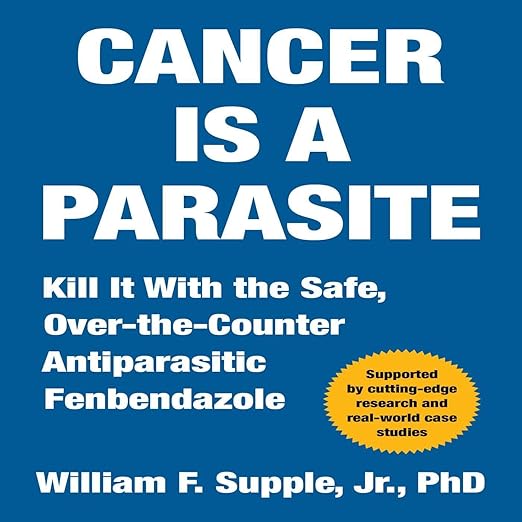
Three years past a diagnosis, a family posted a review that reads more like a thank-you note than an assessment. Their brother is alive, he was at his son's wedding a few months back, a recent scan came back perfect, and his doctor called him a miracle patient. The family has followed this author's work since 2023 and says so in the first line. That five-star, filed three days after this audiobook appeared in March 2026, is the register of nearly everything written about Cancer Is a Parasite, and any honest review of it has to start by saying what kind of book generates responses like that one. This is an argument against the standard of care, told largely through the people who went outside it.
Fenbendazole's Microtubule Claim, Told Through Patient Testimony
The claim is specific and the copy states it without hedging. Fenbendazole, an inexpensive and widely available antiparasitic medication with a long safety record, is presented as a serious cancer treatment on the grounds that cancer cells and parasites share a vulnerability in their microtubule structures, which the drug is described as uniquely equipped to target. The promise attached to that mechanism is the part doing the emotional work: destruction of cancer cells while healthy cells are left alone, and none of the toxicity that makes conventional chemotherapy what it is. The author, credited as a PhD on the byline, founded the Substack the copy names, which is where most of this readership arrived from.
What the book delivers alongside the science is testimony. The description promises case studies covering breast and prostate cancer, lung and brain tumors, drawn from patients who tried this after conventional treatment had been exhausted, and it frames the whole project as a challenge to the medical establishment and a redefinition of cancer as a parasitic process. That structure, mechanism followed by human story followed by protocol, is what makes it listenable rather than technical. It is also what makes it persuasive in a way that has nothing to do with whether the underlying claim survives scrutiny, and both facts deserve stating in the same breath.
Torres Narrates Pharmacology and Testimony With Restraint
Anyone trying to understand the fenbendazole argument will find it assembled here in one place. Eight hours and twenty-four minutes from Skyhorse gives it room to lay out the reasoning, the history and the case reports in sequence, which no scattered set of posts or podcast appearances can do. A five-star from March 12 makes the practical case for the format, calling the book excellently researched and yet concise, saying most of what is currently known is presented clearly, and mentioning owning both the audio and the ebook, which is the version of endorsement that actually tells you something about the file.
Eric Torres is the only voice on the recording, and the material puts unusual demands on any reader taking it on: drug names, mechanisms of cell division, dosing discussions and a steady procession of patient histories, none of which can be skimmed by ear. What a listener needs is clean enunciation of the pharmacology and enough restraint in the testimony sections to let those stories carry themselves, because material this emotionally charged does not need any help. Anyone planning to act on the protocols will want the ebook alongside the audio regardless.
Five-Star Launch Reviews Include One Sick Dog
Read the record's own shelving before you read anything else. It files under health and wellness with an Alternative and Complementary Medicine tag, and the copy describes evidence consisting of case studies, theories and testimonies rather than clinical trials. None of that is concealed; it is the book's declared position, and it advertises a challenge to the medical establishment on its own cover. But it changes what this can responsibly be used for. Taken as an argument to raise with an oncologist, it is a legitimate thing to listen to. Taken as a protocol to follow instead of treatment, it is a decision no audiobook should be making for anyone.
Reader responses deserve the same scrutiny. Eight ratings, five written responses, every one of them five stars, and all five filed inside two weeks of the March 5 release, which is a launch reaction from an existing following rather than a settled verdict. One of the five, posted on March 6, is about a dog: an eleven-year-old Belgian Tervuren given six weeks to live after a terminal diagnosis, reported still alive. That response is sincere and specific, and it is also a veterinary case standing among the human ones on a page selling a book to cancer patients, which tells you how mixed the evidence base being cited here really is.
Meant to Inform the Appointment, Never Replace It
Patients and caregivers who have already encountered fenbendazole and want the fullest version of the argument are the clear audience, along with anyone determined to understand what family members are talking about when they raise it. A five-star from March 11 suggests a wider case, recommending the book to people with no current diagnosis on the grounds that it is better to know what this is before you or someone close to you needs to decide anything. That is a fair use for it, and reading it in calm circumstances rather than desperate ones is likely to produce clearer thinking about what it does and does not establish.
Peer-reviewed clinical evidence is not what this offers, and knowing that at the outset saves a great deal of frustration later. Anyone in the middle of active treatment decisions should be especially careful with a book whose emotional pull is this strong and whose framing casts conventional medicine as an adversary, since fear and hope are both terrible advisors on dosing. The most useful thing this record can be is a well-organized brief on a claim that is circulating widely and will keep circulating. Take it to the appointment. Do not take it instead of the appointment.
Before You Listen
What kind of evidence does the book actually present?
Case studies, patient testimonies and a proposed mechanism, rather than clinical trial data. The description sets out the microtubule argument and then supports it with real-world accounts from people who turned to the drug after conventional treatment ran out. Anyone expecting trial data, control groups or peer review should recalibrate before pressing play.
Where did the fenbendazole story come from before this book?
One five-star traces the route it took, describing finding a website years ago, following semi-annual podcasts on the topic, then arriving at the author's Substack, which the copy names directly. The book gathers material that had been circulating in scattered form and gives it a single structure, which is much of its appeal to that existing audience.
Does the audiobook include the case studies and protocols in full?
The description promises case studies across breast, prostate, lung and brain cancers as part of the main text, so they are in the recording. Protocol details are the harder part to use by ear, since numbers and schedules do not survive listening while doing something else. Plan on a text version alongside if precision matters.
Is this audiobook safe to listen to during active cancer treatment?
Listening is not the risk; acting on it alone is. The book argues explicitly against the medical establishment, which is a persuasive frame to encounter while frightened. Anyone in treatment should treat it as material to raise with an oncology team, since drug interactions and monitoring are exactly what a book cannot supervise.