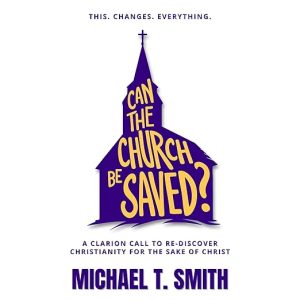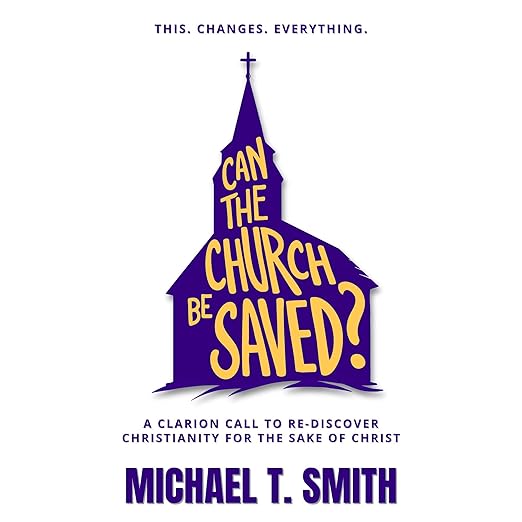
Spiritual disruption is a familiar premise in religious audiobooks, but Michael T. Smith arrives at the genre with something sharper than the usual gentle reform manifesto. I listened to Can the Church Be Saved? over the course of two long drives, and what struck me from the opening chapter was how clearly the author understands the difference between dismantling an institution and mourning it. This is not a polemic. It is, as Smith himself frames it, a love letter, and the audiobook format deepens that quality considerably because you are hearing a pastor's voice as much as a writer's argument.
The audiobook clocks in at just over four and a half hours, which is compact for the ambition of the thesis. Smith is asking whether the organized Church, across two thousand years of accumulated doctrine and political architecture, has drifted so far from Jesus's actual message that it has become the thing it was meant to oppose. That is a provocative question, and Smith poses it with enough specificity that you cannot easily dismiss it as generalist deconstruction. He is not asking listeners to abandon faith. He is asking them to interrogate what has been done with it.
Smith's Different Voices and Accents
Smith narrates his own work, and this turns out to be the right call for this particular audiobook. One reviewer specifically noted appreciating "his different voices and accents on audible," and while that playfulness might seem at odds with the gravity of the subject, it actually serves the book's core argument: that faith can coexist with irreverence, humor, and self-awareness without losing its depth. Smith's cadence in the more devotional passages is measured and warm; in the more critical sections, he carries a controlled urgency that a hired narrator would likely smooth away. That urgency is load-bearing.
Where the audiobook earns its place in the religious disruption space is in the precision of its critique. Smith identifies what he calls "weaponized Christianity" and the us-versus-them logic that has come to define much of organized religion's public face. He does not blame congregants; he traces the structural pressures that make fear and tribalism easier to maintain than love. This is an argument with a clear lineage, running from the social gospel movement through liberation theology, and Smith's contribution is making it accessible and personal rather than academic.
Pairing a PDF With Jesus's Actual Message
The accompanying PDF, noted in the audiobook's product details, suggests that Smith designed this as a companion experience rather than a purely sonic one. Listeners who engage with both formats will find that the audio carries the emotional argument while the written text presumably provides the structural scaffolding. As a standalone listen, however, the audiobook holds up. Smith's chapters are tight, and he resists the temptation to pad with anecdote where argument would serve better.
The book's spiritual center is a recovery of what Smith sees as Jesus's actual message, which he presents as radically inclusive and fundamentally incompatible with the power structures the institutional Church has normalized. Reviewer Frank S. described finishing it "in tears," calling it "one of the most truthful revelations of Love." That response is not unusual for this subgenre, but what distinguishes Smith's work is that the emotional impact appears to arise from recognition rather than manipulation. The writing earns its feeling.
For listeners approaching from a secular or post-religious perspective, the book's theological framing may require some patience. Smith is not writing for skeptics; he is writing for people who believe but who have been hurt by the vehicle of that belief. That is a specific and underserved audience, and Smith serves them with genuine care. The audiobook's five-star ratings and its small but emotionally engaged reviewer community suggest it is landing where it is aimed.
Too Conciliatory in Four and a Half Hours
The book's central limitation is one of scope. Smith makes large historical claims about the Church across two millennia, and at four and a half hours the runtime does not accommodate substantiating all of them with the rigor a historian might require. Listeners who want scholarly apparatus will need to come to Smith's argument with patience and a willingness to follow the logic rather than demand footnotes at every turn. This is pastoral theology more than academic theology, and those are different modes of engagement.
A particular emotional register runs throughout the audiobook, one of anguished love for an institution Smith clearly cannot quite give up on. For some listeners, that sustained mourning will be precisely what resonates. For others, it may read as too conciliatory toward structures that reviewer Lisa, writing from a faith perspective, would argue deserve sharper criticism. Smith ultimately opts for the long view, which is either wisdom or accommodation depending on where you stand.
Speaking to the Deconstructing and Post-Evangelical
This audiobook is well suited for listeners who identify as Christian but who have found themselves increasingly alienated from institutional church culture, sometimes called the "deconstructing" or "post-evangelical" community. It is also a useful listen for clergy and lay leaders who feel the tension between the institution they serve and the faith that originally called them to it. Listeners who are firmly outside any faith tradition and approaching purely as observers may find the book's internal theological logic requires more patience than the reward justifies. Those who want historical documentation of the Church's failings rather than a roadmap for renewal will want to pair this with a more scholarly treatment.
Frequently Asked Questions
Is this audiobook suitable for people who have left the church entirely?
Partially. Smith writes primarily for people who still hold Christian faith but feel alienated from its institutional expression. Listeners who have fully left religion may find the theological framework requires patience, though the critique of power structures and tribalism translates across secular contexts.
How does this audiobook compare to others in the Christian deconstruction genre?
Smith's work is more pastoral and emotionally driven than analytical texts like Rachel Held Evans's work or Bart Ehrman's historical critiques. It sits closest to the spiritual memoir tradition while making a sustained theological argument.
At four and a half hours, does the audiobook cover enough ground to support its claims?
The runtime is tight for the scope of the argument. Smith covers two thousand years of institutional history at a necessarily high altitude. Listeners who want rigorous historical documentation should pair this with supplementary reading; those comfortable with pastoral argument will find the pacing purposeful.