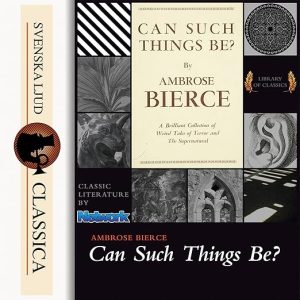
- Performance: Roger Melin brings measured restraint to Bierce's economical prose, avoiding theatrical overreach and letting the language carry its own strangeness with appropriate understatement.
- What it covers: The supernatural as war's aftermath, rationalism vs. inexplicable events, Civil War trauma and haunting
- Feel: Cold, precise, and quietly unsettling, like a newspaper report of something that should not exist
- Our call: A strong audio collection for fans of classic American supernatural fiction, strongest in the Civil War-inflected tales where Bierce's firsthand experience gives the horror real weight.
Ambrose Bierce wrote ghost stories the way a soldier writes about battle: with the emotional residue of someone who had seen things he could not fully explain and found dark comedy in the unexplainable. This audiobook collects 24 of his supernatural tales, narrated by Roger Melin, spanning Civil War fields, rural cottages, and city streets where the boundary between the living and the dead grows inconveniently thin. Bierce is best known today for "An Occurrence at Owl Creek Bridge," but the range of the stories assembled here shows a writer with a far wider and stranger imagination than that single canonical piece suggests.
The title question is both provocation and premise. Can such things be? Bierce never quite answers it. His narrators encounter ghosts, apparitions, and events that refuse rational interpretation, but the stories resist the comfort of either full supernatural confirmation or tidy rationalist dismissal. That refusal to resolve is what makes Bierce's work feel more modern than his Victorian-era contemporaries, and it is what keeps these 24 tales unsettling long after the final story ends.
Bierce Writes Horror Like a News Report
Bierce sits in curious company in American literature. He was a contemporary of writers like Mark Twain and had the Civil War experience that shapes so many of the stories here, where soldiers encounter the dead in ways that feel more like memory than haunting. The stories set near or on Civil War battlefields carry a different kind of weight than the purely domestic ghost tales. A doom or fatality seems to reach the protagonists from the very first pages, as one reviewer noted: the more the characters pursue the conclusion of their stories, the more inevitable and cold the outcome becomes. Bierce does not offer catharsis.
What he does offer is remarkable clarity of prose. Unlike Poe, who dressed horror in elaborate Gothic atmosphere, Bierce writes with an almost journalistic economy. His ghost stories feel like newspaper reports of inexplicable events, which is both their most original quality and occasionally their limitation. A few of the 24 stories in this collection feel like sketches rather than complete narratives, the prose equivalent of a photograph of something that should not exist: vivid in the moment, but thin on sustained dread. The best stories here, however, sustain that dread perfectly, and on audio in particular, their compressed intensity lands with considerable force.
Melin's Restraint Lets the Dread Speak Itself
Roger Melin's narration is the key decision point for this audiobook. He reads with appropriate restraint, avoiding the kind of theatrical performance that can actually diminish horror by signaling too clearly what the listener is supposed to feel. Bierce's prose is tightly controlled, and Melin respects that control, letting the language carry the strangeness rather than imposing interpretation through vocal exaggeration. One reviewer praised his work specifically, noting that the narrator "did a fine job," and the consistent 4-star territory of the collection's overall rating suggests most listeners found the pairing effective.
At 7 hours and 32 minutes, this is an audiobook collection well-suited to a long afternoon or a series of evenings. The short story format means there is no sustained narrative momentum that requires concentrated uninterrupted listening. You can pick it up, finish a story or two, set it down, and return without losing the thread. That episodic quality also makes it ideal for deliberate listening: a single Bierce story, absorbed fully, rewards more than three stories consumed in a distracted half-hour. Melin's pacing supports that reflective approach, delivering each tale at a speed that allows the language to register properly.
Civil War Tales Carry the Most Weight
Bierce's settings vary significantly across the 24 stories, and the quality is uneven. The Civil War tales tend to be the strongest, informed by firsthand military experience that gives them an authority and bleakness his other supernatural work occasionally lacks. The urban ghost stories and country cottage hauntings are more familiar in their architecture, closer to Poe's tradition, though Bierce always brings enough stylistic eccentricity to distinguish his work from imitation. Pay particular attention to the stories where the protagonist is a veteran or observer rather than an active participant: Bierce's ghost soldiers are among the most quietly devastating figures in American supernatural fiction.
The collection was originally published in 1893, and the language reflects its era in a few places, particularly around casualness toward violence and some dated social attitudes. None of this rises to the level of needing forewarning, but modern listeners should calibrate their expectations for fiction of this period. The darkness here is not the darkness of transgression but of observation, a writer who watched terrible things and wrote them down precisely because he could not unflinchingly look away.
Fans of Owl Creek Bridge Should Continue Here
This audiobook is for readers who want classic American supernatural fiction delivered without contemporary genre machinery. Bierce offers no redemptive arcs, no final confrontations with evil that restore order, and no love stories threading through the horror. If you come to him expecting Poe's Gothic richness or modern horror's sustained dread, you will need to recalibrate. What you will find instead is something rarer: short fiction that uses the supernatural as a lens on human limitation, mortality, and the particular psychic residue of war.
Listeners new to Bierce would do well to approach this as a companion piece to his biography and his other famous works. One reviewer who admitted knowing more about Bierce the man than Bierce the writer found the collection rewarding precisely because the persona and the fiction illuminate each other. If you already know and love "Owl Creek Bridge," this collection is a natural extension. If that story left you curious about what else this strange, difficult writer could do, Can Such Things Be? provides a generous answer across 24 stories and seven and a half hours.
A Few Questions About Can Such Things Be?
Do you need to be familiar with Ambrose Bierce's work before listening to this audiobook?
No prior knowledge is required. The audiobook collects 24 standalone short stories that function independently. However, listeners who know Bierce's biography and his most famous story, An Occurrence at Owl Creek Bridge, will find additional depth in several tales where his Civil War experience surfaces as a specific kind of dread.
Is this audiobook complete, or does it include only selected Bierce stories?
One reviewer noted the collection is excellent if abbreviated, meaning it does not include every story from the original 1893 Can Such Things Be? publication. At 7 hours and 32 minutes with 24 stories, it represents a substantial but curated selection rather than a definitive complete edition.
How does Bierce's style compare to Poe for listeners who enjoy classic horror fiction?
Bierce writes with significantly more economy and journalistic restraint than Poe. Where Poe builds Gothic atmosphere through layered description and psychological interiority, Bierce delivers strangeness in compact, almost reportorial prose. The effect is colder and less immersive but arguably more lasting. Listeners who find Poe's density oppressive often respond well to Bierce's stripped-down approach.
Is the audiobook format well-suited to short story collections like this one?
Yes, particularly for Bierce. The short story format means you can listen to one or two tales in a sitting and return without losing narrative momentum. Roger Melin's pacing suits reflective listening rather than background consumption, and Bierce's compressed intensity rewards the kind of focused attention an audiobook commute or deliberate evening session provides.