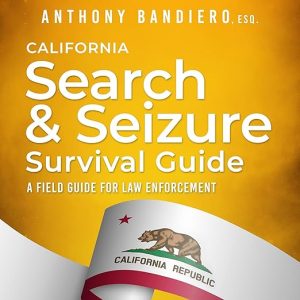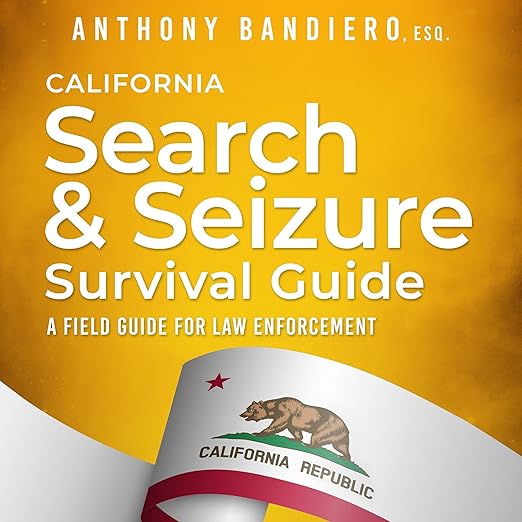
Picture a patrol officer parked between calls, running through a mental checklist before a stop they know could produce a search. The California Search & Seizure Survival Guide audiobook exists for that officer. Anthony Bandiero designed this resource with working field officers in mind rather than law school professors, and the structure of this audio edition reflects that practical orientation at every level. At just over ten hours, it is long for a reference work, but that length corresponds to genuine depth of legal content rather than padding. Search and seizure law is complicated, and any honest treatment of it at a level useful to field officers requires real time and careful organization to cover the ground adequately.
Checklists Turn Case Law Into Field Procedure
Bandiero's core argument is structural as much as legal: police officers get search and seizure wrong not because they are careless, but because the information they need is buried in lengthy case opinions and legal texts that are not written for rapid field application. This audiobook's checklist-style format, praised by reviewers and officers in testimonials, tries to fix that by organizing case law into immediately usable sequences that a working officer can actually follow under pressure. The coverage spans California state law, Ninth Circuit decisions, and relevant U.S. Supreme Court rulings, which is the full legal stack any California officer needs to navigate a stop cleanly and legally in the field.
The writing style that earned Bandiero praise from field officers across the state is genuinely accessible throughout the audiobook. He writes in plain English with direct sentences, which translates reasonably well to audio delivery. For a text that could have been a dense legal treatise full of passive constructions and technical qualifications, the listening experience is more coherent than expected and more usable than most competing resources. That said, this is emphatically a reference audiobook, not a narrative one. Do not come expecting story arcs or distinctive personality. The content is entirely the point, and the content is solid and reliable across the relevant areas of California law.
Double-Check You Got the Right Edition Year
The audiobook format has a specific practical advantage for this kind of material: you can absorb case law while doing something else entirely. An officer who drives a patrol vehicle, works out at the gym, or runs before a shift will get more return from audio than from scanning a printed checklist under pressure and time constraints. One reviewer noted this audiobook is perfect for all levels, suggesting the material works for officers at different career stages, not just rookies refreshing basics or veterans with something specific to update. That range of applicability is a genuine strength for any reference title aiming at a professional audience.
One reviewer flagged a practical purchasing issue worth noting before you buy: they ordered the 2024 edition and received the 2020 version instead. If you are purchasing this audiobook, verify the edition date carefully before completing the transaction. Search and seizure law shifts with every significant appellate decision, and California's Ninth Circuit generates meaningful new rulings on a consistent basis. The edition in your cart should match the edition you actually need for current field application.
Virtual Voice Handles the Legal Terms Competently
The checklist format that makes this so practically useful also creates a structural characteristic worth understanding as a listener before you begin. The audiobook is not built for linear consumption the way a narrative nonfiction book is designed to be experienced. It is organized for targeted access to specific situations, so you may find that jumping between sections serves you better than working straight through ten hours from beginning to end. Listeners who treat this as a structured review of legal principles organized by situation type, rather than as a continuous argument to follow sequentially, tend to get more practical value from the format.
The Virtual Voice narration handles technical legal language competently enough for comprehension throughout the full runtime. The lack of a human narrator means there is no interpretive emphasis on case names or statutory citations, which matters less here than it would in a legal argument context where persuasion is the goal. For a reference guide used primarily to refresh and verify knowledge rather than to learn from scratch, the narration does its functional job. Listeners who find synthetic narration difficult to sustain over long sessions may want to break this into shorter listening blocks organized by legal topic rather than attempting extended marathon sessions through the full ten-plus hours.
Made Specifically for California Patrol Officers
This audiobook is built for California law enforcement officers at any career stage who want reliable, organized access to Fourth Amendment case law and search procedure. It is also useful for criminal justice students studying California law and legal professionals who work with police procedure issues on a regular basis. The checklist format and plain-language approach make it substantially more accessible than standard case reporters or judicial opinions not designed with officers in mind.
Skip it if you are looking for national search and seizure law coverage, academic legal analysis, or a resource that presents both prosecution and defense perspectives on Fourth Amendment issues. This is explicitly a field tool for officers working in California, and it makes no apology for that focused and practical scope. Within that specific audience, the 4.8 rating reflects consistently high satisfaction from exactly the professionals Bandiero designed this resource for over years of revision and field feedback.
The Short Version
- Narration: Virtual Voice narration provides functional delivery for a reference text where precision of content matters more than performance.
- Themes: Fourth Amendment law, California police procedure, case law application
- Mood: Dense and practical
- Verdict: A specialized audiobook built for California law enforcement professionals who need case law in a format they can return to between shifts.