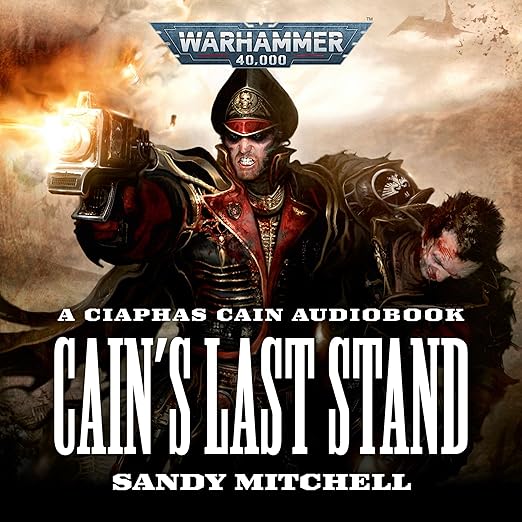
- Performance: the credit names John Banks while the copy names five performers, so the format itself is unresolved on the page.
- What it covers: Reluctant heroism, reputation versus self-knowledge, an old soldier recalled, comic cowardice under fire.
- Feel: Wry and quick, with real dread underneath.
- Our call: One of the funniest entries in military science fiction, undercut by an ending several readers call too easy.
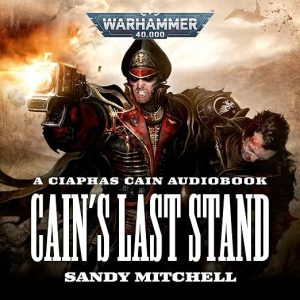
How do you retire a coward who keeps being mistaken for a hero? Sandy Mitchell's sixth Ciaphas Cain book answers by refusing to let him retire at all, and the audiobook runs a little over ten and a half hours on that question. Commissar Cain has a teaching post on Perlia and a distinguished career behind him when a Black Crusade arrives in the sector and every able-bodied citizen, cadets included, is called to the defense. The copy frames it as his greatest and possibly last battle.
What We Made of It
The joke that powers this whole series is that Cain's reputation and Cain's self-assessment have nothing to do with each other, and putting him in a schoolroom before throwing the schoolroom into a war zone is the sharpest use anyone has found for it. An old man pulled out of retirement is a war-story staple; an old man who knows exactly how little he deserves the statue they will build him is not. The cadets change the arithmetic too, because for the first time the person he is most tempted to protect is not himself.
A reader awarding five stars in October 2023 puts the appeal precisely, praising Cain's roguish charm and noting that the book captures him in two registers at once, how he behaves toward the world and what he is thinking while he does it. That gap is the engine, and it is a first-person device: the account is Cain's own, filed as an entry from the Cain Archives, and every heroic act comes pre-discounted by the man reporting it.
Mitchell also handles a real structural risk well. A late-series entry billed as a last stand has to deliver scale without abandoning the small comic texture that made the earlier books work, and the Perlia setting keeps the human scale in reach even as the sector goes under. A schola progenium full of cadets is a very small object to put in front of a Black Crusade, and the disproportion is doing deliberate work.
What Makes Cain's Last Stand Worth Hearing
The comparison a five-star drew in November 2012 is the best short description of this series in print or anywhere else: Flashman in the forty-first century. That response praises Mitchell for holding a story together and for presenting paralyzing fear and physical sickness in comic terms, arguing that the secret coward who somehow pulls it off is a truer picture of combat than the brave version. Anyone who has met the original Flashman will recognize the machinery immediately, and it survives the transplant remarkably well. What the far-future setting adds is scale: a self-serving officer covering his own reputation is one kind of comedy in a single campaign, and quite another while an entire sector goes under.
The production is the other reason to choose audio here, and it is not what the credit field suggests. The listing names John Banks alone, while the description names five performers: Stephen Perring, Penelope Rawlins, Richard Reed, John Banks and Phillipe Bosher. A book structured as an archive, with a memoir voice inside an editorial frame, is exactly the material an ensemble serves better than a solo reading, and a buyer choosing between formats deserves to know which product this is.
Ten and a half hours suits the shape as well. The comic set pieces need room to build, the battle sequences need weight, and the alternation between them holds up far better spoken than skimmed.
What Might Not Land
A reader awarding four stars in September 2010 enjoyed the humor and the balance and then named a real weakness: the ending arrives by machinery rather than by consequence, described there as a deus ex machina that left the reader hanging and felt too easy. That is the standing complaint about this book, and it lands hardest on people who take the last stand framing at face value.
Chronology explains why the page is thin on the recording. That four-star was filed eleven years before this audio existed, another five-star nine years before, and a third response in 2019 also predates it, so most of the visible column is grading a text that has been in print for a very long time. The November 2019 five-star is stranger still: it praises delivery speed and describes a well-loved but maintained secondhand paperback, rough around the edges, which is a verdict on a courier and a used-book seller.
Two fields also disagree with each other. The listing gives the running time as ten hours and thirty minutes while the description states ten hours and thirty-one minutes, which is trivial in itself and tells you the copy was assembled from a different source than the metadata. The same copy carries a marketing header inviting you to listen, so nobody can claim the page was written for print and repurposed by accident.
Should You Listen to Cain's Last Stand?
Existing Ciaphas Cain readers are the obvious audience, and the March 2024 five-star speaks for them: always better informed than the average commissar, Cain and his aide working as one, effective and entertaining at once, and straight on to the next book. That is a series reader's response, and this volume rewards it.
Newcomers to military science fiction with a taste for comic unreliability can start here more easily than the series number suggests, since the retirement premise resets the situation and the copy explains Cain's standing from scratch. Anyone who enjoys a first-person account written by someone with reasons to lie about himself will find the technique in good working order.
Readers who want the grim end of this universe played straight should go elsewhere, because the register is comic throughout and the horror is used for punchlines as often as for dread. Endings matter here too, since that is where the visible dissent concentrates and it concentrates for a reason. And if a full-cast production is what you are paying for, confirm the format before you buy, since the credit on this page names one performer and the description names five.
Questions Listeners Ask
How many performers are on the Cain's Last Stand audiobook?
Five, according to the description, which lists them by name at the end of the copy. The credit field on the same page lists John Banks alone. That is a meaningful difference for anyone choosing between a solo reading and an ensemble production, and the listing gives no way to confirm which you are buying.
Do you need the earlier Ciaphas Cain books before this audiobook?
Not strictly. This is book six, but the setup places Cain in retirement and rebuilds his reputation and situation from the opening pages, so a newcomer can follow it. Long-running relationships, particularly with his aide, carry more weight if you have read the earlier volumes.
Why do so many of the reviews predate the recording?
Because the novel long predates this audio edition, published in October 2021. Responses from 2010, 2012 and 2019 all sit on the same page. Weigh the visible column as commentary on a novel that has been circulating for well over a decade rather than on anything recorded in 2021.