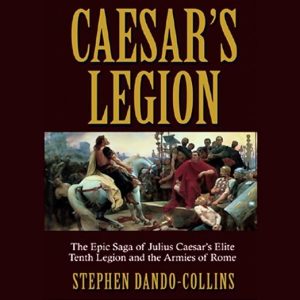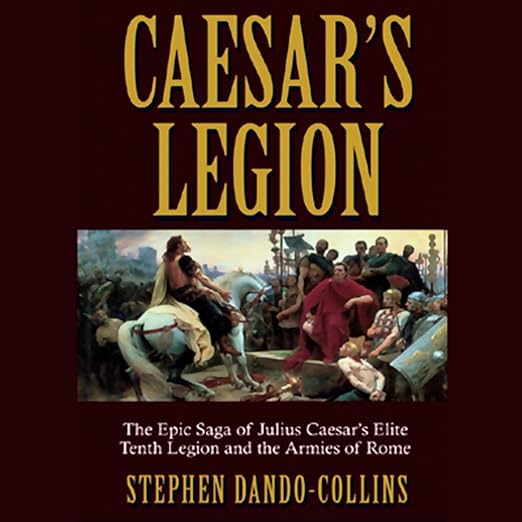
I spent a long train journey with Caesar's Legion last autumn, somewhere between Philadelphia and New York, and found myself so absorbed in the siege of Alesia that I missed my stop by two stations. Stephen Dando-Collins has written something technically unusual: a regimental history, focused on one specific military unit across the full arc of its existence, that reads with the momentum of narrative nonfiction rather than the dry inventory of conventional military history. I had expected to learn things. I had not expected to be gripped.
The Tenth Legion, Legio X Equestris, was Caesar's favorite and most trusted unit, raised early in his career and present at virtually every significant campaign from Gaul through the civil wars. Dando-Collins follows it from inception through its various postings across decades of Roman history, and in doing so he constructs something rare: an inside view of how a Roman legion actually functioned as a social and military organism, not just as an instrument of conquest.
Our Take on Caesar's Legion
What Dando-Collins does well, and what immediately explains his readership, is his ability to move between two registers without losing the thread of either. He can describe the daily routine of a Roman legionnaire in the kind of granular detail that scholars spend careers reconstructing, and then immediately shift to the macro political context that explains why that legionnaire was camped in a particular river valley on a particular day. That dual vision is rare in military history writing, which tends to favor either the operational detail or the strategic overview but rarely both.
The book is also honest about its source challenges. One reviewer, a critic with obvious historical literacy, noted the difficulty of writing about events two thousand years old when your primary sources had their own agendas. Dando-Collins addresses this directly in his methodology, explaining how he weighs Caesar's own Gallic Wars as a self-serving account against other sources, and how he identifies what is plausible versus what is Caesar managing his own historical reputation. That intellectual honesty strengthens rather than undermines the narrative. You know what you are getting.
Stuart Langton is a capable narrator for this material. Military history has specific audio challenges: the proper nouns are numerous and some are unfamiliar to English ears, the geographic names require consistent pronunciation to serve as landmarks in the listener's mental map, and the tactical descriptions need pacing that allows visualization without grinding to a halt. Langton handles all of this professionally. His delivery has authority without arrogance, which suits a text that is confident in its research but not condescending toward general readers.
At just over twelve hours, the runtime reflects genuine depth of coverage. Dando-Collins is not padding. He is documenting the full career of a military unit through multiple campaigns and commanders, and twelve hours is actually lean for that scope. Listeners who have spent time with longer Roman history surveys, Gibbons, Holland, or the various legion-focused podcasts, will find this detailed without being redundant. A reviewer who studied Roman history in college noted being presented with fresh information throughout, which is a meaningful endorsement from someone who already knew the general outlines.
What to Watch For in Caesar's Legion
Dando-Collins uses modern equivalences throughout, mapping Roman military ranks and units onto contemporary analogs. A reviewer noted that die-hard history specialists will find this anachronistic, and they are right to flag it. For general listeners, the equivalences are helpful orientation. For those with deep background in Roman military organization, they may occasionally produce friction. Dando-Collins is clearly writing for the engaged general reader rather than the academic specialist, and that choice shapes every aspect of the book's approach.
The coverage extends beyond Caesar's death into the subsequent career of the Tenth Legion under different commanders and through the civil wars that followed the assassination. This is where the book becomes genuinely revelatory: the life of a legion did not end with its founding commander, and the Tenth's subsequent history under Antony and then Augustus involves conflicts and relocations that are rarely covered in general histories of the period. Dando-Collins treats the unit as his protagonist even when Caesar is no longer present, which is both unusual and very effective.
Who Should Listen to Caesar's Legion
A strong pick for anyone who finished Adrian Goldsworthy's Caesar or the Rubicon by Tom Holland and wanted more granular detail about the military mechanics behind the political narrative. This is also the right book for listeners who find Roman history interesting in the abstract but have not found an entry point that makes the daily texture of Roman military life feel real. Specialists who prefer their ancient history without modernizing analogies may find Dando-Collins's approach slightly frustrating, but the underlying research is solid enough that even they will find value in the legionnaire-level perspective.
Before You Press Play
- Narration: Stuart Langton delivers the military history with clear, authoritative pacing, well-suited to material that requires tracking multiple campaigns across decades.
- Themes: Roman military discipline and loyalty, Caesar as commander and politician, the grunt's experience of ancient warfare
- Mood: Immersive and detailed, reads like novelistic history at its most confident
- Verdict: The definitive regimental history of Caesar's Tenth Legion, written for general readers without sacrificing depth, essential for Roman history enthusiasts.
Before You Listen
How does Dando-Collins handle the unreliability of Caesar's own Gallic Wars as a historical source?
He addresses it directly and uses multiple sources to cross-check Caesar's account. He is explicit about where Caesar is likely managing his own reputation versus where his account is supported by other evidence. This critical approach is one of the book's intellectual strengths.
Is Stuart Langton's narration able to handle the volume of Latin names and military terminology without becoming confusing?
He handles it consistently, which is the key requirement. Latin proper nouns are pronounced with consistent standards throughout, and the tactical terminology is delivered at a pace that allows listeners to follow the action without getting lost. It is not a stylistically distinctive narration, but it is competent and clear.