I came to Cache Lake Country after a reader recommendation arrived in my inbox describing it as the kind of book that makes you want to go outside immediately. That is not usually how I approach audiobooks, but it was a Sunday with no particular obligations, and I put it on while walking in a park not far from home. About thirty minutes in I had to stop and just listen. There is something in Rowlands's voice, the unhurried, precise, and genuinely joyful attention to how things work in the wilderness, that resists being background noise. It demands a certain quality of attention, and it rewards it.
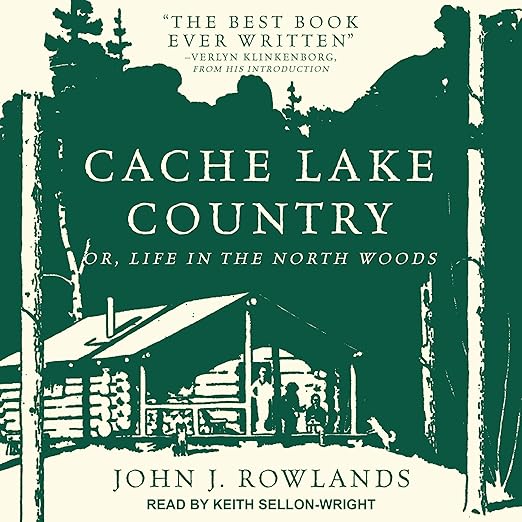
Published in 1947 and now available in audio through Tantor, Cache Lake Country is the chronicle of John Rowlands's decision to canoe alone into the wilds of northern Canada, survey land for a timber company, and eventually settle at what he named Cache Lake: the lake of my boyhood dreams. The book has been in print for nearly eight decades, and the New York Times quote on the cover, calling it a gem, is entirely deserved. It belongs in the same quiet tradition as Walden, though Rowlands is more practically minded than Thoreau and considerably less self-righteous.
Instructions in Shelter-Building Carry a Real Philosophy
What distinguishes Cache Lake Country from straightforward wilderness how-to writing is that Rowlands never loses sight of why any of this matters. The instructions for building a shelter, constructing an outdoor oven, making moccasins, and fashioning a canoe are all here, and they are specific and useful. But running alongside the practical knowledge is something harder to name, a kind of philosophy about the relationship between attention and contentment. Rowlands is not performing simplicity. He found a place that gave him what he describes as the peace and contentment he felt he could not live without, and the book is his attempt to share not just the techniques but the orientation toward life that makes those techniques meaningful.
One reviewer compared him to Thoreau, another called him the Thoreau of the North Woods, and the comparison holds in terms of spirit if not in terms of self-examination. Rowlands is less interested in his own interior life than in the external world he inhabits. That makes the book more companionable and, for many readers, more practical.
Keith Sellon-Wright Reads Like Sharing Knowledge by Firelight
Sellon-Wright is a narrator I have encountered in several natural history and memoir titles, and he consistently brings a quality of patience that suits material like this. His reading of Cache Lake Country does not impose drama where there is none. He matches the quiet authority of Rowlands's own voice, and the result is an audiobook that genuinely sounds like someone sharing knowledge by firelight. The eight-hour runtime passes more quickly than you might expect from a book with essentially no plot, which is a testament to both Rowlands's writing and Sellon-Wright's ability to make it feel alive.
Maybe Partly Fictionalized, and Maybe Still Relevant
One long review in the reader comments raises questions about the autobiographical authenticity of the book, suggesting the account may be partially fictionalized or compressed across time. It is worth knowing. Rowlands's own biography is more complicated than the serene narrative suggests, and the book's perfectly balanced contentment may owe something to literary shaping rather than pure reportage. That said, the wilderness knowledge is real, the folklore is genuine, and the philosophy is earnest. Whether the events described happened exactly as narrated affects the book's status as memoir without diminishing it as literature.
One reviewer notes it may be losing relevance in modern times, and I understand the concern but disagree with the conclusion. The relevance of Cache Lake Country is not primarily practical in 2025. It is the relevance of any book that makes you stop and consider the relationship between skill, attention, and a life that feels well-spent.
Trusting the Reader, Craft Scenes Included
What Rowlands does that is genuinely unusual, even among wilderness writers, is trust the reader to find meaning without being instructed to find it. He does not editorialize about what his time at Cache Lake meant. He simply describes it, with the precision and affection of someone who lived it, and leaves the philosophical weight for the reader to absorb. That restraint is part of what makes the book feel so durable across decades. It is not trying to convert anyone to a particular philosophy of life. It is simply showing what one version of a well-lived life looked like, in granular, practical, beautiful detail.
Sellon-Wright's narration is worth returning to in this context. He reads the craft sections, the moccasin-making, the canoe construction, the stove design, with the same unhurried care he brings to the philosophical passages. In another narrator's hands, those sections might feel like interruptions to the narrative. Here they feel integral, because the pacing never suggests that instructions are less important than reflection. Both are the same thing in this book.
Shares Shelf Space With Thoreau and Aldo Leopold
This audiobook is for listeners who can tolerate, and actively enjoy, books without conventional narrative momentum. It suits people who read Annie Dillard or Annie Proulx's nature essays, who appreciated Aldo Leopold's Sand County Almanac, or who have been meaning to read Walden but want something warmer in tone. Listeners who need character conflict, plot development, or forward momentum will find it difficult to sustain attention across the full runtime. But for the right listener, this is exactly the kind of audiobook that stays with you long after the final chapter ends.
Good to Know
Is Cache Lake Country primarily a how-to manual or a memoir?
It is genuinely both. Rowlands weaves practical woodcraft instruction, including canoe-building, moccasin-making, and shelter construction, throughout a first-person narrative of his life at the lake. The two elements are inseparable, and neither dominates at the expense of the other.
Does the audiobook version lose anything compared to the print edition?
The original book contains hand-drawn illustrations of tools and techniques that cannot be reproduced in audio. Listeners who want the visual woodcraft reference will want to consult the print edition alongside the audiobook. The narrative and philosophical content translates fully.
How does Cache Lake Country compare to other wilderness classics like Walden?
Rowlands is more practical and more companionable than Thoreau, less given to self-examination and more interested in the external world of skills and seasonal rhythms. Readers who found Walden too inward-looking often respond more warmly to Rowlands.
Is this audiobook appropriate for younger listeners or teenagers?
Yes, and several reviewers specifically note it as valuable for young readers. The language is clear, the values are straightforward, and the woodcraft content is genuinely instructive. One reviewer wrote that every young boy should read it, though the appeal extends considerably beyond that framing.