- Narration: Johnny Heller delivers Whitman's punchy, list-heavy prose with crisp authority; his pacing matches the book's rapid-fire instructional style well.
- Themes: Consumer psychology, persuasion science, advertising copywriting
- Mood: Fast and provocative, like a crash course from a Madison Avenue veteran
- Verdict: A solid primer on advertising psychology that moves quickly enough to hold attention, though listeners looking for deep strategic analysis may want to supplement with additional reading.
I picked up Ca$hvertising on a Tuesday evening after a frustrating afternoon trying to tighten up some promotional copy for a side project I had been working on. I wanted something actionable, not another 300-page meditation on brand philosophy. Within the first twenty minutes, Whitman had me reconsidering a headline I thought was perfectly fine. That alone was worth the listen.
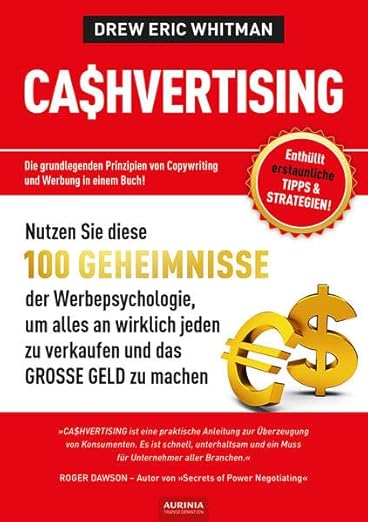
One note before we get into the substance: this edition, published by Aurinia Verlag in 2020, is a German-language version narrated by Johnny Heller. If your German is not strong, you will want to seek out the original English edition instead. The core content is the same Whitman book that has become a staple in direct-response marketing circles, but the language of delivery matters here.
How Ca$hvertising Holds Up
Whitman's central argument is deceptively simple: the most effective advertising does not rely on creativity for its own sake but on a working knowledge of how the human brain processes and responds to persuasion. The book draws on what Whitman calls the "Life Force 8", a set of biologically driven desires that underpin almost every purchase decision a human being makes. Hunger, safety, sex, companionship, comfort, the desire to be superior: none of these are new ideas, but Whitman packages them in ways that are immediately applicable to real advertising problems.
What separates this from many marketing books is the density of the practical guidance. Whitman covers 22 headline prescriptions, the psychology of typeface and layout, the "Pyramid Principal" for directing eye movement, and the specific emotional words that lower reader resistance. It reads less like a manifesto and more like a field manual, and it moves quickly enough that the 6-hour runtime never drags. The German reviews consistently praise it as compact and to the point, and that assessment holds.
Why Ca$hvertising Works as an Audiobook
The audiobook format suits this material better than you might expect. Whitman's prose is punchy and built around lists, which Heller handles competently. The book's structure, moving from psychological principles to copywriting tactics to design psychology, flows naturally in audio. You can absorb the headline formulas on a commute and come back to the layout sections when you are at a desk with a notepad.
The 30-plus years of Madison Avenue experience Whitman brings to the text are evident throughout. He is not trafficking in abstract theory but in tested, observable patterns of consumer behavior. His section on the "5-Second Headline Test" is particularly useful, the idea that any ad element not immediately legible and compelling in five seconds is costing you response rates. One German reviewer, Ron, noted that he was actively applying the tips to a client's new online shop while reading, and that specificity of response is a reliable signal that the content is doing real work.
Weak Spots in Ca$hvertising
The book's strengths are also the source of its limitations. Whitman is a practitioner of direct-response advertising, and the entire framework is calibrated for that discipline. Brand advertising, content marketing, or long-cycle B2B sales work under different rules, and some of Whitman's prescriptions will feel like a poor fit if your context is far removed from a direct-mail letter or a product landing page.
A couple of the German reviewers noted that the book leans heavily into examples and away from nuanced strategic discussion, one called it good on storytelling but thin on details around risk assessment. That is a fair reading. Whitman tells you what to do and why it worked in his experience, but he does not spend much time on when a tactic might backfire or how to adapt the principles for complex products. Treat this as a starting toolkit, not a complete system.
Who Should Listen to Ca$hvertising
This one is well-suited for small business owners writing their own marketing copy, freelance copywriters looking to sharpen their psychological vocabulary, and anyone who has ever written an email subject line and wondered why nobody opened it. It is less useful for brand strategists, digital marketers working primarily in content, or senior marketing professionals who have already absorbed these frameworks through years of practice. If you are new to direct-response thinking, the 6-hour investment will pay off quickly. If you are already deep in the discipline, you will likely recognize most of the terrain.
Common Questions
Is this the English Ca$hvertising or a different version?
This particular audiobook edition (ASIN 3966720124, publisher Aurinia Verlag) is a German-language version released in 2020. The underlying content is Drew Eric Whitman's original book, but the narration is in German. If you need the English edition, search for the original Little, Brown version.
Does Ca$hvertising work for digital marketing, or is it mainly about print advertising?
Whitman's principles are drawn from direct-response advertising history, including print and direct mail. Most of the psychological foundations, headline testing, emotional triggers, the Life Force 8, transfer cleanly to digital contexts like email subject lines and landing pages. Layout and typographic advice translates less directly to social media formats.
How long is the audiobook and is it dense or easy listening?
The runtime is 6 hours and 17 minutes. The pace is fast and the content is list-heavy, which makes it easier to absorb in shorter sessions. It is not a leisurely narrative listen, it is instructional and moves quickly from one tactic to the next.
Does Whitman back his claims with research, or is it mostly anecdote?
The book blends advertising industry lore, psychological research references, and Whitman's own 30-plus years of practitioner experience. It is not an academic text with citations, but it grounds its recommendations in observable consumer behavior patterns rather than pure opinion. Readers expecting rigorous sourcing will find it lighter than they might prefer.