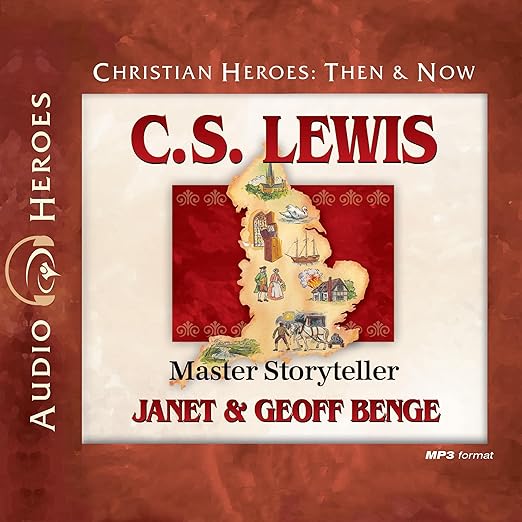
Quick Take
- Performance: Tim Gregory delivers a measured, clear performance well-suited to younger listeners, bringing the texture of Lewis's early life in Belfast and wartime Oxford into focus without overplaying the drama.
- What it covers: Faith and doubt, the power of story, intellectual and spiritual development
- Feel: Warm and engrossing, with the intimacy of a campfire biography
- Our call: C.S. Lewis: Master Storyteller distills a complex life into an accessible and genuinely involving portrait that works for curious young listeners and adults who want a brisk introduction to Lewis.
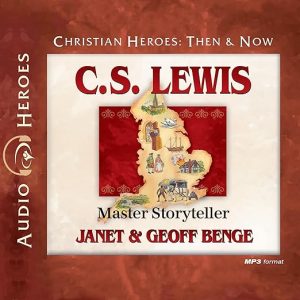
C.S. Lewis: Master Storyteller arrives in the children's audiobook space with a particular challenge: Lewis led a life that is simultaneously well-documented and deeply interior. The famous professor who wrote Narnia and Mere Christianity was also the child who insisted at age two on being called Jack, a grief-stricken boy who lost his mother early, a skeptic who became a believer against his own intellectual resistance, and a man whose friendships with Tolkien and the Inklings shaped his imagination as much as any book he ever read. Janet Benge navigates all of this in under five hours, and what comes through is a portrait of Lewis that genuinely earns the word master in its title.
Nesbit, Paradise Lost, and a Nursemaid's Tales
Benge writes in the Christian Heroes: Then and Now series tradition, which means the faith dimension of Lewis's life is present and foregrounded. Lewis's conversion from atheism to Christianity is not treated as an optional subplot but as a structural turning point in his biography, which is appropriate given how thoroughly it shaped everything he produced afterward. For families who share that faith context, this framing will feel natural. For secular listeners, the biographical content is substantive enough that the spiritual emphasis is unlikely to become an obstacle, particularly because Lewis's own intellectual engagement with questions of faith is itself one of the most interesting things about him.
The biography is attentive to Lewis's early life in Belfast, his voracious reading as a child including Black Beauty, Paradise Lost, and the novels of E. Nesbit, and the way stories told by his nursemaid shaped his imagination long before he wrote any of his own. One reviewer who went into considerable detail about Lewis's childhood noted that the book captures the formative details of those Belfast years with real texture. The trajectory from avid reader to professional writer to reluctant convert to one of the most influential Christian voices of the twentieth century is drawn clearly without feeling rushed.
A Son Used This Audiobook as a Primary Source
Tim Gregory's narration holds the material together over the nearly five-hour runtime with a consistency that suits the episodic structure of biography aimed at younger listeners. The audiobook format works well here because Benge writes in a voice that moves rather than lingers, keeping the pacing tight enough that the historical material, which spans two world wars and the full arc of Lewis's academic career, never becomes heavy. The content appropriate for middle grade and up, and the rating of 4.8 from over 400 listeners reflects an audience that has found it effective across multiple age ranges.
One listener's account of her son using this audiobook as a primary source for a paper on Lewis speaks to how seriously the biographical content is treated. This is not a simplified picture book adaptation. The theology is handled with enough rigor that older listeners will find it intellectually satisfying, and the life events are specific enough to give anyone who reads Lewis afterward a richer sense of where his ideas came from. The sections on Lewis's friendship with J.R.R. Tolkien and the Inklings group are particularly valuable for understanding the context of the Narnia books and the Space Trilogy.
Tim Gregory's narration sustains a tone that manages to be both accessible and respectful of the material's weight. Lewis's life contained real grief, the early loss of his mother, the long years of combat and wartime dislocation, the complicated domestic arrangements of his adult life, and Gregory navigates these heavier passages without either understating them for a younger audience or over-dramatizing them in ways that would feel exploitative. That calibration is what makes the biography work across a wider age range than the target readership technically requires.
A Stray Reference to Someone Named Doerries
The Christian Heroes series has a consistent editorial perspective, and listeners should understand that this biography is written from within a faith tradition rather than from a position of scholarly neutrality. That is not a disqualification, but it does mean that Lewis's doubts and early atheism are presented primarily as a stage on the way to conviction rather than as an equally valid intellectual position. Doerries's life has inspired multiple full-length academic biographies for adult readers who want a more contested portrait.
At just under five hours, the audiobook covers an enormous amount of biographical territory. The compression means that some of the more complex aspects of Lewis's personal life, including his unusual domestic arrangement with Janie Moore and his late-life marriage to Joy Davidman, are treated with brevity. The book is a biography for young readers first and a comprehensive life study second, and it succeeds within those parameters.
Screwtape and Mere Christianity Fans Get Context
Young readers who have discovered Narnia and are curious about the person behind it will find this audiobook an engaging next step. Parents looking for biography content that treats faith as a serious subject without being preachy will appreciate the tone Benge maintains throughout. Educators and homeschoolers using Lewis as a curriculum touchpoint will find the audiobook accessible enough for classroom use and substantive enough to support discussion. Adult listeners who already know Lewis's work but have not engaged with his biography will find this a quick and engaging orientation, though those wanting deeper coverage of his intellectual life will want to supplement with longer treatments. The audiobook is also well suited to listeners who come to Lewis through Mere Christianity or The Screwtape Letters and want biographical context for where those ideas developed.
Questions Listeners Ask
Is this audiobook suitable for secular families or does the faith content make it inaccessible?
The Christian Heroes series is explicitly faith-oriented, and Lewis's conversion is a structural focus of the narrative. Secular listeners will find the biographical content about Lewis's childhood, academic career, and literary output engaging, but should expect the spiritual dimension to be central rather than incidental.
How does the C.S. Lewis: Master Storyteller audiobook compare to other Lewis biographies for adults?
This biography prioritizes accessibility and narrative momentum over scholarly comprehensiveness. It is an excellent introduction but not a substitute for longer, more detailed treatments such as Alister McGrath's C.S. Lewis: A Life, which covers the same territory with greater depth and critical distance.