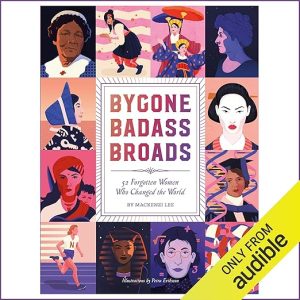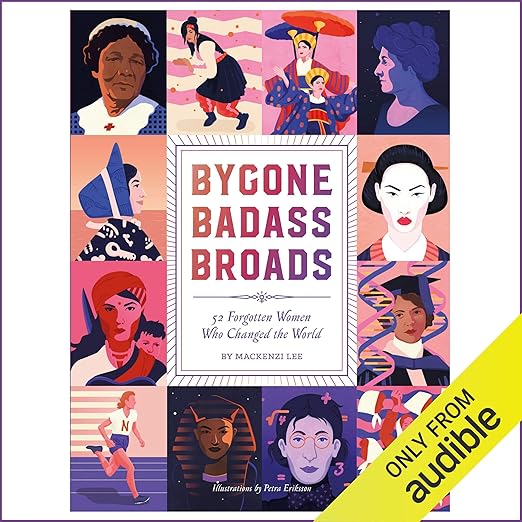
I have a specific frustration with histories that claim comprehensiveness while quietly centering the same demographic across every century. Mackenzi Lee shares this frustration, and Bygone Badass Broads is the result: 52 profiles of women from across the globe and across twenty-five centuries, most of whom have been effectively omitted from the standard historical record. The project began as a Twitter series, which explains the writing style, punchy, direct, sometimes sharp enough to cut, but Lee has done real historical legwork here, and the combination of rigorous research and deliberately informal delivery is what makes this audiobook work.
The chronological span is impressive: starting in the fifth century BC and running to the near-present, the collection does not confine itself to the obvious centuries or the obvious geographies. These are not just European women with interesting lives. Lee draws from African kingdoms, Asian courts, the Americas, the Pacific. The effect is cumulative: by the time you are a dozen profiles in, the sheer volume of erased achievement becomes its own argument, and a fairly cutting one.
Lee's voice as a writer is immediately recognizable to anyone who has read The Gentleman's Guide to Vice and Virtue or its sequels: clever, historically grounded, and genuinely funny without sacrificing the substance underneath. The Twitter origin of this material shows in the best way. Each entry is tight, fully formed, and built to deliver a combination of biographical fact and editorial wit without sprawling. The effect in audio is something like the best kind of podcast: you feel informed and entertained simultaneously, which is harder to achieve than it sounds.
Multiple reviewers have noted that they knew very little about the women profiled here before encountering this book. This is the point, and Lee makes it without belaboring it. These are not women who were overlooked because they were minor figures. Many of them were central players in the political, military, and intellectual life of their time, and were systematically omitted from the record by historians who either actively disapproved of their prominence or simply could not conceive of including them. Lee's anger at this is visible throughout, but it is controlled anger, channeled into wit rather than polemic.
James Shifts From Amused to Moved in Minutes
Lucy James's narration is excellent. She has the flexibility to track Lee's tonal range, which shifts from amused to genuinely moved within a single profile, without making those shifts feel jerky. The format, short profiles of four to ten minutes each, is particularly well-suited to audio because it allows for natural stopping points. This is an audiobook that works equally well listened to in order or browsed by chapter, and at under five hours it is a compact listen that rewards repeated dipping rather than demanding to be consumed in a single sitting.
The Audible Studios production is clean, with no distracting audio issues. One consideration: the print edition of this book includes illustrations for each subject, which are obviously absent from the audio version. Listeners who want the full visual experience of the project may want to supplement the audiobook with the print edition, but the narration stands entirely on its own as a complete experience of Lee's writing.
Twitter Origins Trade Depth for Quick Accessibility
The Twitter origins are a genuine feature, but they can also be a limitation. The profiles prioritize accessibility and wit over comprehensive biography, and listeners who want deep contextual history around any given subject will need to take these entries as starting points rather than endpoints. This is a feature for many readers and a limitation for others, and it is worth knowing going in.
One reviewer flagged that the writing is Twitter-esque as a mild criticism, though the majority of readers appear to find this a feature. The informal register is deliberately chosen, and the historical accuracy is not sacrificed to achieve it. But listeners expecting the register of a traditional history book will need to recalibrate.
Fifty-Two Women Even History Buffs Have Missed
This is for history lovers who are tired of the same names appearing in every collection, for readers who want to argue at dinner parties about women nobody has heard of, and for anyone who has a thirteen-year-old in their life who could use evidence that the official story of history is incomplete. It also works for adults who simply want to spend five hours being delighted and periodically outraged in productive ways. Skip it if you want deep biographical scholarship; this is introductory by design and proud of it. Come to it if you want the gateway drug to a hundred rabbit holes.
Does Bygone Badass Broads require any prior historical knowledge to appreciate?
None whatsoever. Lee's writing style is deliberately accessible, and the profiles are constructed to stand alone without requiring readers to know the broader historical context in advance. The book is designed as a gateway rather than a sequel to existing knowledge.
Are the profiles focused exclusively on Western women or does the book have genuine global range?
The collection has genuine global range, drawing from African kingdoms, Asian courts, the Americas, and the Pacific across 2,500 years. This breadth is one of the book's distinguishing features compared to similar collections that default to European subjects.
How does Lucy James's narration handle the tone shifts between humor and genuine emotion?
Very well. The profiles vary considerably in emotional register, and James navigates those shifts without flattening either the wit or the weight. Her reading of the more quietly outraged passages lands with particular force, complementing Lee's controlled anger at how these women were erased from the record.