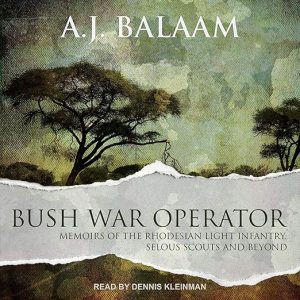
Twelve years inside Rhodesia's Selous Scouts taught Andrew Balaam things this audiobook doesn't flinch from retelling. Bush War Operator is his own account of that service, first in the Rhodesian Light Infantry and then in the Selous Scouts, the elite, secretive unit that spent the 1960s and '70s hunting ZANLA and ZIPRA guerrillas infiltrating the country. Balaam was twice decorated for that work, and narrator Dennis Kleinman reads the whole thing at ten hours and one minute with the flat, unadorned delivery of a man recounting what actually happened rather than performing a war story for effect. That register turns out to be the right call for material this raw, since anything more theatrical would have worked against the book's own credibility.
Pseudo Operator to Coup Plotter, One Memoir
The synopsis calls Balaam a former pseudo operator, a term worth pausing on. Selous Scouts pseudo operators infiltrated guerrilla networks by posing as insurgents themselves, gathering intelligence and striking from inside enemy structure rather than from a conventional front line, a far stranger and more psychologically demanding job than standard infantry combat. That's the book's first half. Its second half covers something reviewers find genuinely more surprising: after Rhodesia became Zimbabwe, Balaam joined other former Scouts in botched coup attempts against Ciskei, a South African homeland, and Lesotho, both governments whose real crime, as the synopsis puts it, was supporting the African National Congress.
That second section is where the book's moral complexity actually lives. Balaam had spent a decade fighting to stop exactly the kind of insurgent training he was now allegedly helping deliver to other would-be liberation armies, and the book doesn't resolve that contradiction so much as sit inside it. Reviewer Fritz makes this point directly, calling the post-Rhodesia material the best part of the book and noting that it functions almost as two short works stitched together rather than one continuous narrative. That structural observation matters for anyone deciding how to approach the listen.
Kleinman Treats Rare Post-War Vocabulary as Ordinary
Kleinman's steady pacing serves both halves of that structure without favoring either. He doesn't rush past the coup-attempt chapters as a lesser postscript to the main Rhodesian narrative, which would have been an easy mistake given how the synopsis itself frames Rhodesia as the primary subject. Reviewer R. Sivertsen calls the whole thing hard to put down and specifically praises how it illuminates the Rhodesian conflict and its South African aftermath as connected history rather than two separate topics. For listeners with any interest in African Cold War history, hearing that continuity read in one unbroken voice, rather than as two separately packaged books, is a real structural advantage of the audio format.
This also fits into a small, specific subgenre worth naming: firsthand Rhodesian security-forces memoir. Balaam's book distinguishes itself within that subgenre precisely because of its second act; most Bush War memoirs end when the war does, and few carry a veteran's story forward into the stranger, murkier chapter of post-war mercenary work. Hearing period-specific military terminology, the MLM and MFC decorations, ZANLA and ZIPRA as distinct guerrilla forces, pseudo operator tactics, read aloud by a narrator who treats the vocabulary as ordinary rather than exotic adds real authenticity for listeners already familiar with this specific military history niche, and gives newcomers a genuine, unglossed education in how that vocabulary was actually used.
One Soldier's Story, Not a Balanced History
Reviewer Robert D. offers real, unambiguous dissent, calling the book kind of disjointed and describing it as more a set of chapter-length vignettes than a narrative that flows with real purpose from beginning to end. That's a fair criticism of memoirs built from a soldier's own recollections rather than a historian's reconstructed timeline, and it's worth going in expecting an episodic structure rather than a driving through-line. The other thing worth naming plainly: this is an insider's account from inside Rhodesia's security forces, told without much interest in the perspective of the ZANLA and ZIPRA fighters on the other side of that war. It's not a balanced, multi-perspective history, and listeners should treat it as one soldier's testimony rather than a neutral account of the conflict.
Vignettes You Can Pick Up Anytime
At just over ten hours, the runtime is substantial but not unusual for military memoir in this vein, and the vignette structure Robert D. describes actually makes the audiobook easier to pick up and put down across multiple sessions than a tightly plotted narrative would allow. If you're the kind of listener who likes finishing chapters in one sitting, this format rewards that instinct better than most memoirs do, since each vignette tends to resolve on its own terms before the next one begins.
Listeners new to this specific history may want a broader companion history alongside Balaam's personal account, since this book assumes real familiarity with Rhodesia's collapse into civil war and the broader Cold War-era politics of southern Africa rather than explaining that context from scratch. Balaam is telling you what he did and saw, not teaching a survey course on the war's origins or its aftermath across the region. Pairing this with a general history of the Rhodesian Bush War or Zimbabwe's independence will supply the political and military background this memoir assumes is already understood, and will make Balaam's specific, personal chapters land with more weight.
Selous Scouts Veterans Get a Rare Sequel
This one is for readers of African and Cold War-era counterinsurgency history, and for anyone who's read other Rhodesian Bush War memoirs and wants the rarer, stranger follow-up story of what happened to Selous Scouts veterans after the war ended. Fritz's enthusiasm for the post-Rhodesia material is a good signal here. If botched coup attempts against apartheid-era South African client states sound like an unusual angle you haven't encountered elsewhere, that's exactly what sets Bush War Operator apart from the more common straight Bush War memoir.
Skip This for a Balanced Multi-Sided War Story
It also rewards listeners generally drawn to special-forces and irregular-warfare memoir as its own subgenre, regardless of specific regional focus, since the pseudo-operator tradecraft Balaam describes has real parallels to how other elite counterinsurgency units have operated in unrelated conflicts.
Skip this if you're looking for a balanced or multi-perspective account of the Rhodesian conflict, or if Robert D.'s disjointed, vignette-style structure sounds like a dealbreaker rather than a feature. Readers wanting a single, tightly plotted narrative arc rather than episodic first-person recollection should look elsewhere first. This audiobook works best for listeners who already understand they're getting one soldier's unfiltered, pro-Rhodesian-security-forces perspective and want that specific vantage point rather than a textbook survey.
Questions Listeners Ask
Does this audiobook cover more than just the Rhodesian Bush War?
Yes. Roughly the second half covers Andrew Balaam's later involvement in attempted coups against Ciskei and Lesotho, two governments targeted largely for supporting the African National Congress, and reviewer Fritz specifically calls that section the strongest part of the book.
Is Bush War Operator told from a neutral historical perspective?
No, and it doesn't claim to be. This audiobook is Andrew Balaam's own first-person account from inside the Rhodesian Light Infantry and the Selous Scouts, told without much attention to the perspective of the ZANLA and ZIPRA fighters he was fighting against.
Why do some listeners find the audiobook's structure disjointed?
The book reads more like a series of chapter-length vignettes drawn from personal memory than a single continuous narrative, a structure reviewer Robert D. specifically flags as disconnected, though other listeners find that same episodic pacing easy to return to across sessions.
What does the term pseudo operator mean in this audiobook?
It refers to the Selous Scouts' practice of infiltrating guerrilla networks by posing as insurgents themselves, gathering intelligence and striking from inside enemy structure rather than fighting a conventional front line, the specific role Balaam describes serving for years.