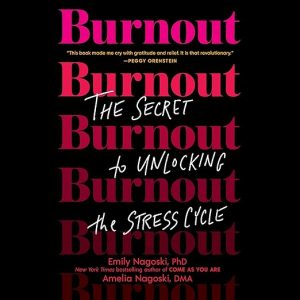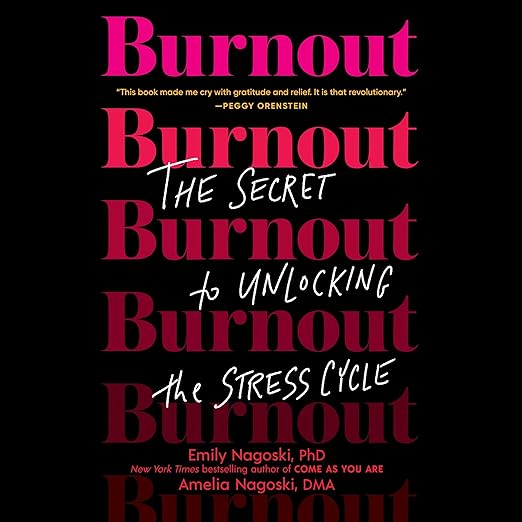
I came to Burnout during a period when I was working too much and sleeping badly and telling myself the situation was temporary. A colleague had mentioned it twice in passing, and when I finally looked it up, the subtitle stopped me: why women experience burnout differently than men. That claim felt either genuinely illuminating or the kind of reductive framing that collapses a complex topic into a gendered brand. I needed to know which.
After seven hours with Emily Nagoski and her sister Amelia Nagoski, I have a much clearer answer, and I also have a better understanding of why I had been telling myself the situation was temporary when I had been saying exactly that for the better part of a year.
Closing the Stress Cycle Instead of Managing Stressors
The Nagoski sisters built this book around a distinction that turns out to be more useful than it initially sounds: the difference between the stressor and the stress response. Most self-help frameworks focus on managing or eliminating stressors, the workload, the difficult relationship, the constant demands. Burnout argues that this misses the more fundamental problem, which is that the biological stress cycle, once activated, needs to be completed or it compounds. The chapter explaining what actually completes the stress cycle, physical movement, genuine social connection, creative expression, is specific enough to feel actionable rather than vague.
The book's coverage of what the authors call the Human Giver Syndrome, the cultural expectation that women should be perpetually available, pleasant, and self-effacing, is where the social science and the personal experience converge most effectively. A reviewer who works as a mental health professional with a neuroscience background described the book as handling the unique challenges women and people of color face in our society while remaining accessible and often humorous. That balance is real. The book does not read like an academic text, but it also does not simplify the science to the point of uselessness.
Nagoski's Own Voice Makes the Humor Land
Nagoski narrating her own book is a significant asset. Her delivery is conversational and warm, she sounds like she is talking to a friend who is intelligent and capable but also genuinely exhausted, which is precisely the audience she is writing for. The humor, which is a consistent feature of the prose, lands better in her voice than it would in a neutral professional narrator. A reviewer described the experience as accessible and funny, and the audio format preserves that register in a way that reading in fragments on a phone might not.
The seven-hour runtime means this is completable in a few commuting sessions or a focused weekend, which matters for a book aimed at people who are, by definition, short on time.
Structural Framing Frustrates Some Practical Readers
The book is explicitly written for women, and a reviewer who found it useful but somewhat frustrating noted that its structural argument, that patriarchal societal expectations are a root cause of female burnout, left her feeling that the book identified a problem she could not control rather than providing tools for the parts she could. That tension is real and worth acknowledging. The book does provide practical tools, but the social analysis that frames them is unapologetically structural. Readers who prefer strictly behavioral solutions without the political framing may find the register occasionally frustrating even as they find the advice useful.
Exhausted Women Are the Primary Audience Here
Women who have been running on exhausted functional mode for longer than they can account for will find this book a useful diagnostic and practical resource. It works well for people who have already read more generic stress management material and found it insufficient, the biological specificity here offers something different. Mental health professionals and coaches who work primarily with women will find the framework applicable to clinical conversations. Men curious about the structural argument will find it illuminating, though the book does not position them as its primary audience.
- Narrator: Emily Nagoski narrating her own book brings immediacy and warmth that matches the conversational, often funny tone of the writing, she sounds like she means every word.
- Subjects: Female stress physiology, societal expectations and exhaustion, the biology of emotional completion
- Tone: Affirming and scientifically grounded, occasionally bracing in what it asks you to acknowledge
- Bottom line: A genuinely useful framework for understanding why exhaustion accumulates differently for women, delivered with enough humor and rigor that both the science and the practical tools feel credible.
Questions Listeners Ask
What is the biological stress cycle, and why does completing it matter so much in this book?
Nagoski argues that stress activates a physical response in the body that evolved to be completed through action, typically movement and safety, but modern stressors rarely allow for completion. The result is accumulated physiological stress even after the original stressor has passed. The book provides specific tools for completing the cycle rather than just managing the stressor.
Is this book useful for men, or is it exclusively written for women?
The book is explicitly written for women and addresses gendered societal pressures throughout. Men can find the stress biology and the social analysis valuable, but they are not the primary audience and may find the framing occasionally requires mental translation.
Does Emily Nagoski's narration match the tone of the book?
Yes. She brings the same conversational warmth and occasional humor to the audio that reviewers describe in the written version. Self-narration is the right choice here, the book is intimate and occasionally personal, and that quality comes through in her delivery.
How does this book differ from other burnout and stress management audiobooks?
The key differentiator is the physiological specificity. Nagoski grounds the burnout discussion in stress biology and hormonal response rather than staying at the level of time management or mindset. The social science framework, particularly around the Human Giver Syndrome, is also more developed than most popular wellness books in this space.