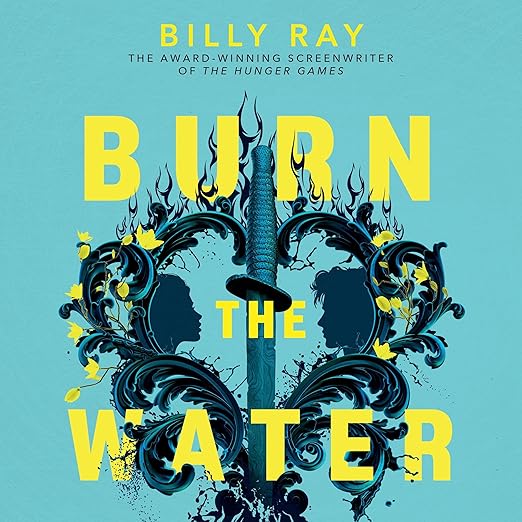
I started Burn the Water on a Monday evening after reading that Billy Ray, the screenwriter behind The Hunger Games adaptation, had written his first novel. That credential established an expectation: cinematic scope, clean action sequences, a world rendered in images rather than in interior monologue. The book delivers all of that. What it is still working out is how to build a love story at the same pace it builds a war.
The premise is genuinely arresting. The year is 2425. London has been underwater for three centuries, a consequence of rising oceans that left only the skeletal upper stories of skyscrapers above the flood. Two factions, the Crowns and the Rogues, have been fighting over what remains for those same three hundred years, so long that no one alive can remember the original cause. Into that cycle of inherited violence come Rafe, the Rogues' most fearsome captain, and Jule, the Crowns' deadliest soldier. They are the last people on either side who should fall in love. They fall in love anyway.
The Verdict, Briefly
Ray's screenwriting background is both the book's greatest strength and its most visible limitation. The world of sunken London is stunning. The dead skyscrapers used as fortresses, the submerged streets navigated by divers and boats, the architecture of violence that has accumulated over three centuries, all of that is drawn with visual precision that a prose debut rarely achieves. Ray sees his world in frames. The problem is that a novel's interior space, the place where characters live in their own heads between the action sequences, is where character-first readers live. And Rafe and Jule, for all the passion attributed to them, are not quite as legible on the inside as they are from the outside. Their love is described as all-consuming, and Zoe Boyle performs it as such, but several reviewers noted that the emotional relationship felt rushed relative to the space given to the war.
Why Burn the Water Works as an Audiobook
Zoe Boyle is a strong choice for this material. She has a facility with action-adjacent drama that keeps the combat sequences from losing momentum in audio form, and she handles the enemies-to-lovers dynamic with enough restraint that the eventual emotional shift feels earned rather than announced. The listen moves at a pace that suits the book's cinematic ambitions. At just under eleven hours it does not overstay its welcome, and the final stretch, where mysterious foreigners arrive and force both houses to consider whether there is a third option, is where the book opens into something larger than its initial premise suggests.
What Might Not Land
The parallel structure of Rafe and Jule's perspectives is the formal engine of the book. Watch how their separate understandings of the same conflict gradually overlap as the relationship deepens, and how Ray uses that convergence to suggest that the war itself is partly a failure of perspective rather than purely one of resources and territory. The appearance of outsiders in the final act is the most interesting development in the book and the one that points toward where a sequel or continuation might go. Also worth tracking is the way the book treats childhood soldiers: children fighting and dying is depicted with enough weight to signal that Ray is not aestheticizing violence even as he renders it cinematically.
Should You Listen to Burn the Water?
Fans of the Hunger Games films rather than the novels may find this a particularly natural listen, given the shared creative lineage. Readers who prefer their YA dystopia focused primarily on world-scale threat rather than romantic interiority will find more to hold onto than those who read primarily for the love story. This is not a book where the romance is the architecture and the world is the wallpaper. It is closer to the reverse. If that balance suits you, the listen rewards the investment. If you are primarily here for enemies-to-lovers emotional texture, manage expectations around how developed that thread actually is.
Does Billy Ray's Hunger Games screenwriting background make the audiobook feel like it is meant for screen adaptation?
Yes, in the sense that the world is rendered with extraordinary visual clarity and the action sequences are structured almost scene by scene. Some listeners will find this a strength. Others may wish for more interiority. It is a cinematic novel rather than a deeply interior one.
Is the enemies-to-lovers romance in Burn the Water the primary focus of the story?
It is central but not dominant. The war between the Crowns and the Rogues, its history and its costs, occupies at least as much narrative space as the relationship between Rafe and Jule. Listeners who want a romance-first listen should be aware of this balance before starting.
How does Zoe Boyle handle the two main POV characters?
Boyle keeps the two voices distinct enough for the alternating POV structure to work clearly. The performance has a kinetic quality that suits the book's pacing and matches the author's action-forward sensibility.